

BIG-IP R2800 is the higher-performance model in the F5 r2000 Series, designed for application delivery and security environments that need more processing capacity than the entry-level R2600 while keeping the same compact 1RU hardware footprint. It can run BIG-IP services for load balancing, SSL/TLS processing, DNS, application security, access control, and network protection according to the purchased entitlement.
R2800 uses all eight physical CPU cores available in the r2000 platform. That makes it particularly relevant when application traffic, encryption, security inspection, or future growth could push an R2600 beyond its four licensed cores. The two models share the same underlying hardware, so F5 can also upgrade an R2600 to R2800 capacity through Pay-as-you-Grow licensing.
Series Highlights
- Higher-performance tier of the F5 r2000 Series
- Eight CPU cores available for BIG-IP workloads
- 32 GB system memory
- 480 GB SSD storage
- 1G, 10G, and 25G network connectivity
- BIG-IP tenant architecture running above F5OS
- Hardware acceleration for application delivery and security
Review BIG-IP R2800 Price List and request a quote tailored to your licensing needs.
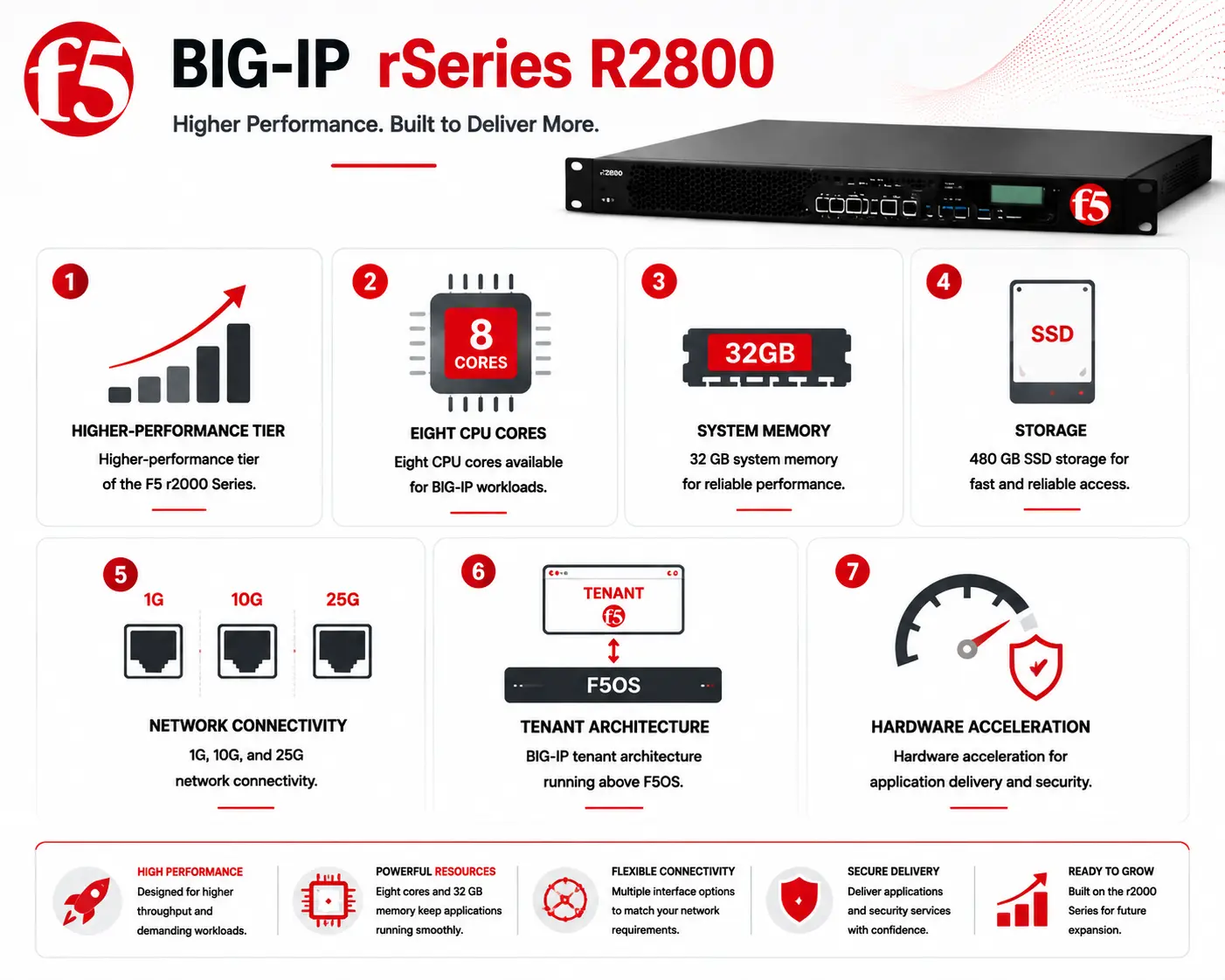
BIG-IP R2800 At a glance
What it is: Higher-capacity F5 r2000 Series application delivery and security appliance
Product family: BIG-IP rSeries License
Platform software: F5OS
CPU capacity: Eight physical CPU cores available to BIG-IP workloads
System memory: 32 GB
Tenant memory pool: 24 GB
Storage: 480 GB SSD
Network interfaces: Four 1G/10G/25G optical ports and four 1G/10G copper data ports
Tenant capacity: Up to two on F5OS-A 1.8.0 or later; earlier releases support one
Typical use: ADC, SSL offload, WAF, DNS, access services, network security, and application consolidation
Series Overview
BIG-IP R2800 uses F5’s rSeries architecture, where the physical network and system resources are managed by F5OS and BIG-IP runs as a tenant above that platform layer. F5 describes rSeries as an API-first architecture built around modern hardware acceleration for application delivery, SSL/TLS processing, and security services.
The R2800 and R2600 share the same r2000 hardware. The main performance difference comes from licensing: R2600 exposes four CPU cores, while R2800 makes all eight available. R2800 retains 32 GB of system memory, with 24 GB available for tenant allocation.
Current F5OS documentation adds another useful distinction. With F5OS-A 1.8.0 or later, R2800 can support up to two tenants, each requiring at least four vCPUs. This gives buyers some workload-separation flexibility that was not available in earlier r2000 deployments.
Licensing and Part Number Guidance
Ordering BIG-IP R2800 requires matching the appliance with the BIG-IP License functionality that the environment actually needs. The hardware name alone does not tell you whether the system is intended for LTM, DNS, Advanced WAF, AFM, APM, or a broader service combination.
F5 rSeries licensing is handled at the platform layer, while BIG-IP tenants consume the system resources and licensed capabilities assigned to the appliance. The exact SKU can therefore vary according to the BIG-IP software bundle, security services, support term, power configuration, and accessories.
R2800 is also the upper PAYG level of the r2000 family. An existing R2600 can be moved to R2800 performance through a license change that unlocks the remaining CPU resources rather than requiring a new physical chassis. For a new deployment that is already expected to use most of the available capacity, ordering R2800 from the beginning may be more practical than planning an early R2600 upgrade.
Common Use Cases
| Use case | Why R2800 can fit |
|---|---|
| Application delivery | Higher processing headroom for LTM and ADC workloads |
| SSL/TLS offload | More CPU capacity for encrypted application traffic |
| Web application security | Physical platform for licensed WAF services |
| DNS services | Dedicated BIG-IP DNS deployment |
| Secure access | APM-based application access when appropriately licensed |
| Workload separation | Up to two BIG-IP tenants on supported F5OS releases |
| iSeries refresh | Current rSeries option for smaller physical F5 environments |
| HA deployment | Two matched appliances can form BIG-IP tenant-level HA |
F5 recommends that HA between two rSeries appliances be configured between corresponding BIG-IP tenants rather than at the F5OS platform layer.
Models, Licenses, and Ordering Scope
| Area | What to confirm |
|---|---|
| Appliance | BIG-IP R2800 |
| BIG-IP services | LTM, DNS, Advanced WAF, AFM, APM, or required combination |
| Capacity | Traffic, SSL/TLS, connections, and security inspection |
| Tenants | One larger workload or supported two-tenant design |
| Interfaces | Required 1G, 10G, or 25G connectivity |
| Availability | Standalone or HA pair |
| Migration | New system or R2600 PAYG upgrade |
| Optics | SFP, SFP+, or SFP28 requirements |
| Power | Required platform power configuration |
| Support | F5 support level and term |
| Part number | Hardware, software bundle, support, upgrade, and accessories |
What to Check Before Requesting a Quote
Start with current traffic and the services that BIG-IP will actually perform. An LTM deployment processing moderate application traffic has different sizing needs from a system performing SSL termination together with Advanced WAF or other security inspection.
Also confirm the number of applications, peak traffic, expected growth, interface speeds, HA requirement, and whether workload isolation requires separate tenants. If you currently operate an R2600, include its license and utilization information so a PAYG upgrade can be compared with other options.
For an iSeries replacement, provide the current appliance model, BIG-IP modules, software release, and actual traffic. F5 positions rSeries as its newer hardware architecture for modernizing previous BIG-IP appliance environments.
Activation and Delivery Notes
R2800 is first configured at the F5OS platform layer. Network interfaces, LAGs, VLANs, licensing, and tenant resources are handled there, while the BIG-IP tenant receives the VLAN connectivity and hardware resources assigned by the administrator. Only F5OS-compatible BIG-IP tenant images should be deployed, and the exact F5OS/BIG-IP combination should be checked before installation or upgrade.
For a new order, verify the license bundle, support, optics, power, HA quantity, and tenant design before delivery. For an R2600 upgrade, the PAYG entitlement changes the available platform capacity without replacing the underlying r2000 hardware.
Related F5 Categories
BIG-IP R2800 belongs under the BIG-IP rSeries License family. Buyers with lower processing requirements should compare BIG-IP R2600, which uses the same physical platform but licenses only four CPU cores. If R2800 is already close to the required ceiling, moving to the r4000 Series may be the better design. The r4000 family provides higher performance and broader multi-tenant capacity rather than simply adding another incremental r2000 upgrade.
F5 pricing depends on your product edition, license type, deployment model, traffic needs, term, and support requirements.