

Cisco ISR 4000 Series is a modular Cisco branch router family designed for enterprise WAN edge, secure connectivity, application services, VPN, SD-WAN migration, and medium-to-large branch networking. Compared with smaller ISR models, the Cisco ISR 4000 Series is usually selected when the branch needs stronger performance, more interface flexibility, service integration, or long-term routing scalability. This page helps buyers understand the Cisco ISR 4000 Series, review the main licensing and ordering considerations, and move to the related Cisco ISR 4000 part numbers for accurate quote planning.
Series Highlights
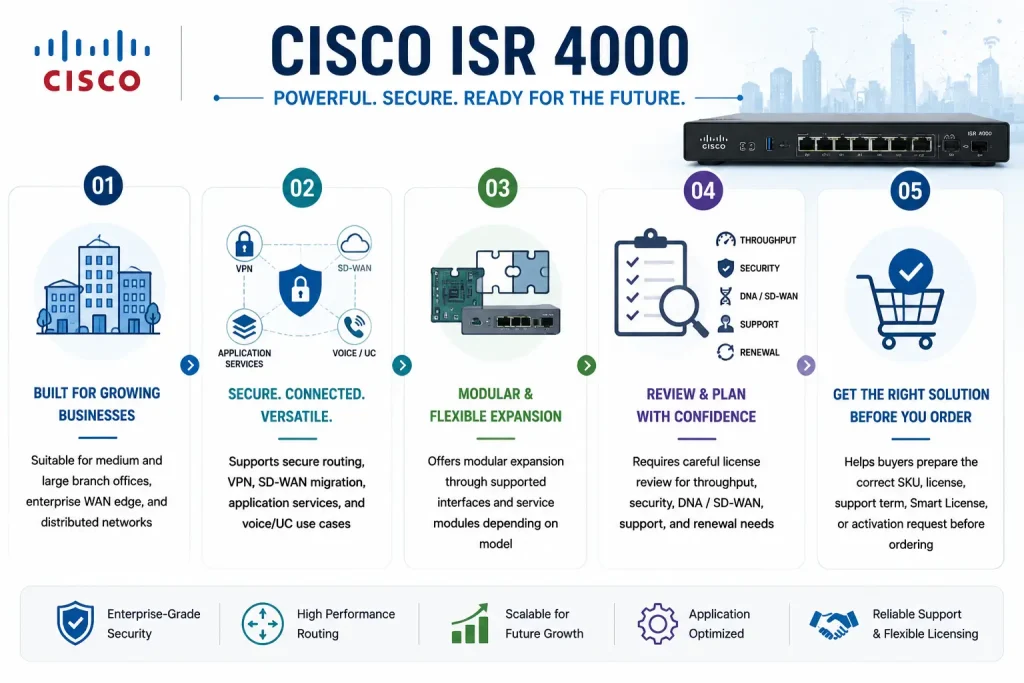
- Suitable for medium and large branch offices, enterprise WAN edge, and distributed networks
- Supports secure routing, VPN, SD-WAN migration, application services, and voice/UC use cases
- Offers modular expansion through supported interfaces and service modules depending on model
- Requires careful license review for throughput, security, DNA / SD-WAN, support, and renewal needs
- Helps buyers prepare the correct SKU, license, support term, Smart License, or activation request before ordering
Review Cisco ISR 4000 Series Price List and request a quote tailored to your licensing needs.
Cisco ISR 4000 At a glance
What it is : Cisco ISR 4000 Series is an enterprise integrated services router family for branch WAN, secure routing, service integration, and SD-WAN-ready deployments.
Product family : Cisco Router ISR
Typical use : Enterprise branch routing, WAN edge, VPN, internet edge, SD-WAN migration, voice services, security services, and application-aware routing.
License or ordering scope : Router model, throughput or performance license, DNA / Catalyst SD-WAN subscription, security features, support renewal, Smart License, and activation method.
Who needs it : Organizations that use Cisco ISR 4000 routers and need the correct part number, license, renewal, support option, upgrade path, or activation guidance.
Series Overview
Cisco ISR 4000 Series is built for branches that need more than basic routing. It is commonly deployed where the branch router must handle multiple responsibilities at the same time, including WAN connectivity, secure site-to-site communication, VPN, application services, local survivability, and integration with enterprise network policies.
In a typical network design, Cisco ISR 4000 routers sit at the branch edge and connect the local site to headquarters, data centers, cloud services, internet links, MPLS, or SD-WAN overlays. They are often used by organizations with larger branch offices, regional locations, retail networks, financial sites, healthcare branches, and distributed enterprise environments.
The main value of this series is flexibility. Buyers may need a router for traditional WAN routing today, while also preparing for SD-WAN, higher throughput, security services, or service expansion later. Because of that, part-number selection should not only focus on the chassis. The license, throughput level, software feature, support term, and activation model must also match the real deployment.
Licensing and Part Number Guidance
Choosing the correct part number for Cisco ISR 4000 depends on the exact router model, required throughput, software version, WAN interface needs, security features, SD-WAN plan, support coverage, and activation method.
One of the most important licensing areas for Cisco ISR 4000 is performance. Some ISR 4000 deployments require a Performance License or throughput-related license to support higher forwarding capacity. This is especially important when the router handles VPN, encrypted traffic, larger WAN circuits, or more demanding branch workloads.
Some environments may also require Cisco DNA or Catalyst SD-WAN subscriptions, depending on whether the router is used in a traditional routing design or as part of a Cisco SD-WAN deployment. Security, application visibility, voice, and support renewal requirements can also affect the final SKU.
Before selecting a part number, the exact model and licensing objective should be confirmed. This helps avoid ordering a router license that does not match the required throughput, software release, or activation workflow.
Common Use Cases
| Use case | Why it matters |
|---|---|
| Medium or large branch routing | Supports higher branch traffic and more advanced WAN edge requirements |
| SD-WAN migration | Helps move from traditional WAN routing to Cisco SD-WAN or Catalyst SD-WAN |
| VPN and encrypted traffic | Requires correct performance and security license planning |
| WAN edge upgrade | Matches router capacity, interfaces, and software features to new circuit needs |
| Voice and UC branch services | Supports branches that still require integrated communication services |
| Renewal or replacement | Helps validate the existing license status and support term while comparing renewal or replacement options available through the Cisco Router License category |
Models, Licenses, and Ordering Scope
| Area to check | What to confirm |
|---|---|
| Router model | Exact ISR 4000 model, interface needs, and expansion requirement |
| Throughput need | Base performance, Performance License, encrypted traffic, or WAN circuit size |
| Deployment mode | Traditional routing, VPN, secure branch, SD-WAN, or mixed environment |
| License type | DNA / Catalyst SD-WAN, security feature, support renewal, throughput license, or Smart License |
| Quantity | Number of routers, sites, spare units, or renewal targets |
| Term | 1-year, 3-year, 5-year, renewal, or support period |
| Activation method | Smart License, SLP, PLR License, SLR License, or product-specific workflow where applicable |
| Part number | Correct Cisco ISR 4000 SKU and related license or support item |
What to Check Before Requesting a Quote
Before requesting a quote for Cisco ISR 4000, confirm the router model, site size, WAN bandwidth, software version, required throughput, license type, support term, and activation method.
You should also check whether the router will run as a traditional WAN edge device or as part of a Cisco SD-WAN deployment. This matters because SD-WAN subscriptions, controller-based management, and Catalyst SD-WAN licensing can change the ordering requirements.
If the router is used in a restricted, offline, or compliance-controlled network, PLR License or SLR License options should also be reviewed before ordering where supported.
Activation and Delivery Notes
After the correct Cisco ISR 4000 part number is selected, activation depends on the license type and software environment. Some deployments may use Smart Licensing or Smart Licensing Using Policy. Some older or migration environments may involve Classic License, PAK history, or license conversion review.
For throughput or performance-related licenses, the license status should be validated after activation to confirm that the router is operating at the expected capacity. For SD-WAN deployments, the subscription and management workflow should also be checked before delivery.
For renewals, upgrades, or replacements, the existing license status and support coverage should be reviewed first. This helps prevent activation issues and keeps the router aligned with the correct Cisco licensing method.
Cisco ISR 4000 pricing depends on your router series, license type, deployment model and support requirements.