

Checkmarx License provides access to enterprise Application Security Testing (AST) solutions designed to identify, manage, and remediate security vulnerabilities throughout the software development lifecycle. Checkmarx helps organizations secure applications by combining technologies such as Static Application Security Testing (SAST), Software Composition Analysis (SCA), API Security Testing, and Developer Security workflows.
Quick Benefits
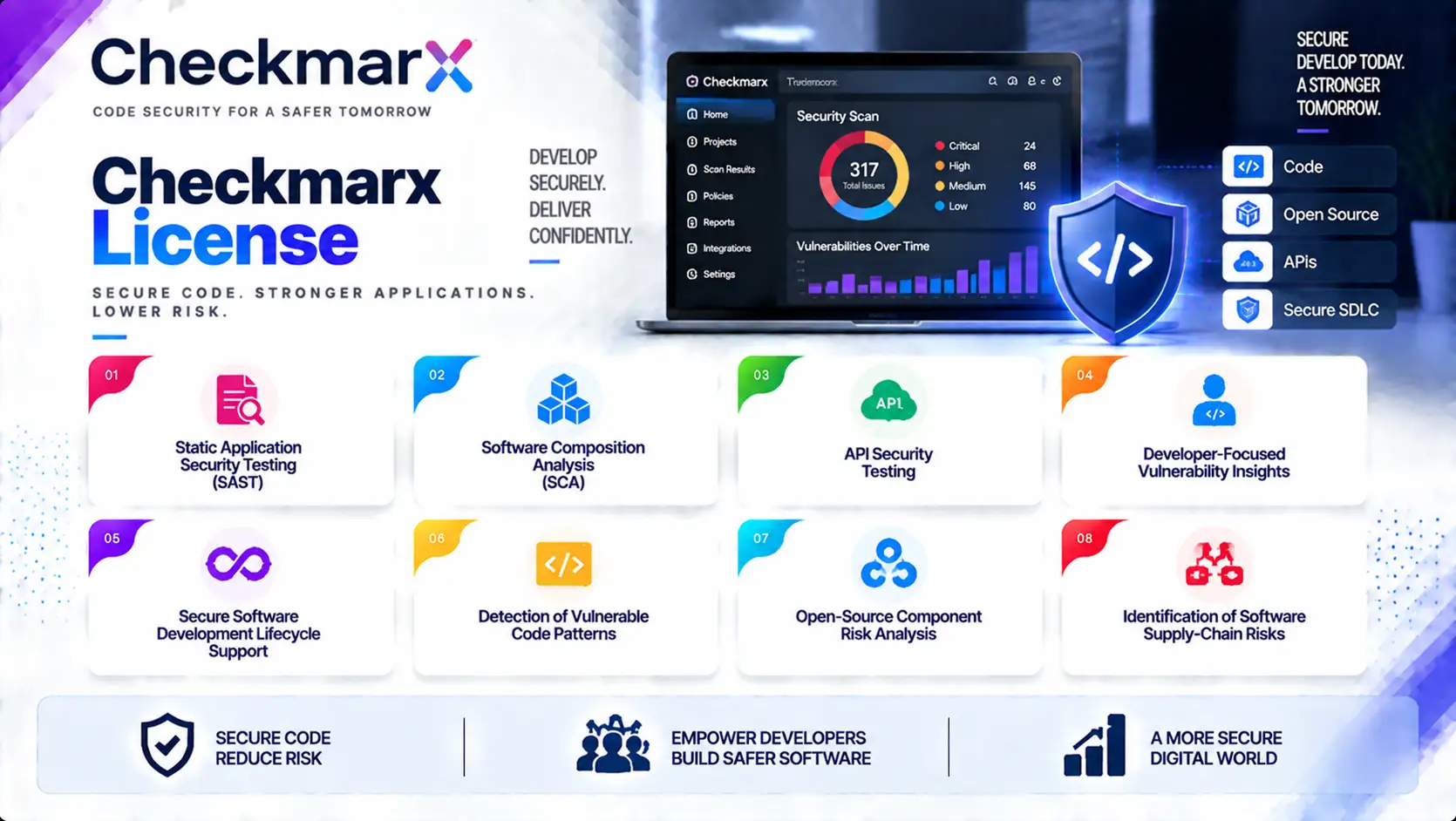
- Static Application Security Testing (SAST)
- Software Composition Analysis (SCA)
- API security testing
- Developer-focused vulnerability insights
- Secure software development lifecycle support
- Detection of vulnerable code patterns
- Open-source component risk analysis
- Identification of software supply-chain risks
Checkmarx License At a Glance
What it is: Enterprise Application Security Testing licensing platform
Primary role: Identify and manage application security vulnerabilities during software development
Security areas: Source code security, open-source risk, API security, application testing, and DevSecOps
Core technologies: SAST, SCA, API Security, IaC Security, and application security management
Deployment models: Cloud, on-premises, and hybrid environments
Typical environments: Enterprise software development, financial services, healthcare, telecommunications, government, SaaS platforms, and large application teams
Management: Checkmarx One platform and centralized security dashboards
License model: Subscription-based licensing
License Overview
A Checkmarx License defines access to Checkmarx application security capabilities based on the organization’s development environment, security requirements, and application portfolio.
Unlike traditional vulnerability scanners that primarily evaluate running systems, Checkmarx focuses on identifying security weaknesses earlier in the software development lifecycle.
The licensing structure is influenced by factors such as:
- Number of developers
- Number of applications
- Source code repositories
- Required security testing modules
- API security requirements
- Open-source component analysis needs
- CI/CD integration requirements
How Checkmarx Licensing Works
Checkmarx licensing is designed around securing applications from development through deployment.
A typical workflow includes:
Code Development
→ Developers create application code
Security Analysis
→ Checkmarx evaluates source code, dependencies, APIs, or infrastructure definitions
Risk Identification
→ Security vulnerabilities and compliance issues are discovered
Prioritization
→ Findings are categorized according to risk and business impact
Remediation
→ Developers receive guidance to resolve security issues
This approach helps organizations integrate security into DevOps and reduce the cost of fixing vulnerabilities later in the application lifecycle.
Checkmarx Security Capabilities Overview
| Capability | Primary Purpose |
|---|---|
| SAST | Identify vulnerabilities in proprietary source code |
| SCA | Detect risks in open-source software components |
| API Security | Assess vulnerabilities in application APIs |
| Infrastructure as Code Security | Identify security issues in cloud infrastructure definitions |
| Container Security | Evaluate container-related risks |
| DevSecOps Integration | Connect security testing with development pipelines |
| Risk Management | Prioritize vulnerabilities based on impact |
| Security Reporting | Provide visibility into application security posture |
Licensing Options and Models
| Licensing Option | Description | Suitable For |
|---|---|---|
| Checkmarx One Subscription | Cloud-based application security platform with integrated security capabilities | Organizations adopting centralized AST management |
| SAST Licensing | Provides source-code vulnerability analysis capabilities | Development teams requiring code security testing |
| SCA Licensing | Identifies vulnerabilities and risks in open-source components | Organizations managing software dependencies |
| API Security Licensing | Tests APIs for security weaknesses | API-driven applications and microservices |
| Developer-Based Licensing | Licensing based on development users and teams | Organizations with defined developer groups |
| Application-Based Licensing | Licensing based on protected applications and projects | Enterprises managing application portfolios |
| Enterprise Subscription | Expanded security coverage for large organizations | Global development environments |
| Multi-Year Subscription | Extended security platform access | Long-term application security programs |
Features and Benefits
Static Application Security Testing (SAST)
SAST is one of the core capabilities of Checkmarx.
It analyzes application source code to identify vulnerabilities before software is deployed.
SAST helps detect issues such as:
- Injection vulnerabilities
- Authentication weaknesses
- Insecure coding practices
- Data exposure risks
- Improper security controls
By analyzing code during development, organizations can identify problems earlier and reduce remediation costs.
Software Composition Analysis (SCA)
Modern applications rely heavily on open-source components.
SCA helps organizations understand the security risks associated with third-party libraries and dependencies.
It can identify:
- Known vulnerabilities
- Outdated components
- Open-source risks
- License compliance concerns
This is increasingly important as software supply-chain attacks become more common.
API Security Testing
APIs are a critical part of modern applications and cloud services.
Checkmarx API security capabilities help organizations identify weaknesses in API implementations, including:
- Authentication problems
- Authorization issues
- Data exposure risks
- Security configuration weaknesses
This helps protect applications built around microservices and distributed architectures.
Compatibility and Requirements
Before selecting a Checkmarx License, organizations should evaluate:
- Number of developers
- Application portfolio size
- Source-code repositories
- Programming languages
- CI/CD platforms
- API inventory
- Open-source dependency usage
- Cloud or on-premises deployment
- Security reporting requirements
- Integration requirements
Common supported environments include:
- Enterprise development teams
- Cloud-native applications
- Web applications
- Mobile applications
- APIs
- Microservice architectures
Exact capabilities depend on the selected Checkmarx solution and deployment model.
Activation and Deployment
A typical Checkmarx deployment includes:
- Select required application security capabilities
- Define development teams and applications
- Activate the license
- Connect source-code repositories
- Configure scanning policies
- Integrate with CI/CD workflows
- Configure reporting and dashboards
- Begin application security assessments
Organizations often begin by protecting critical applications before expanding security testing across the entire software portfolio.
Pricing and Quote Process
Pricing for Checkmarx License depends on application scope, development teams, security modules, and deployment requirements.
Before requesting a quote, prepare:
- Number of developers
- Number of applications
- Source-code repositories
- Programming languages
- Required SAST coverage
- SCA requirements
- API security requirements
- CI/CD integration needs
Checkmarx pricing depends on your application security requirements, license edition, SAST and SCA capabilities, number of applications, deployment model, license term, and support needs.