

Cisco Catalyst 9800 Series is a Cisco enterprise wireless controller family designed for centralized WLAN management, secure wireless access, mobility services, high-availability wireless control, and large-scale Catalyst access point deployments. Unlike Catalyst access switches or Catalyst 9100 access points, Cisco Catalyst 9800 acts as the wireless control platform that manages AP registration, client roaming, RF operations, security policy, guest access, and wireless network availability. This page helps buyers understand Cisco Catalyst 9800 ordering considerations, review licensing and part-number requirements, and move to the related Cisco Catalyst 9800 part numbers for accurate quote planning.
Series Highlights
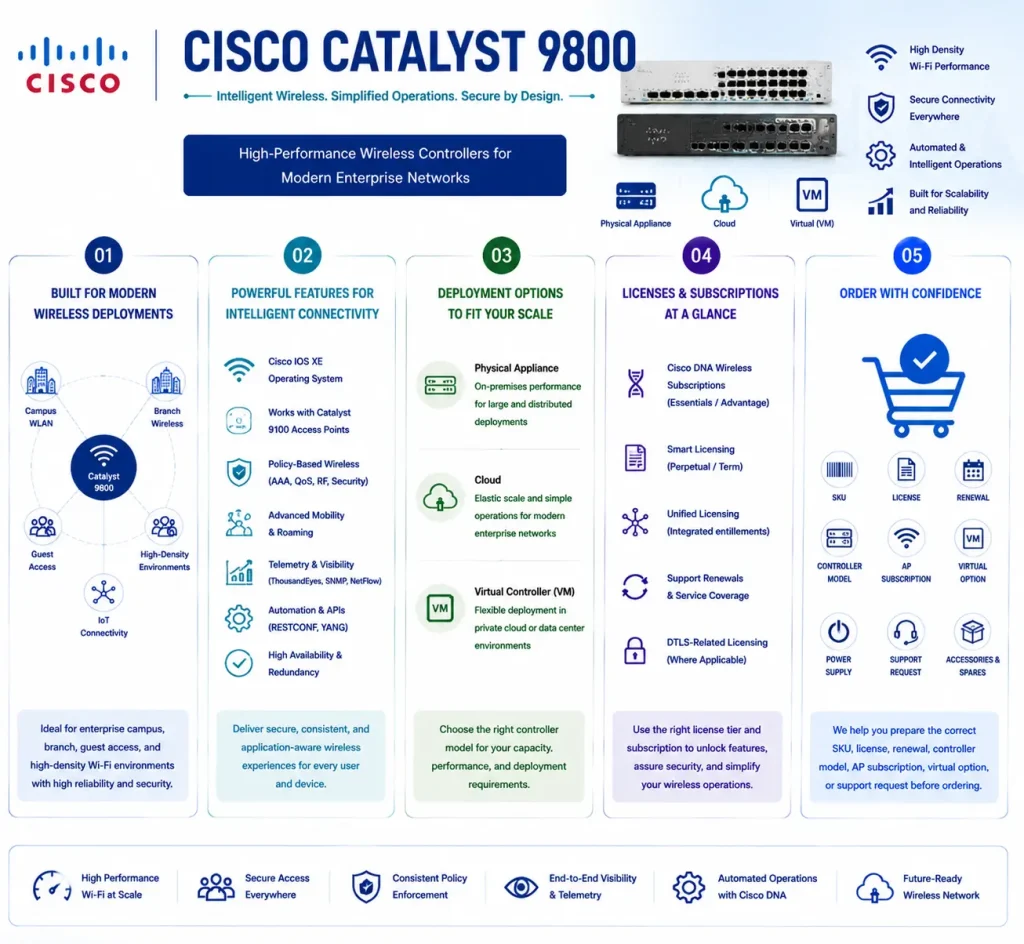
- Suitable for enterprise wireless controller deployments, campus WLAN, branch wireless, guest access, and high-density Wi-Fi environments
- Supports Cisco IOS XE, Catalyst 9100 access points, policy-based wireless, mobility, telemetry, automation, and high availability
- Available in physical appliance, cloud, and virtual controller options depending on scale and deployment model
- Commonly associated with Cisco DNA wireless subscriptions, Smart Licensing, Unified Licensing, support renewals, and DTLS-related licensing where applicable
- Helps buyers prepare the correct SKU, license, renewal, controller model, AP subscription, virtual controller option, or support request before ordering
Review Cisco Catalyst 9800 Price List and request a quote tailored to your licensing needs.
Cisco Catalyst 9800 At a glance
What it is : Cisco Catalyst 9800 Series is an enterprise wireless LAN controller family for Cisco Catalyst wireless networks.
Product family : Cisco Catalyst Products
Typical use : Campus wireless control, branch WLAN, Catalyst 9100 AP management, secure wireless access, guest access, mobility, high availability, and wireless network operations.
License or ordering scope : Controller model, access point count, Cisco DNA wireless subscription, Smart Licensing, Unified Licensing, DTLS license where applicable, support renewal, virtual controller sizing, and software compatibility.
Who needs it : Organizations deploying, expanding, replacing, or renewing Cisco wireless controllers that need the correct Cisco Catalyst 9800 part number, AP license, subscription term, support option, or activation guidance.
Series Overview
Cisco Catalyst 9800 Series is built for enterprise wireless networks where access points, users, roaming, security, and policy need to be controlled from a centralized wireless platform. It is commonly used in campuses, universities, hospitals, hotels, warehouses, retail environments, offices, and distributed branches.
Organizations reviewing access points, wireless controllers, and enterprise WLAN licensing can visit the Cisco Wireless category for the broader range of Cisco wireless solutions.
In a typical deployment, Catalyst 9800 controllers manage Cisco Catalyst access points such as Catalyst 9100 models. The controller handles AP join, WLAN configuration, client sessions, roaming, authentication integration, policy enforcement, guest access, telemetry, and operational visibility.
The value of Cisco Catalyst 9800 is not only controller capacity. Buyers should also consider deployment model, AP scale, redundancy design, controller placement, licensing, software version, AP compatibility, and management integration with platforms such as Cisco Catalyst Center.
Cisco Catalyst 9800 can be ordered as a physical appliance, a virtual controller, or a cloud-ready controller option depending on the required architecture. Because the controller and AP licensing model are closely connected, part-number selection should be reviewed before ordering.
Licensing and Part Number Guidance
Choosing the correct part number for Cisco Catalyst 9800 depends on the controller model, AP count, deployment type, software release, Cisco DNA wireless subscription, Smart Account status, support coverage, and activation method.
Some buyers may need a physical controller such as a Catalyst 9800-L, 9800-40, or 9800-80. Others may need Cisco Catalyst 9800-CL for a virtual wireless controller deployment. The correct model depends on AP scale, client scale, throughput, redundancy, site design, and whether the controller will be used in a campus, data center, private cloud, public cloud, or branch environment.
Licensing should be checked at the access point level as well. Catalyst access points connecting to a Cisco Catalyst 9800 controller commonly require Cisco DNA wireless subscriptions. Buyers should confirm subscription tier, term, AP quantity, renewal status, and Smart Licensing workflow before finalizing the quote.
Common Use Cases
| Use case | Why it matters |
|---|---|
| Campus wireless control | Centralizes WLAN configuration, AP management, client access, and wireless policy for enterprise campuses |
| Catalyst 9100 AP deployment | Supports modern Cisco wireless access point environments with controller-based management |
| Guest and secure wireless access | Helps manage SSIDs, authentication, access policy, segmentation, and guest connectivity |
| High-availability WLAN | Supports resilient wireless controller designs for environments where Wi-Fi downtime is not acceptable |
| Virtual wireless controller deployment | Allows controller deployment in virtualized or cloud-based environments where supported |
| Renewal or controller refresh | Helps validate AP count, license status, controller model, software version, and support coverage before ordering |
Models, Licenses, and Ordering Scope
| Area to check | What to confirm |
|---|---|
| Controller model | Exact Cisco Catalyst 9800-L, 9800-40, 9800-80, 9800-CL, or related controller requirement |
| Deployment role | Campus controller, branch controller, virtual controller, cloud deployment, HA pair, or controller refresh |
| AP requirement | Number of access points, AP models, Catalyst 9100 compatibility, and AP growth plan |
| License type | Cisco DNA wireless subscription, Smart License, Unified Licensing, support renewal, or DTLS license where applicable |
| Software version | Cisco IOS XE release, AP compatibility, Catalyst Center requirement, and upgrade path |
| Redundancy design | Standalone controller, HA pair, SSO design, disaster recovery, or distributed controller model |
| Quantity | Number of controllers, AP licenses, subscription renewals, support items, or replacement units |
| Term | 3-year, 5-year, 7-year, renewal, subscription, or support coverage period |
| Activation method | Smart License, SLP, Cisco DNA wireless subscription workflow, Unified Licensing, or Cisco-supported activation method |
| Part number | Correct Cisco Catalyst 9800 hardware, virtual controller, license, subscription, renewal, or support SKU |
What to Check Before Requesting a Quote
Before requesting a quote for Cisco Catalyst 9800, confirm the controller model, deployment type, AP count, AP models, Cisco DNA wireless subscription term, software version, Smart Account status, and support coverage.
You should also define whether the request is for a new wireless deployment, controller replacement, AP expansion, HA design, virtual controller deployment, license renewal, DTLS license, or migration from an older AireOS wireless controller. Each scenario can change the required SKU and licensing scope.
For existing wireless networks, prepare the current inventory first. This should include controller model, serial number, IOS XE release, AP count, AP models, license status, Smart Account details, redundancy design, and support coverage.
Activation and Delivery Notes
After the correct Cisco Catalyst 9800 part number is selected, activation depends on the controller model, AP subscription count, Smart Account, Cisco DNA subscription, and IOS XE release. Many Catalyst 9800 deployments use Smart Licensing or Smart Licensing Using Policy for entitlement visibility and license reporting. AP subscriptions should be aligned with the number of access points that will connect to the controller.
For hardware or virtual delivery, compatibility should be checked before deployment. Controller model, AP model, software version, license tier, HA design, and management platform should match the planned wireless architecture.For renewals, replacements, or migrations, review the current license and support status first. This helps prevent ordering delays and keeps the selected SKU aligned with the real wireless controller requirement.
Cisco Switch pricing depends on your Switch series, license type, deployment model and support requirements.