

Cisco Nexus 3000 Series is a Cisco data center switching family designed for low-latency Ethernet switching, top-of-rack connectivity, high-density server access, Layer 2 and Layer 3 data center networking, and NX-OS-based operations. Unlike Cisco Catalyst switches that are mainly used in campus access, distribution, or core environments, Cisco Nexus 3000 switches are selected for data center networks where performance, port density, latency, optics compatibility, and software feature alignment matter. This page helps buyers understand Cisco Nexus 3000 ordering considerations, review licensing and part-number requirements, and move to the related Cisco Nexus 3000 part numbers for accurate quote planning.
Series Highlights
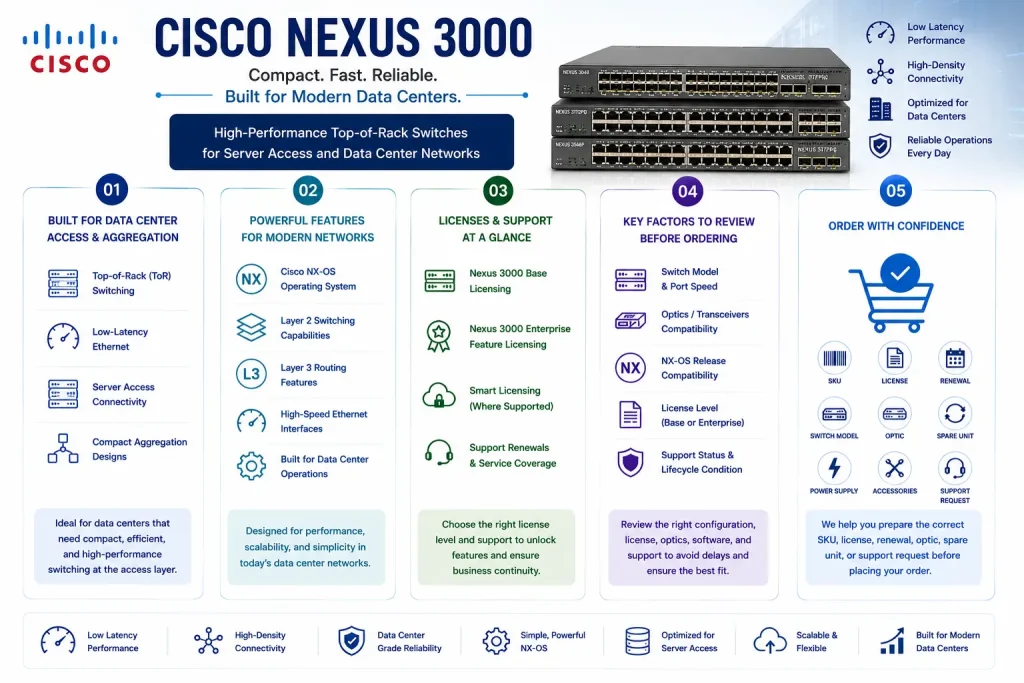
- Suitable for data center top-of-rack switching, low-latency Ethernet, server access, and compact aggregation designs
- Supports Cisco NX-OS, Layer 2 switching, Layer 3 routing features, high-speed Ethernet, and data center operations
- Commonly associated with Nexus 3000 base and enterprise feature licensing, Smart Licensing where supported, and support renewals
- Requires careful review of switch model, port speed, optics, NX-OS release, license level, support status, and lifecycle condition
- Helps buyers prepare the correct SKU, license, renewal, optic, spare unit, or support request before ordering
Review Cisco Nexus 3000 Price List and request a quote tailored to your licensing needs.
Cisco Nexus 3000 At a glance
What it is : Cisco Nexus 3000 Series is a Cisco data center switch family for low-latency, high-density Ethernet switching.
Product family : Cisco Nexus License
Typical use : Top-of-rack switching, server access, data center aggregation, low-latency workloads, Layer 2/Layer 3 switching, cloud infrastructure, and high-performance Ethernet fabrics.
License or ordering scope : Switch model, port speed, optics, Cisco NX-OS release, LAN Base or LAN Enterprise feature needs, Smart Licensing where supported, support renewal, and spare hardware.
Who needs it : Data center teams, service providers, cloud operators, financial networks, hosting providers, and enterprises that need the correct Cisco Nexus 3000 part number, license, optic, support renewal, or replacement unit.
Series Overview
Cisco Nexus 3000 Series is built for data center networks where switching performance, predictable latency, and compact high-density Ethernet are important. These switches are commonly deployed as top-of-rack platforms for servers, storage-facing Ethernet networks, cloud infrastructure, hosting environments, financial applications, and service-provider facilities.
In a typical design, Cisco Nexus 3000 switches connect servers and upstream data center switches while running Cisco NX-OS. Depending on the model, design, and software release, they may support Layer 2 switching, Layer 3 routing, vPC, high-speed uplinks, automation features, and data center operational tools.
The value of Cisco Nexus 3000 within the broader Cisco Switch License category is its focused data center switching role. It is not ordered like a campus access switch, and it should not be treated as a Catalyst replacement. Buyers need to confirm the exact model, interface speed, optics, software release, licensing requirement, support coverage, and compatibility with the current data center architecture. It is not ordered like a campus access switch, and it should not be treated as a Catalyst replacement. Buyers need to confirm the exact model, interface speed, optics, software release, licensing requirement, support coverage, and compatibility with the current data center architecture. Because many Nexus 3000 environments are already deployed, quote requests often involve expansion, support renewal, optic matching, spare replacement, license validation, or migration planning toward newer Nexus platforms.
Licensing and Part Number Guidance
Choosing the correct part number for Cisco Nexus 3000 depends on the exact switch model, required interface speed, NX-OS release, license feature set, optics, deployment role, support term, and activation method. Cisco Nexus 3000 licensing may involve base Layer 3 licensing, enterprise feature licensing, NX-OS feature entitlement, support renewal, or Smart Licensing where supported by the platform and software release. Older models may follow different licensing behavior than newer Nexus 3000 platforms, so the model and NX-OS version should be checked before ordering.
Some requests may focus only on hardware, such as a fixed switch, optics, spare power supply, fan, cable, or replacement unit. Other requests may involve a feature license, renewal, software support, or migration review. The quote should clearly separate hardware SKUs from software, license, and support items. For existing data center environments, the current inventory should be reviewed first. This helps avoid unsupported optics, incorrect NX-OS assumptions, missing feature licenses, or renewal items that do not match the installed switch.
Common Use Cases
| Use case | Why it matters |
|---|---|
| Data center top-of-rack switching | Connects servers to the data center network with compact, high-density Ethernet switching |
| Low-latency workloads | Supports environments where predictable forwarding and reduced latency are important |
| Layer 2 and Layer 3 data center designs | Helps support switching, routing, vPC, and data center connectivity features depending on license and software |
| Cloud and hosting infrastructure | Provides high-speed Ethernet switching for service-provider, hosting, and cloud environments |
| Optics or spare replacement | Helps match transceivers, power supplies, fans, and replacement units with the installed model |
| Renewal or migration planning | Helps validate NX-OS version, license status, support coverage, and upgrade path before ordering |
Models, Licenses, and Ordering Scope
| Area to check | What to confirm |
|---|---|
| Switch model | Exact Cisco Nexus 3000 model, generation, port layout, and hardware status |
| Deployment role | Top-of-rack, server access, data center aggregation, low-latency switching, or replacement unit |
| Port requirement | Required 1G, 10G, 25G, 40G, 100G, copper, fiber, breakout, and optics compatibility |
| Software version | Cisco NX-OS release, feature support, upgrade path, and Smart Licensing support where applicable |
| License type | LAN Base, LAN Enterprise, Layer 3 feature license, NX-OS entitlement, support renewal, or Smart License where supported |
| Hardware scope | Fixed switch, optics, power supplies, fan modules, cables, spare parts, or replacement units |
| Quantity | Number of switches, ports, optics, licenses, support renewals, or spare units |
| Term | 1-year, 3-year, 5-year, renewal, support coverage, or software access requirement |
| Activation method | Classic License, license file, Smart License, SLP, PLR License, SLR License, or Cisco-supported workflow where applicable |
| Part number | Correct Cisco Nexus 3000 hardware SKU and related license, optic, accessory, renewal, or support item |
What to Check Before Requesting a Quote
Before requesting a quote for Cisco Nexus 3000, confirm the exact switch model, port-speed requirement, optics, NX-OS release, current license status, deployment role, support term, and replacement or expansion need.
You should also define whether the request is for a new switch, support renewal, feature license, spare unit, optics, power supply, fan, software entitlement, or migration project. Each request type can change the final SKU and licensing scope.
For existing deployments, prepare the current inventory first. This should include model number, serial number, installed NX-OS release, license status, optics, power and fan details, and support coverage. This is especially important for older Nexus 3000 models because licensing and software support may vary by platform.
Activation and Delivery Notes
After the correct Cisco Nexus 3000 part number is selected, activation depends on the switch model, NX-OS release, license type, and Cisco-supported licensing workflow. Some Nexus 3000 deployments may use traditional license files or feature licenses, while supported newer software and platform combinations may use Smart Licensing or Smart Licensing Using Policy. The activation path should be validated before delivery, especially in restricted or offline environments.
For hardware delivery, compatibility should be checked before shipment. Optics, breakout cables, fans, power supplies, airflow direction, and NX-OS release requirements should match the planned data center design. For renewal, replacement, or migration projects, reviewing the current license and support status first helps prevent ordering delays and keeps the selected SKU aligned with the real data center switching requirement.
Cisco Nexus Series pricing depends on your Switch series, license type, deployment model and support requirements.