

Juniper License provides the software rights and subscriptions required to enable advanced routing, switching, security, AI-native networking, and cloud-managed capabilities across Juniper platforms. Juniper Networks, now part of HPE, uses a flexible licensing framework that spans physical hardware, virtual systems, cloud services, and software applications.
Quick Benefits
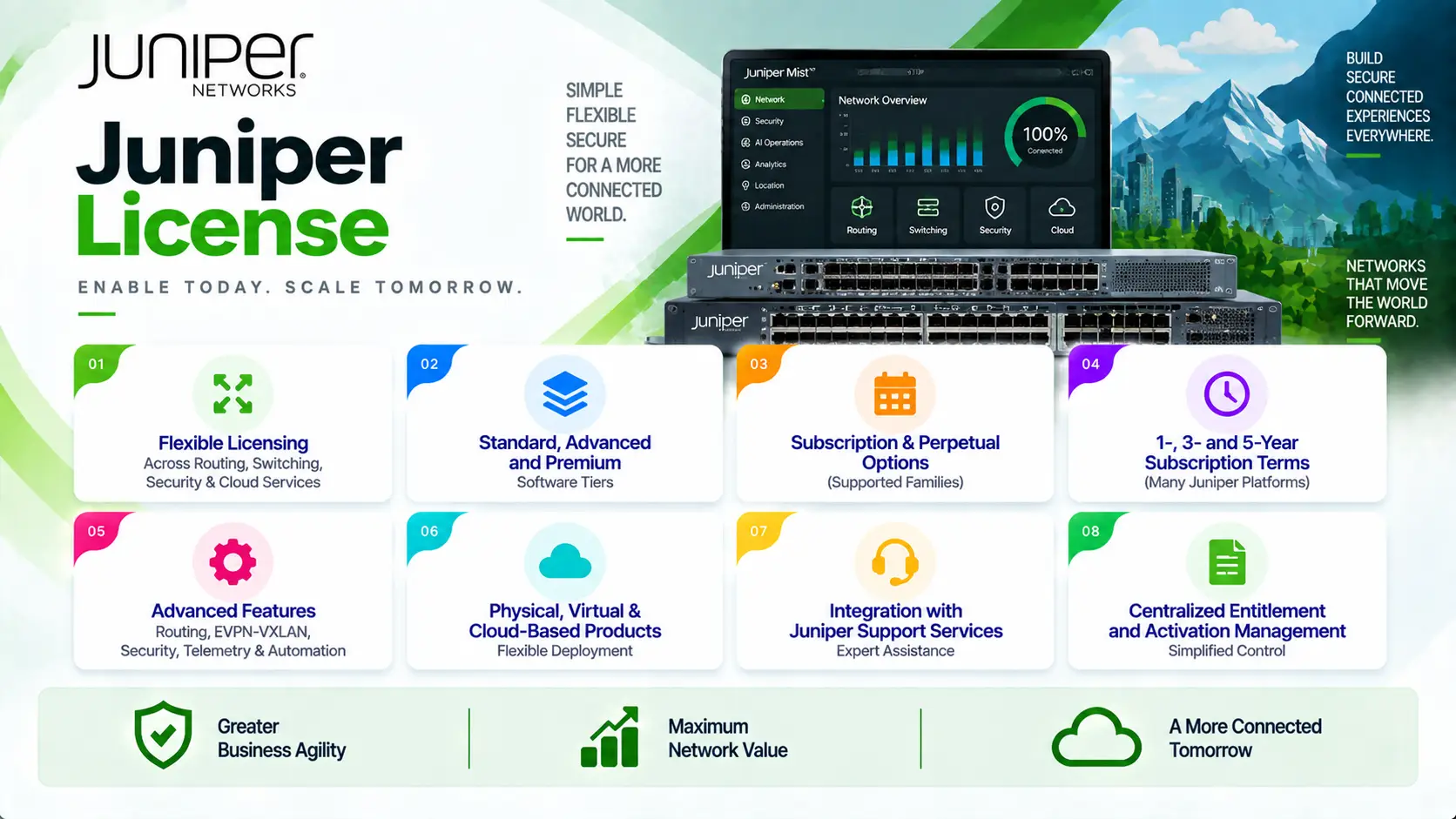
- Flexible licensing across routing, switching, security, and cloud services
- Standard, Advanced, and Premium software tiers
- Subscription and perpetual options on supported product families
- 1-, 3-, and 5-year subscription terms across many Juniper platforms
- Access to advanced routing, EVPN-VXLAN, security, telemetry, and automation features where supported
- Licensing for physical, virtual, and cloud-based products
- Integration with Juniper support services
- Centralized entitlement and activation management
Juniper License At a Glance
What it is: Software licensing and subscription framework for Juniper networking and security products
Vendor: Juniper Networks, now part of HPE
Core licensing framework: Juniper Flex
Primary tiers: Standard, Advanced, and Premium
License types: Subscription and perpetual, depending on product family
Common subscription terms: 1, 3, and 5 years; some product families support additional terms
Primary platforms: EX, QFX, MX, PTX, ACX, SRX, cSRX, Juniper Mist, and other Juniper software platforms
Deployment models: Physical appliances, virtual platforms, cloud services, and standalone software
Licensing metrics: Device class, bandwidth, subscribers, sessions, users, devices, features, or cloud-service consumption depending on product
License Overview
A Juniper License provides the right to use software features associated with supported Juniper hardware and software products. The exact entitlement depends on the device family, hardware class, requested functionality, and selected licensing tier.
Juniper Flex uses a common three-tier structure built around Standard, Advanced, and Premium capabilities. On hardware platforms, the Standard software feature set is generally included with the platform, while Advanced and Premium tiers unlock additional functionality. Virtual platforms, cloud services, and standalone software may use subscription-based Standard, Advanced, or Premium licensing instead.
The important point for buyers is that Juniper licensing is not identical across every product family. A QFX data-center switch may use Advanced 1, Advanced 2, or Premium 1 licenses based on device class and required functions, while PTX licensing now distinguishes WAN and Data Center use cases and can also involve bandwidth or scale. Subscriber-service licenses may be calculated according to subscriber or session capacity rather than physical device count.
For this reason, selecting a Juniper License should begin with the exact platform and required use case rather than the product family name alone.
How Juniper Licensing Works
Juniper licensing starts with the platform being deployed and the features that need to be enabled. For integrated hardware and software products, the base hardware normally includes the Standard software capability, while additional Advanced or Premium software rights are purchased according to the intended use case. Subscription licenses commonly include support during the subscription period, while perpetual licensing and support arrangements depend on the specific product family and commercial model. For software-only, virtual, and cloud offerings, subscriptions are commonly used from the start. The selected entitlement is then associated with the customer account and activated through the appropriate Juniper licensing system or cloud portal.
Juniper Product and Licensing Portfolio
| Product Family | Typical Role | Licensing Considerations |
|---|---|---|
| Juniper EX Series | Campus and enterprise switching | Feature tier, switch model, Mist subscriptions, advanced routing or telemetry requirements |
| Juniper QFX Series | Data-center switching and fabric networking | Device class, A1/A2/P1 tier, EVPN-VXLAN, MACsec, telemetry, subscription or perpetual term |
| Juniper MX Series | Edge and service-provider routing | Platform model, routing features, bandwidth, subscriber services, scale, and use case |
| Juniper PTX Series | High-capacity core and transport routing | WAN/Data Center use case, bandwidth, scale, tier, and term |
| Juniper ACX Series | Metro, access, and edge routing | Bandwidth level, Advanced/Premium feature set, term, and platform model |
| Juniper SRX / cSRX | Firewall and network security | Firewall tier, NGFW services, IDP, AppID, antivirus, web filtering, throughput, and deployment type |
| Juniper Mist | AI-native wireless, wired, WAN, and assurance services | Device consumption, organization/site scope, selected assurance service, and subscription term |
| Juniper Apstra | Data-center network automation | Managed devices, deployment scope, automation requirements, and subscription model |
Because feature availability varies by hardware model, the inclusion of a capability in a software tier does not automatically mean every device in that family supports it. Juniper explicitly recommends checking model-specific product documentation before ordering.
Licensing Options and Models
| Licensing Model | Description | Suitable For |
|---|---|---|
| Standard Tier | Base feature set included with many hardware platforms or offered as a subscription on software/cloud platforms | Deployments requiring core networking capabilities |
| Advanced Tier | Adds functionality above Standard; exact features vary by platform | Enterprises requiring advanced routing, fabric, security, or automation capabilities |
| Premium Tier | Adds the highest available feature set above Advanced on supported products | Advanced data-center, service-provider, and complex enterprise deployments |
| Subscription License | Provides right-to-use software for a defined term, commonly 1, 3, or 5 years | Organizations preferring term-based licensing and included support |
| Perpetual License | Provides perpetual software rights on supported hardware/product families | Long-term deployments where perpetual licensing is available |
| Capacity-Based License | Licensing tied to bandwidth, subscribers, sessions, cores, or other scale metrics | Service-provider and high-capacity routing environments |
| Cloud Subscription | Subscription tied to cloud-managed features or devices | Mist and other cloud-delivered services |
Features and Benefits
The main advantage of Juniper licensing is flexibility. Organizations do not necessarily have to purchase every advanced feature with the hardware. Instead, the software tier can be aligned with the actual role of the device and the architecture being deployed.
This is particularly useful in large networks. A leaf switch in an EVPN-VXLAN fabric may require a different feature set from an access switch, while an edge router supporting subscriber services can have very different licensing requirements from a core transport router.
Juniper Flex also provides a more consistent structure across physical appliances, virtual platforms, and cloud services. Although individual SKUs still vary significantly, the Standard/Advanced/Premium approach gives buyers a clearer starting point when comparing capabilities.
Cloud-managed services follow a related but different model. Juniper Mist subscriptions can operate at organization or site level, and usage may be calculated using metrics such as managed devices or active clients depending on the service. For example, Juniper states that Wi-Fi Assurance is required when using Juniper access points.
Compatibility and Requirements
Before purchasing a Juniper License, the exact network environment should be documented.
Important checks include:
- Exact Juniper hardware model
- Device class where applicable
- Installed or planned Junos OS version
- Required routing, switching, security, or automation features
- Network role such as access, leaf, spine, WAN edge, or core
- Required bandwidth or subscriber scale
- Cloud-management requirements
- Mist services required
- MACsec or telemetry requirements
Activation and Deployment
Juniper software entitlements can be activated through the Juniper Agile Licensing Portal for supported products. During activation, administrators locate the entitlement, select the appropriate software version, and activate the required quantity. For licenses involving scale such as bandwidth or CPU capacity, multiple quantities may be activated where the SKU permits it.
A typical workflow includes:
- Confirm the product and license SKU
- Verify software/Junos version
- Locate the entitlement
- Activate the required quantity
- Install or associate the license where required
- Verify entitlement status
- Monitor subscription expiration and renewal
Cloud products such as Juniper Mist use their own subscription-management workflows through the Mist portal.
Pricing and Quote Process
Pricing for a Juniper License depends heavily on the platform and the actual networking use case. The same product family may contain multiple hardware classes, software tiers, bandwidth levels, and subscription options.
Before requesting a quote, define:
- Exact hardware model
- Required software tier
- Required feature set
- Device or hardware class
- Bandwidth or scale requirements
- Number of devices
- Junos OS version
- Subscription duration
Juniper pricing depends on your product family, license edition, router, switch or SRX model, Mist Cloud requirements, deployment model, license term, and support needs.