

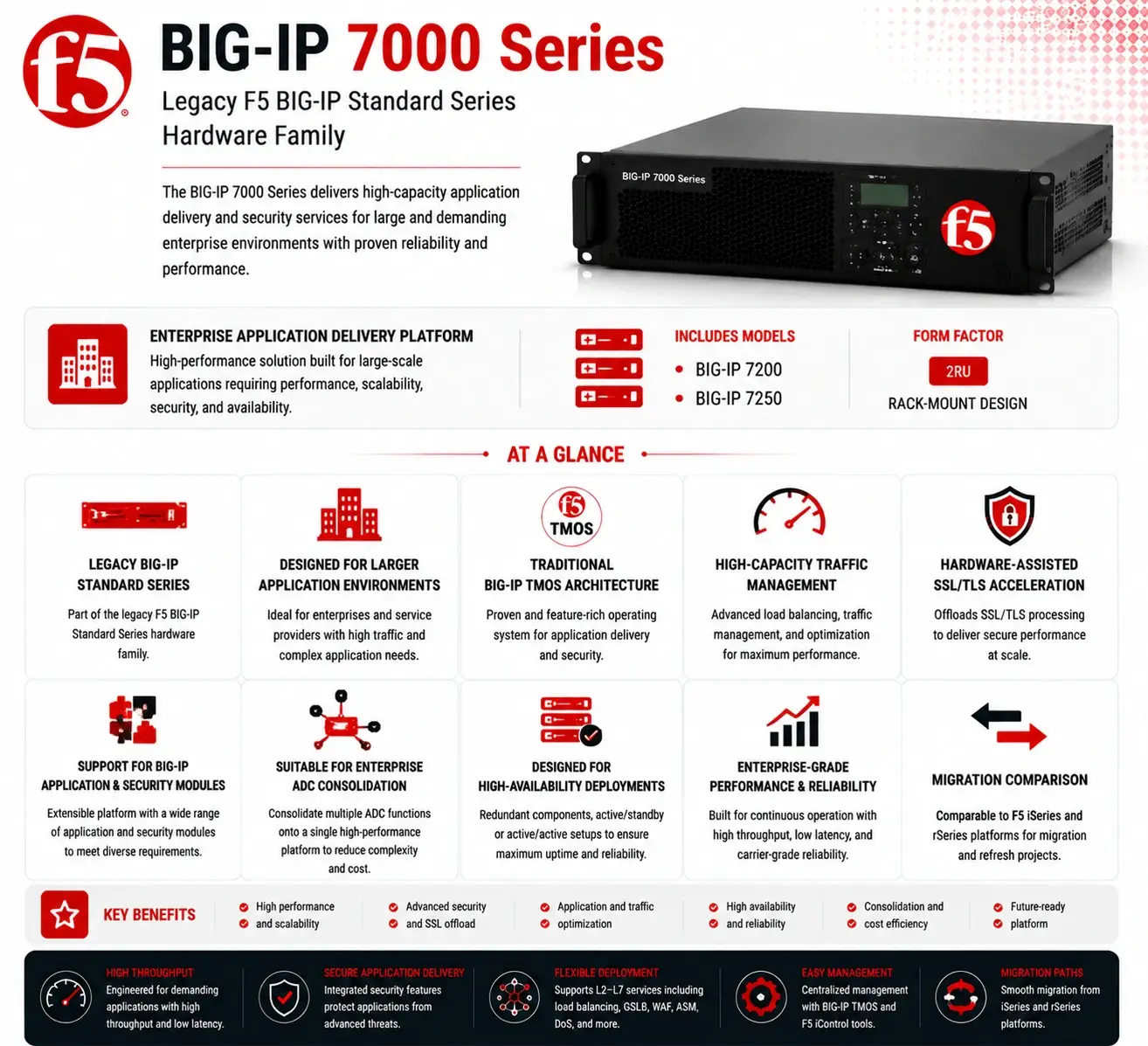
BIG-IP 7000 Series is a legacy F5 Standard Series application delivery platform designed for enterprise environments requiring higher-capacity traffic management, SSL/TLS acceleration, and advanced BIG-IP services. The family includes BIG-IP 7200 and BIG-IP 7250 models, providing increased performance compared with lower Standard Series platforms such as BIG-IP 4000 and BIG-IP 5000 families. These appliances were commonly deployed in enterprise data centers where organizations needed a dedicated ADC platform capable of handling larger application workloads and multiple BIG-IP modules.
Series Highlights
- Legacy F5 BIG-IP Standard Series hardware family
- Includes BIG-IP 7200 and BIG-IP 7250 models
- Enterprise application delivery platform
- Designed for larger application environments
- Traditional BIG-IP TMOS architecture
- High-capacity traffic management capabilities
- Hardware-assisted SSL/TLS acceleration
- Support for BIG-IP application and security modules
- Suitable for enterprise ADC consolidation
- Designed for high-availability deployments
- Migration comparison: F5 iSeries and rSeries platforms
Review BIG-IP 7000 Series Price List and request a quote tailored to your licensing needs.
BIG-IP 7000 Series At a glance
What it is: Enterprise F5 physical application delivery platform
Product family: BIG-IP Standard Series
Models: BIG-IP 7200 and BIG-IP 7250
Software architecture: BIG-IP TMOS
Deployment type: Physical ADC appliance
Typical role: Application load balancing, SSL/TLS offload, application security, traffic management, and application availability
Series Overview
The BIG-IP 7000 Series was designed for organizations that required more application delivery capacity than lower Standard Series platforms could provide. As application environments became more complex, enterprises needed ADC platforms capable of handling increasing traffic volumes, encrypted connections, and additional application services. The BIG-IP 7000 Series addressed these requirements by providing a higher-performance hardware platform while maintaining the familiar BIG-IP TMOS operating model.
The family includes:
| Model | Position |
|---|---|
| BIG-IP 7200 | Enterprise performance configuration |
| BIG-IP 7250 | Higher-capacity configuration |
The BIG-IP 7250 provided additional performance capability compared with the 7200 model, making it more suitable for environments with greater application traffic, larger connection volumes, or heavier SSL/TLS processing requirements.
Typical BIG-IP 7000 Series deployments included:
- Enterprise application load balancing
- Web application delivery
- SSL/TLS termination
- Application health monitoring
- Secure application access
- Traffic optimization
- High-availability ADC environments
Licensing and Part Number Guidance
BIG-IP 7000 Series part numbers represent a complete solution rather than only the hardware chassis. A configuration may include:
- Appliance model
- BIG-IP software license
- Enabled modules
- Support coverage
- Accessories
The selected BIG-IP license determines which services are available on the appliance. Common licensing considerations include:
- LTM for application load balancing
- DNS services for global application traffic management
- APM for secure access scenarios
- Security modules for additional protection capabilities
For existing deployments, the active license configuration is often more important than the appliance name because the same hardware family may support different BIG-IP service combinations.
Common Use Cases
| Use case | Typical BIG-IP 7000 Series role |
|---|---|
| Enterprise ADC | Application traffic distribution |
| SSL/TLS offload | Dedicated encryption processing |
| Web application delivery | Application availability and optimization |
| Secure access | Controlled user and application connectivity |
| Data center infrastructure | Central traffic management |
| Application security | Supported BIG-IP security services |
| HA deployment | Redundant ADC architecture |
| Hardware migration | Transition toward newer F5 platforms |
Models, Licenses, and Ordering Scope
| Area | What to confirm |
|---|---|
| Model | BIG-IP 7200 or BIG-IP 7250 |
| Platform family | BIG-IP Standard Series |
| BIG-IP services | LTM, DNS, APM, security modules |
| Performance | Throughput, connections, SSL demand |
| Software | TMOS compatibility |
| Network design | Current interface requirements |
| Deployment | Standalone or HA pair |
| Support | Renewal or replacement requirements |
| Migration | Future platform planning |
| Part numbers | Hardware, software, support, accessories |
What to Check Before Requesting a Quote
When preparing a BIG-IP 7000 Series request, start by understanding the current production environment.
Important information includes:
- Existing hardware model
- Enabled BIG-IP modules
- Application count
- Peak traffic volume
- SSL/TLS requirements
- Connection requirements
- Availability design
- Expected growth
A common issue during ADC refresh projects is assuming that a new appliance can be selected through direct model replacement. F5 platform generations use different architectures, and newer systems may handle resources differently. For example, an existing BIG-IP 7250 running multiple security modules may require a different migration approach compared with a system used only for basic load balancing.
Before finalizing a quote, consider:
- Configuration migration
- Software compatibility
- License transfer
- Application testing
- Maintenance planning
- Rollback requirements
Activation and Delivery Notes
BIG-IP 7000 Series uses the traditional F5 TMOS appliance architecture. The deployment process normally includes:
- Physical installation
- License activation
- Module provisioning
- Network configuration
- Application policy deployment
- High-availability validation
Unlike modern F5 rSeries platforms, BIG-IP 7000 Series does not use F5OS or tenant-based deployment. Organizations migrating from this generation should plan carefully because newer platforms introduce different resource allocation and operational models.
Before delivery or replacement, confirm:
- Appliance model
- Required modules
- Support requirements
- Network connectivity
- Migration strategy