

Ransomware Protection is a cybersecurity capability designed to help organizations prevent, detect, and respond to ransomware attacks before they cause significant operational damage. As ransomware continues to evolve beyond simple file encryption into data theft, lateral movement, and double-extortion attacks, organizations need endpoint security controls that can identify suspicious behavior and respond quickly.
Within the ManageEngine ecosystem, ManageEngine Ransomware Protection is delivered through endpoint security and management capabilities, particularly through Endpoint Central, helping organizations strengthen endpoint defenses, monitor suspicious activity, and reduce the risk of ransomware infections spreading across their environments.
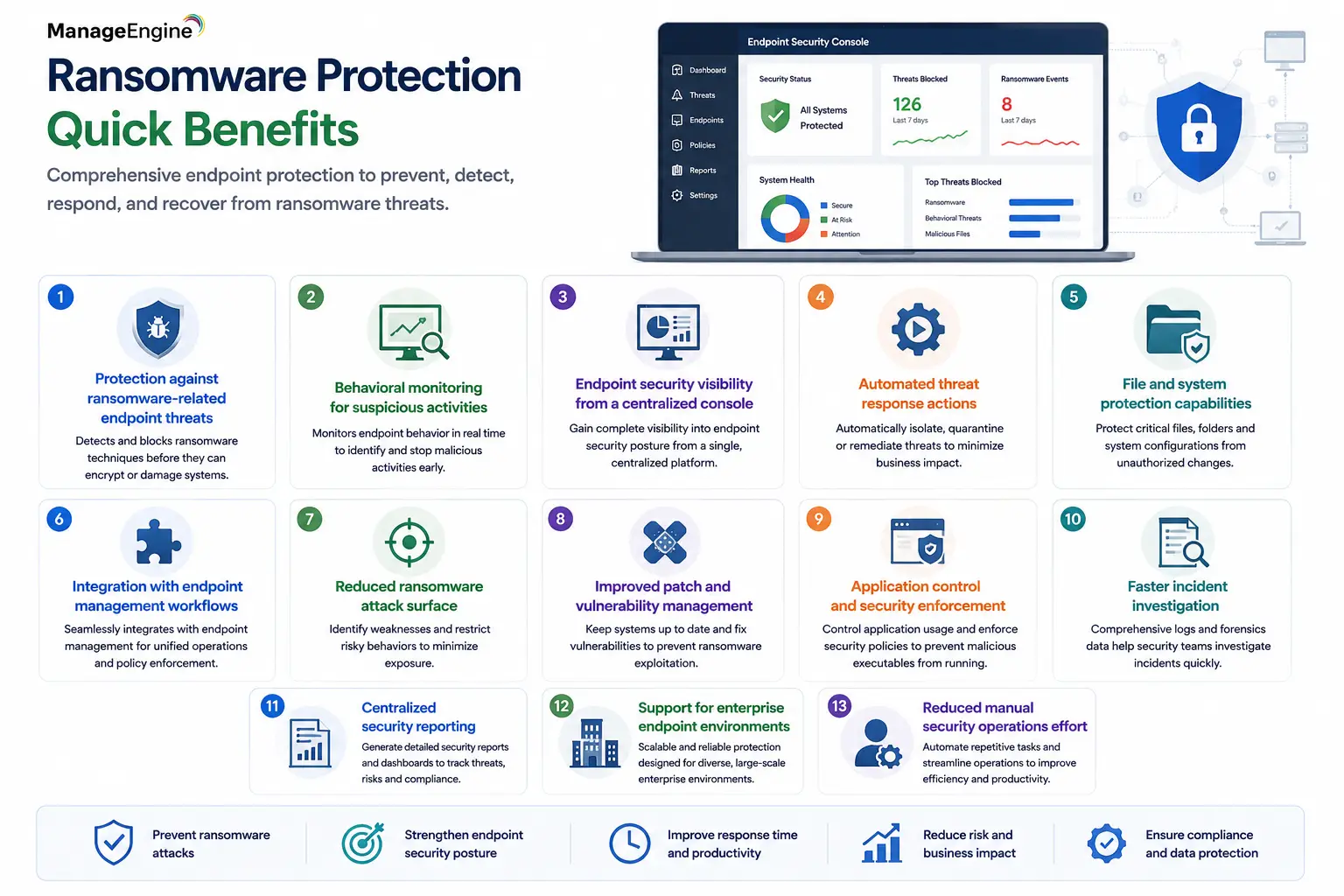
Quick Benefits
- Protection against ransomware-related endpoint threats
- Behavioral monitoring for suspicious activities
- Endpoint security visibility from a centralized console
- Automated threat response actions
- File and system protection capabilities
- Integration with endpoint management workflows
- Reduced ransomware attack surface
- Improved patch and vulnerability management
- Application control and security enforcement
- Faster incident investigation
- Centralized security reporting
- Support for enterprise endpoint environments
- Reduced manual security operations effort
Ransomware Protection At a Glance
What it is: Endpoint-focused ransomware prevention and response capability
ManageEngine solution: ManageEngine Ransomware Protection
Primary platform: Endpoint Central security capabilities
Parent category: ManageEngine License
Primary role: Prevent, detect, and respond to ransomware threats
Main users: IT administrators, endpoint security teams, SOC analysts, and system administrators
Security focus: Endpoint behavior, malicious activity detection, prevention, and response
Deployment: Enterprise endpoint management environment
Protected assets: Workstations, laptops, servers, and managed endpoints
Licensing factors: Endpoints, users, modules, and security requirements

License Overview
A ManageEngine Ransomware Protection license is typically evaluated according to the number of endpoints that require protection and the level of endpoint management and security capabilities needed.
Unlike traditional security products that may only focus on malware signatures, ransomware protection requires multiple layers of defense. Organizations should consider endpoint count, operating systems, security policies, automation requirements, and existing endpoint-management capabilities when planning licensing.
For smaller environments, ransomware protection may be included as part of broader endpoint management requirements. Larger organizations may require additional endpoint controls, reporting, automation, and integration with security operations processes.
The correct licensing approach depends on whether the organization needs basic ransomware prevention or a broader endpoint security and management strategy.
Product Overview
Endpoint-Based Ransomware Defense
Ransomware attacks typically target endpoints because users interact with email attachments, downloaded files, websites, and applications every day.
A single compromised workstation can become the starting point for a larger attack if security controls do not detect suspicious behavior quickly.
ManageEngine Ransomware Protection focuses on strengthening endpoint security by combining prevention techniques with monitoring and management capabilities.
Instead of relying only on detecting known ransomware files, modern protection strategies analyze suspicious activities such as unauthorized encryption behavior, abnormal file changes, and unusual application actions.
Behavioral Detection and Prevention
Traditional malware protection relies heavily on identifying known threats. However, ransomware attackers frequently modify their techniques to bypass traditional detection methods.
Behavior-based protection helps identify activities that resemble ransomware behavior even when the specific malware variant has not been previously identified.
This approach allows security teams to respond to suspicious activity earlier and reduce the impact of emerging ransomware campaigns.
Endpoint Management Integration
Effective ransomware protection is closely connected with endpoint management. Unpatched operating systems, outdated applications, excessive privileges, and unmanaged software increase ransomware risk.
Because ManageEngine Ransomware Protection works within the broader ManageEngine endpoint-management ecosystem, organizations can combine security protection with operational controls such as patch management, software deployment, configuration enforcement, and device visibility. This creates a stronger security posture by addressing both active threats and the weaknesses that allow ransomware attacks to succeed.
How ManageEngine Ransomware Protection Works
The protection process begins by monitoring managed endpoints and collecting security-related activity information.
When suspicious behavior is identified, the platform evaluates the activity against configured security policies and response rules.
Depending on the detected risk, administrators can investigate the event, isolate affected systems, restrict applications, or apply remediation actions.
The centralized management approach allows security teams to maintain consistent ransomware protection policies across large numbers of devices.
For enterprise environments, this reduces the challenge of manually configuring security settings on every workstation or server.
Core Technical Flow
User Endpoint Activity
→ File / Application / System Behavior Monitoring
→ Suspicious Activity Detection
→ Security Policy Evaluation
→ Automated Response or Administrator Action
→ Incident Investigation and Reporting
→ Endpoint Security Improvement
The objective is to identify ransomware behavior early and limit the ability of threats to spread.
Options and Licensing Models
| Licensing Factor | Description | Suitable For |
|---|---|---|
| Managed Endpoints | Number of computers, laptops, and servers requiring protection | Organizations with different endpoint sizes |
| Security Modules | Additional endpoint security capabilities and controls | Businesses requiring broader protection |
| User Coverage | Number of users operating protected devices | Environments with shared devices or multiple users |
| Management Platform Integration | Use with Endpoint Central and related capabilities | Organizations seeking unified endpoint management |
| Reporting Requirements | Security reports, alerts, and compliance visibility | Enterprises requiring operational tracking |
| Deployment Scale | Number of locations and distributed endpoints | Multi-site organizations |
The final licensing requirement depends on whether ransomware protection is deployed as a standalone security capability or as part of a wider ManageEngine endpoint management strategy.
Features and Benefits
The main advantage of ManageEngine Ransomware Protection is combining security controls with endpoint management visibility.
Ransomware prevention is not only about blocking malicious files. Organizations also need to understand endpoint status, software exposure, user behavior, and configuration weaknesses.
By connecting security and endpoint administration, IT teams can improve their response process.
For example, if ransomware activity is detected on a device, administrators can quickly identify the affected endpoint, review its configuration, check installed software, and apply remediation actions.
Another important benefit is operational consistency. Large organizations often manage thousands of endpoints across different locations. Centralized policies allow security teams to apply protection standards without relying on manual configuration.
Compatibility and Requirements
Before deploying ManageEngine Ransomware Protection, organizations should evaluate:
- Number of managed endpoints
- Supported operating systems
- Existing endpoint security products
- Patch management processes
- Application control requirements
- Security monitoring workflows
- Compliance requirements
- Incident response procedures
Organizations should also review existing antivirus or endpoint detection platforms to avoid unnecessary overlap. A ransomware protection strategy works best when combined with strong identity controls, regular patching, backup processes, and user security awareness.
How Activation and Deployment Work
Deployment begins by enabling the required ransomware protection capabilities within the ManageEngine endpoint-management environment.
After activation, administrators define security policies, identify protected devices, and configure monitoring settings.
A phased rollout is usually recommended. Organizations can begin with a test group of endpoints, review detection behavior, adjust policies, and then expand protection across the wider environment.
After deployment, security teams should continuously review alerts, update policies, and evaluate endpoint exposure.
Ransomware protection is not a one-time configuration task. It requires ongoing monitoring as attackers continue changing their techniques.
Pricing and Quote Process
Pricing for a ManageEngine Ransomware Protection license depends mainly on endpoint coverage and required security capabilities.
For an accurate quote, organizations should provide:
- Number of protected endpoints
- Desktop and server count
- Existing endpoint security products
- Required management capabilities
- Reporting requirements
- Deployment environment
Organizations should also consider future growth. Endpoint numbers typically increase over time, especially in distributed enterprises and organizations adopting remote work models. The best licensing approach is one that provides enough protection capacity without creating unnecessary security-management complexity.
ManageEngine pricing depends on your license edition, users, devices, deployment model, term, and support needs.