

GFI MailEssentials is an email security solution designed to protect business communication from spam, phishing attempts, malware, and unwanted messages. A GFI MailEssentials License helps organizations improve email protection through filtering, threat detection, and centralized email security management.
Quick Benefits
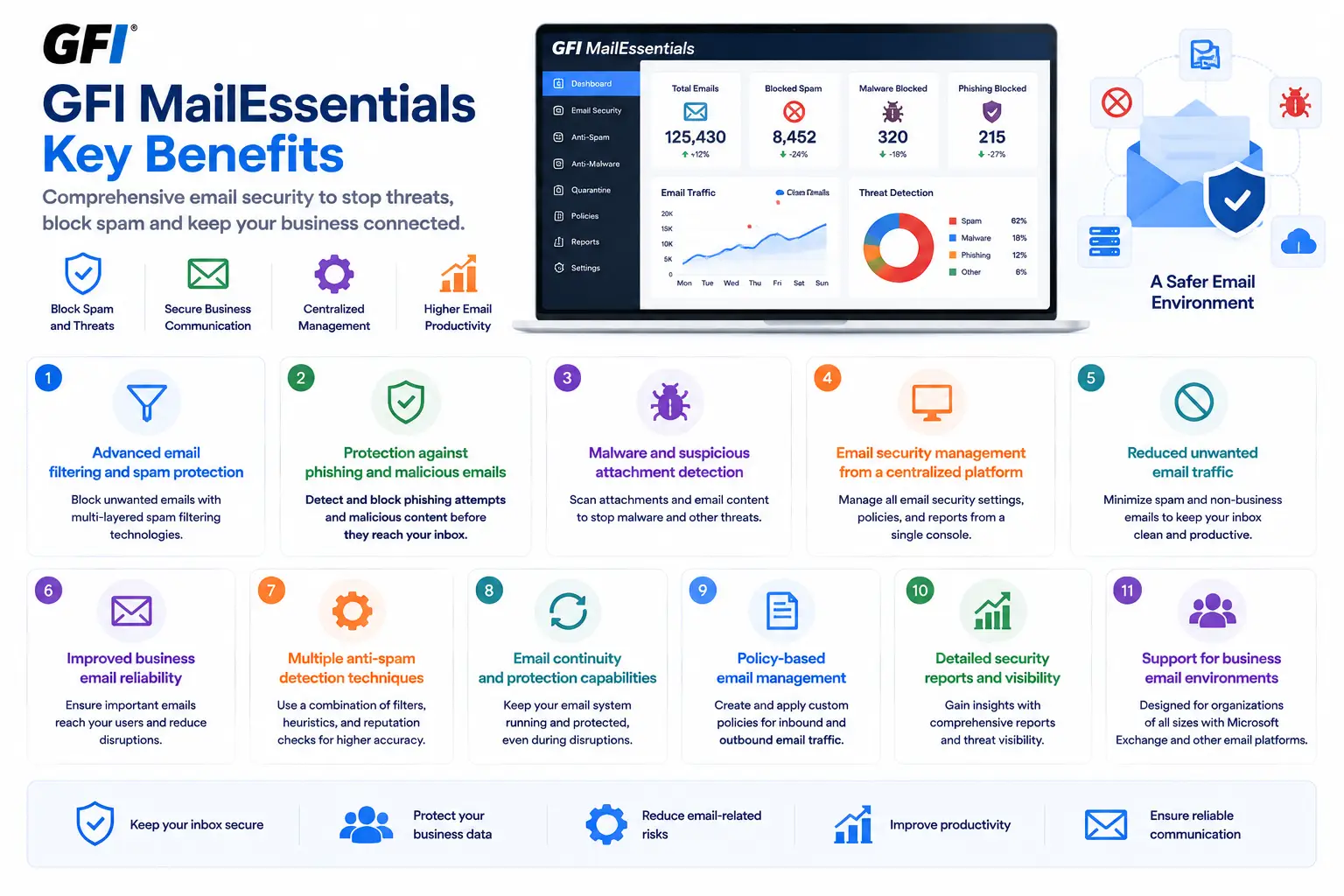
- Advanced email filtering and spam protection
- Protection against phishing and malicious emails
- Malware and suspicious attachment detection
- Email security management from a centralized platform
- Reduced unwanted email traffic
- Improved business email reliability
- Multiple anti-spam detection techniques
- Email continuity and protection capabilities
- Policy-based email management
- Detailed security reports and visibility
- Support for business email environments
- Reduced administrative effort for email security teams
GFI MailEssentials At a Glance
What it is: Business email security and anti-spam protection platform
Vendor: GFI Software
Parent category: GFI License
Primary role: Protect email systems from spam, malware, phishing, and unwanted communication
Main users: IT administrators, security teams, email administrators, and organizations managing business email systems
Core capabilities: Anti-spam filtering, email threat detection, policy management, reporting, and email protection
Supported environments: Business email infrastructures and supported mail servers
Deployment: On-premises and supported hosted email environments depending on configuration
Licensing factors: Users, mailboxes, email accounts, and deployment requirements
Typical environments: SMBs, enterprises, regulated organizations, and businesses requiring secure email communication
License Overview
A GFI MailEssentials License is primarily determined by the number of users or mailboxes that require email protection. Since the product focuses on securing business communication, licensing is usually aligned with the scale of the organization’s email environment rather than the number of physical devices.
Organizations should evaluate the total number of protected email accounts, mailboxes, domains, and expected email growth when selecting a license capacity. A small business with a limited number of users may require a smaller deployment, while larger enterprises may need broader coverage across multiple departments, domains, or locations.
The required license can also depend on deployment architecture, including the type of mail server environment, security requirements, and additional protection capabilities. Correct sizing ensures that all business email accounts are protected without purchasing unnecessary capacity. For organizations operating in industries where email security and compliance are critical, licensing decisions should also consider reporting requirements, retention needs, and integration with existing security workflows.
Product Overview
Email Threat Protection
Email remains one of the most common attack channels used by cybercriminals. Phishing campaigns, malicious attachments, and spam messages can expose organizations to data theft, malware infections, and business disruption. GFI MailEssentials provides multiple layers of email protection designed to identify and block unwanted or dangerous messages before they reach user inboxes. By filtering incoming communication before delivery, organizations can reduce exposure to common email-based threats while improving overall email security.
Anti-Spam Filtering
Spam continues to create operational challenges by consuming user time, increasing email storage requirements, and creating opportunities for malicious content delivery. GFI MailEssentials uses multiple filtering methods to analyze incoming messages and identify unwanted communication. The solution can evaluate sender reputation, message characteristics, content patterns, and other indicators to improve spam detection accuracy. This layered approach helps organizations reduce false positives while maintaining stronger protection against unwanted email traffic.
Phishing and Malware Protection
Modern email attacks often attempt to imitate trusted organizations or employees to steal credentials and sensitive information. GFI MailEssentials helps identify suspicious messages and reduce the likelihood of users interacting with malicious content. Protection against dangerous attachments, suspicious links, and known malicious patterns helps organizations strengthen their email security posture. For businesses where email is a primary communication channel, these protections are essential for reducing social engineering risks.
Core Technical Flow
Incoming Email Traffic
→ GFI MailEssentials Filtering Engine
→ Spam / Malware / Policy Analysis
→ Security Decision and Filtering Action
→ Approved Email Delivery
→ Reports and Administrative Monitoring
Options and Licensing Models
| Licensing Factor | Description | Suitable For |
|---|---|---|
| Protected Users | Number of users requiring email security protection | Organizations with different email sizes |
| Mailboxes | Number of business mailboxes covered by the solution | Companies managing employee email accounts |
| Email Domains | Number of domains protected by the deployment | Organizations with multiple business domains |
| Security Features | Additional protection capabilities and modules | Businesses requiring advanced email defense |
| Deployment Model | On-premises or hosted email security deployment | Different infrastructure architectures |
| Support and Maintenance | Product updates and technical assistance | Long-term production environments |
The appropriate licensing model depends on the organization’s email architecture, number of protected accounts, and required security capabilities.
Features and Benefits
GFI MailEssentials helps organizations improve email security by providing a structured defense layer between external email traffic and employee inboxes. Instead of relying only on basic mail server filtering, businesses can apply additional security controls designed specifically for spam reduction, phishing prevention, and malicious content detection.
One of the main benefits of the platform is reducing the workload placed on IT teams. Without dedicated email filtering, administrators often spend significant time investigating spam issues, managing unwanted messages, and responding to user reports. Centralized filtering and reporting simplify these tasks.
The solution also supports better security awareness by providing visibility into email threats and helping organizations understand common attack patterns targeting their users. For businesses that depend heavily on email communication, improving email reliability and reducing malicious messages can directly improve productivity and reduce security risks.
Compatibility and Requirements
Before deploying GFI MailEssentials, organizations should evaluate their current email infrastructure and security requirements.
Important considerations include:
- Existing mail server environment
- Number of protected users and mailboxes
- Email traffic volume
- Required filtering policies
- Security and compliance requirements
- Integration with existing email systems
GFI MailEssentials is designed for business email environments and should be planned according to the organization’s mail architecture. Organizations should also review existing email security solutions to avoid unnecessary overlap and ensure that filtering responsibilities are clearly defined.
Activation and Deployment
GFI MailEssentials deployment begins with activating the purchased license and preparing the email environment for integration.
Typical deployment steps include:
- License registration and activation
- Installation and initial configuration
- Connecting the email environment
- Defining security policies
- Testing email filtering rules
Organizations usually begin with monitoring and policy configuration before enforcing stricter filtering rules. This approach helps reduce disruption and ensures that legitimate business emails are not incorrectly blocked.
Pricing and Quote Process
Pricing for a GFI MailEssentials License depends mainly on the number of protected users, mailboxes, email domains, and required security capabilities.
Before requesting a quote, organizations should define:
- Number of email users
- Number of mailboxes
- Email platform architecture
- Required security features
- Deployment method
- Support and maintenance requirements
Accurate information helps determine the appropriate license capacity and ensures that email protection covers the entire business environment. Organizations should also consider future growth because additional employees, departments, or business domains may increase email security requirements over time.
GFI pricing depends on your product edition, security solution, license term, deployment model, user requirements, and support needs.