

GFI MailArchiver is an email archiving solution designed to help organizations securely store, manage, search, and retrieve business email communications. A GFI MailArchiver License enables companies to improve email retention, compliance readiness, and long-term access to business correspondence.
Quick Benefits
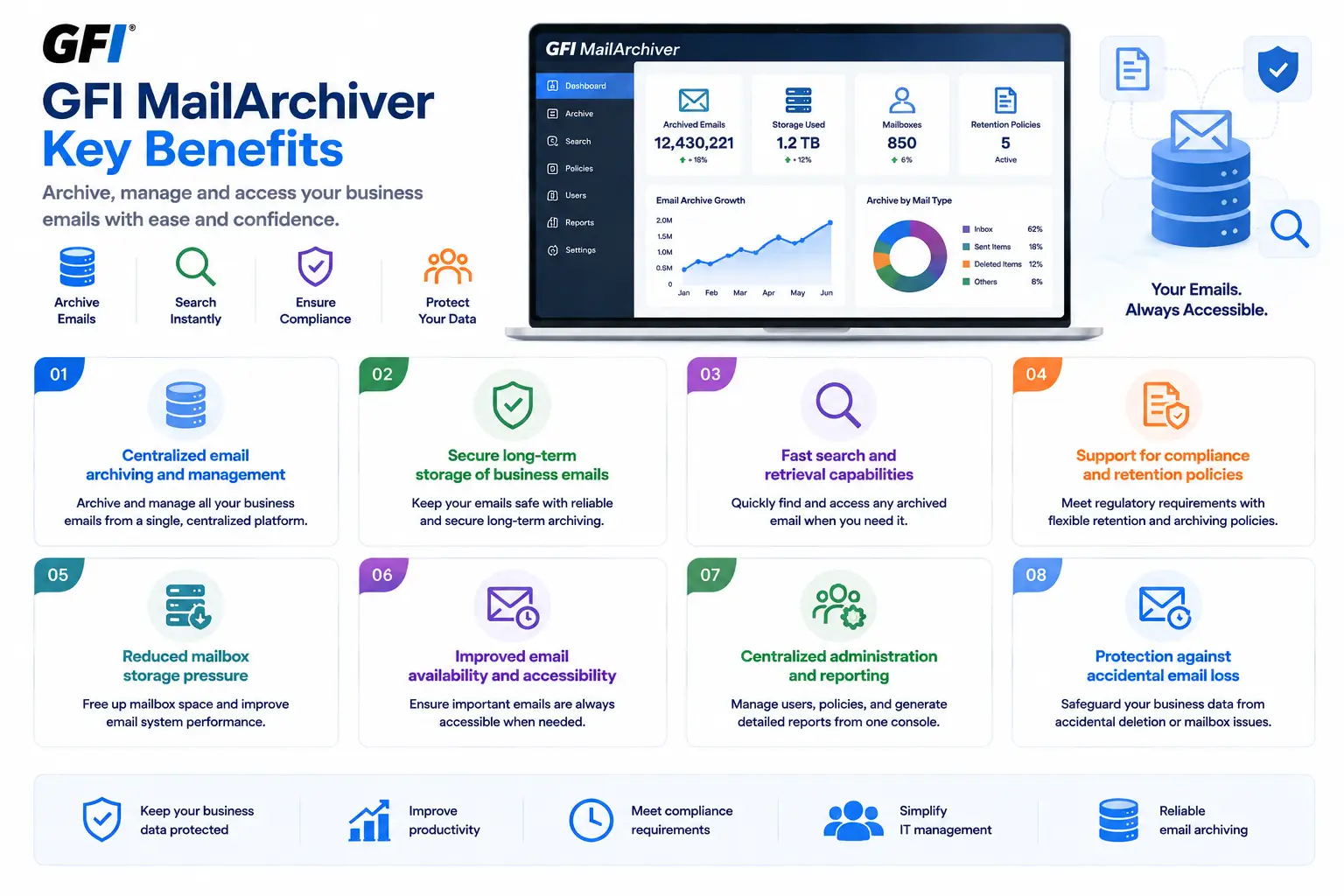
- Centralized email archiving and management
- Secure long-term storage of business emails
- Fast search and retrieval capabilities
- Support for compliance and retention policies
- Reduced mailbox storage pressure
- Improved email availability and accessibility
- Centralized administration and reporting
- Protection against accidental email loss
GFI MailArchiver At a Glance
What it is: Email archiving and management platform
Parent category: GFI License
Primary role: Store, manage, search, and retain business email communications
Main users: IT administrators, compliance teams, legal departments, and organizations managing business email records
Core capabilities: Email capture, indexing, search, retention management, reporting, and archive access
Supported environments: Business email infrastructures and supported mail platforms
Deployment: On-premises and supported hosted environments depending on configuration
License Overview
A GFI MailArchiver License is generally determined by the number of users or mailboxes whose email communication needs to be archived and managed. Since email archiving focuses on preserving business communication records, licensing is typically aligned with protected email accounts rather than physical devices.
Organizations should evaluate the number of active mailboxes, expected email volume, retention requirements, and storage planning before selecting a license. Businesses with a small number of users may require a limited archive scope, while larger organizations may need broader coverage across multiple departments, domains, or locations.
The licensing requirement can also be influenced by compliance requirements, archive retention periods, search needs, and integration with existing email platforms. Organizations operating under regulatory obligations should carefully evaluate how long emails must be retained and how quickly archived information needs to be retrieved. Selecting the appropriate GFI MailArchiver License helps maintain sufficient archive capacity while avoiding unnecessary licensing and storage costs.
Product Overview
Centralized Email Archiving
Email remains one of the most important sources of business information. Contracts, customer communication, internal decisions, and operational records are often stored within email systems.
However, relying only on user mailboxes creates challenges related to storage limits, employee turnover, accidental deletion, and difficult information retrieval.
GFI MailArchiver provides a centralized approach to preserving email communication by collecting and storing messages in a controlled archive environment.
This allows organizations to maintain access to historical communication without depending on individual mailbox availability.
Email Search and Retrieval
One of the main challenges with traditional email storage is finding specific information when it is needed.
GFI MailArchiver provides search capabilities that allow authorized users to locate archived messages based on different criteria, helping organizations quickly retrieve important communication records.
This is valuable for internal investigations, customer requests, legal reviews, and compliance activities where historical email access is required.
Instead of manually searching through individual mailboxes, organizations can access archived communication from a centralized system.
Retention and Compliance Management
Many organizations are required to maintain email records for specific periods due to industry regulations, internal policies, or legal requirements.
GFI MailArchiver helps organizations implement structured email retention practices by storing communication records according to defined policies.
This improves governance because email data is managed according to organizational rules instead of being distributed across individual user accounts.
For industries such as finance, healthcare, legal services, and government, controlled email retention can be an important part of information management strategies.
Core Technical Flow
Email Platform
→ GFI MailArchiver Collection Process
→ Email Indexing and Storage
→ Archive Management Database
→ Search / Retrieval / Compliance Access
→ Reporting and Administration
Options and Licensing Models
| Licensing Factor | Description | Suitable For |
|---|---|---|
| Users | Number of employees whose emails are archived | Organizations with different mailbox sizes |
| Mailboxes | Number of email accounts included in archiving | Businesses managing multiple accounts |
| Storage Requirements | Archive capacity based on email volume and retention period | Organizations with long-term retention needs |
| Retention Policies | Duration and rules for keeping archived communication | Compliance-focused environments |
| Deployment Model | On-premises or hosted archive deployment | Different infrastructure strategies |
| Support and Maintenance | Updates, assistance, and ongoing product support | Long-term production environments |
Features and Benefits
GFI MailArchiver helps organizations transform email from an unmanaged communication source into a structured business record. Instead of allowing important messages to remain distributed across individual mailboxes, organizations can maintain centralized control over email storage and access.
One of the primary benefits is improved information availability. When employees leave the organization or messages are accidentally deleted, archived communication remains accessible according to defined retention policies.
The solution also improves operational efficiency by reducing the time required to locate historical emails. IT teams, legal departments, and compliance officers can search archived information without manually reviewing multiple mailboxes.
For organizations with regulatory requirements, centralized email archiving provides better governance and helps demonstrate that communication records are managed consistently.
Compatibility and Requirements
Before deploying GFI MailArchiver, organizations should evaluate their email environment and information-management requirements.
Important considerations include:
- Email platform compatibility
- Number of mailboxes
- Daily email volume
- Retention period requirements
- Storage availability
- Compliance requirements
- User access policies
Organizations should also define who requires access to archived emails and what level of permissions different departments need. Storage planning is particularly important because archive size depends on message volume, attachments, retention periods, and organizational growth.
Activation and Deployment
GFI MailArchiver deployment begins with activating the purchased license and preparing the email environment for archiving.
Typical deployment steps include:
- License registration and activation
- Installation and initial configuration
- Connecting email sources
- Defining retention policies
- Configuring user access and archive settings
Organizations usually begin by configuring archive policies and testing email collection before moving the solution into full production.
Pricing and Quote Process
Pricing for a GFI MailArchiver License depends mainly on the number of users, mailboxes, email volume, storage requirements, and retention policies.
Before requesting a quote, organizations should define:
- Number of archived mailboxes
- Expected email volume
- Required retention period
- Storage requirements
- Deployment model
- Compliance and reporting needs
GFI pricing depends on your product edition, security solution, license term, deployment model, user requirements, and support needs.