

GFI LanGuard is a patch management and vulnerability assessment solution designed to help organizations discover, secure, and maintain endpoints, servers, and network devices from a centralized platform. A GFI LanGuard License enables IT teams to improve security visibility, automate patch deployment, and reduce risks caused by outdated software and missing updates.
Quick Benefits
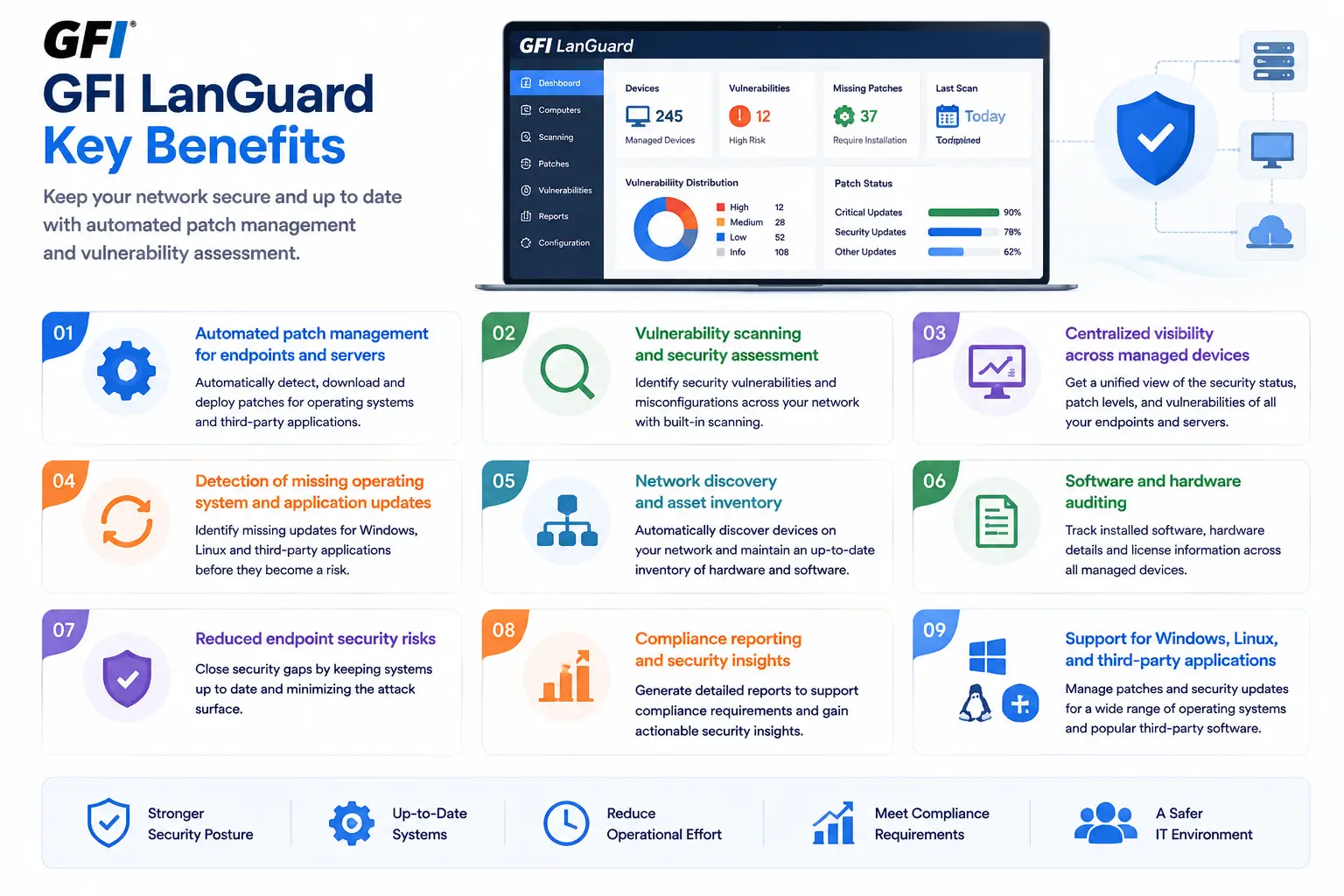
- Automated patch management for endpoints and servers
- Vulnerability scanning and security assessment
- Centralized visibility across managed devices
- Detection of missing operating system and application updates
- Network discovery and asset inventory
- Software and hardware auditing
- Reduced endpoint security risks
- Compliance reporting and security insights
- Support for Windows, Linux, and third-party applications
GFI LanGuard At a Glance
What it is: Patch management and vulnerability assessment platform
Parent category: GFI License
Primary role: Identify vulnerabilities, manage patches, and maintain endpoint security
Main users: IT administrators, security teams, system administrators, and managed service providers
Core capabilities: Network discovery, vulnerability scanning, patch deployment, software auditing, and reporting
Supported environments: Windows, Linux, macOS, servers, workstations, and network devices
License Overview
A GFI LanGuard License is primarily determined by the number of devices or nodes that the organization needs to manage and assess. Unlike user-based licensing models used by some email or collaboration products, GFI LanGuard focuses on the infrastructure resources being monitored, scanned, and maintained.
A managed node may include workstations, servers, virtual machines, and other network-connected systems that require vulnerability assessment or patch management. Organizations should consider their complete asset inventory when estimating licensing requirements because unmanaged systems can represent security gaps even if they are not currently included in daily operations.
The required license size depends on factors such as the number of endpoints, server infrastructure, network complexity, scanning frequency, reporting requirements, and whether the platform will be used internally or by a managed service provider.
For growing organizations, selecting a license with future expansion capacity is important. Adding new employees, servers, remote devices, or branch offices can increase the number of systems that require security assessment and patch management.
Product Overview
Centralized Patch Management
One of the primary purposes of GFI LanGuard is simplifying the process of identifying and deploying missing patches across an organization’s IT environment. Keeping operating systems and applications updated is one of the fundamental requirements of endpoint security. However, manual patch management becomes increasingly difficult as organizations operate hundreds or thousands of devices across multiple locations.
GFI LanGuard provides centralized visibility into missing updates and helps administrators review, approve, and deploy required patches from a single management interface. This allows IT teams to reduce the time required for routine maintenance while improving consistency across managed systems.
Vulnerability Assessment and Security Visibility
Modern security risks often originate from known vulnerabilities that remain unresolved. GFI LanGuard performs vulnerability assessments to identify weaknesses caused by outdated software, missing patches, and insecure configurations. These assessments help organizations understand their security posture and prioritize remediation activities.
Instead of waiting for security incidents to reveal weaknesses, administrators can proactively identify systems that require attention. The platform can also support compliance efforts by providing reports that demonstrate patch status, vulnerability findings, and remediation progress.
Network Discovery and Asset Inventory
Before organizations can protect their infrastructure, they need accurate visibility into what exists on the network. GFI LanGuard includes network discovery capabilities that help identify connected devices and create an inventory of hardware and software assets.
This visibility is valuable because many organizations have systems that are forgotten, incorrectly documented, or managed outside normal processes. By maintaining an updated asset inventory, IT teams can better understand their environment and apply appropriate security policies.
Core Technical Flow
Network Devices and Endpoints
→ Asset Discovery and Inventory Collection
→ Vulnerability and Patch Assessment
→ Patch Approval and Deployment Management
→ Compliance Reports and Security Monitoring
GFI LanGuard creates a continuous management cycle where systems are discovered, assessed, updated, and monitored from a centralized platform.
Options and Licensing Models
| Licensing Factor | Description | Suitable For |
|---|---|---|
| Managed Nodes | Number of endpoints, servers, or devices assessed and managed | Organizations with different infrastructure sizes |
| Endpoint Coverage | Workstations and user devices requiring patch management | Businesses managing employee devices |
| Server Coverage | Servers requiring vulnerability assessment and updates | Data centers and enterprise environments |
| Network Devices | Infrastructure devices included in assessment processes | Organizations requiring broader visibility |
| Subscription Licensing | Time-based access with updates and support options | Organizations preferring predictable costs |
| Maintenance and Support | Product updates, technical support, and ongoing assistance | Long-term deployments |
The correct licensing model depends mainly on the number of systems requiring management. Organizations should include current assets as well as expected infrastructure growth when selecting capacity.
Features and Benefits
GFI LanGuard helps organizations reduce security exposure by creating a structured approach to vulnerability management and patch administration. Instead of relying on manual checks or disconnected tools, IT teams gain centralized visibility into missing updates, vulnerable systems, and remediation progress.
One of the key benefits is operational efficiency. Patch management can consume significant administrative time, especially in environments with multiple locations, remote users, and diverse operating systems. Automation capabilities allow teams to reduce repetitive work while maintaining more consistent security practices.
The platform also supports better security decision-making. By combining asset discovery, vulnerability information, and reporting, organizations can identify high-risk systems and prioritize remediation based on actual exposure. For compliance-focused environments, detailed reports provide evidence that security updates and vulnerability management processes are actively maintained.
Compatibility and Requirements
Before deploying GFI LanGuard, organizations should evaluate their existing infrastructure and security processes.
Important considerations include:
- Number of endpoints and servers
- Supported operating systems
- Network architecture
- Remote device management requirements
- Existing patch management tools
- Compliance reporting needs
- Scanning and deployment policies
GFI LanGuard is commonly deployed in Windows-based management environments and can assess mixed infrastructures containing Windows, Linux, and other supported systems. Organizations should also review whether existing security platforms perform overlapping patch-management functions to avoid unnecessary duplication.
Activation and Deployment
GFI LanGuard deployment begins with activating the purchased license and installing the management platform within the organization’s environment.
A typical deployment process includes:
- License registration and activation
- Initial network discovery
- Adding managed devices
- Configuring scanning policies
- Reviewing vulnerability findings
- Creating patch deployment rules
Pricing and Quote Process
Pricing for a GFI LanGuard License depends mainly on the number of nodes that require vulnerability assessment and patch management.
Before requesting a quote, organizations should define:
- Number of managed endpoints
- Number of servers
- Network device requirements
- Required reporting capabilities
- Deployment scope
- Expected infrastructure growth
GFI pricing depends on your product edition, security solution, license term, deployment model, user requirements, and support needs.