

GFI Help Desk is an IT service management and support solution designed to help organizations organize support requests, manage incidents, and improve communication between users and IT teams. A GFI Help Desk License enables businesses to centralize ticket management, automate support workflows, and improve service delivery.
Quick Benefits
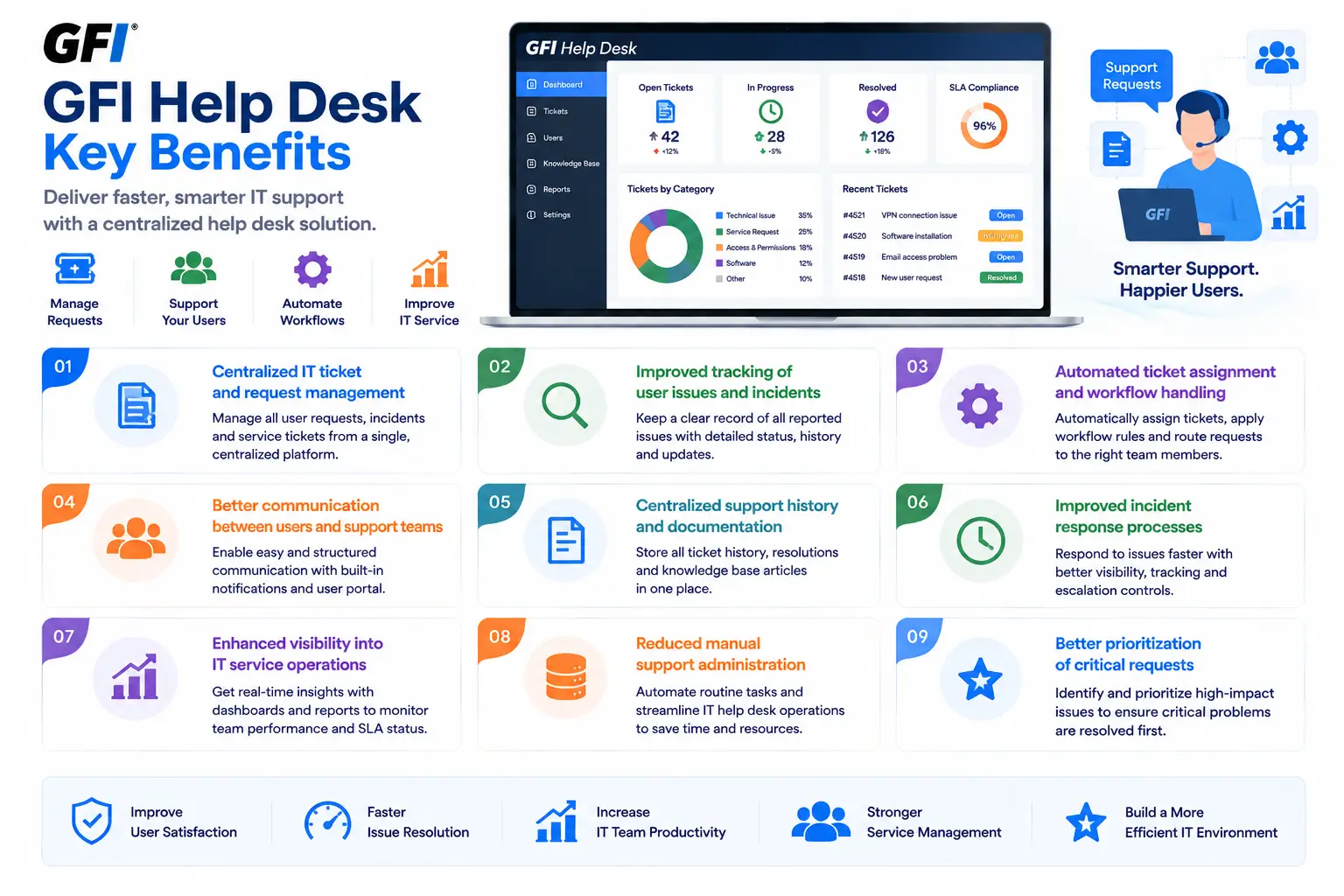
- Centralized IT ticket and request management
- Improved tracking of user issues and incidents
- Automated ticket assignment and workflow handling
- Better communication between users and support teams
- Centralized support history and documentation
- Improved incident response processes
- Enhanced visibility into IT service operations
- Reduced manual support administration
- Better prioritization of critical requests
GFI Help Desk At a Glance
What it is: IT help desk and support management platform
Parent category: GFI License
Primary role: Manage IT support requests, incidents, and service workflows
Main users: IT support teams, help desk technicians, administrators, and service providers
Core capabilities: Ticket management, request tracking, workflow automation, reporting, and user communication
Supported environments: Business IT environments requiring centralized support management
Deployment: Software-based help desk deployment
License Overview
A GFI Help Desk License is generally determined by the size of the support operation, including the number of technicians, agents, users, and service requests managed through the platform. Unlike infrastructure products that are commonly licensed by devices or servers, help desk solutions are usually focused on the people involved in service delivery. Organizations should evaluate the number of support staff, expected ticket volume, user population, and required workflow capabilities when selecting the appropriate license model.
Smaller businesses may require a simple support environment managed by a few technicians, while larger organizations may need broader capabilities for multiple support teams, departments, or customer environments. When planning a GFI Help Desk License, organizations should consider current support requirements as well as future growth. Increasing employee numbers, expanding service operations, or introducing managed support services can affect the required licensing capacity.
Product Overview
Centralized Ticket Management
One of the main challenges for IT teams is managing support requests that arrive through different communication channels. Without a structured system, incidents can be missed, duplicated, or resolved without proper documentation. GFI Help Desk provides a centralized platform where support requests can be recorded, categorized, assigned, and tracked throughout their lifecycle. By maintaining a complete history of incidents and interactions, support teams gain better visibility into recurring problems and improve their ability to deliver consistent service.
Incident and Request Management
IT support teams handle many different types of requests, from technical incidents to service-related questions and access requests. GFI Help Desk helps organizations separate and organize these activities through structured workflows. Tickets can be prioritized based on urgency, assigned to appropriate technicians, and monitored until resolution. This approach improves accountability because every request has a clear status, owner, and resolution history.
Workflow Automation
Manual ticket handling can consume significant time, especially when support teams manage large numbers of requests. GFI Help Desk helps automate repetitive support processes by allowing organizations to define rules for ticket routing, notifications, and escalation. Automation improves response consistency and allows technicians to focus more on solving technical issues rather than administrative tasks.
Core Technical Flow
User Request / Incident Submission
→ GFI Help Desk Ticket Creation
→ Classification and Prioritization
→ Technician Assignment and Workflow Processing
→ Resolution and Communication
→ Reporting and Service Improvement
The platform creates a structured support lifecycle where requests are captured, managed, resolved, and analyzed.
Options and Licensing Models
| Licensing Factor | Description | Suitable For |
|---|---|---|
| Technicians / Agents | Number of support staff managing tickets | Internal IT teams and service desks |
| Users / Requesters | Number of employees submitting support requests | Organizations with different user populations |
| Ticket Volume | Number of incidents and requests processed | High-volume support environments |
| Workflow Requirements | Automation, escalation, and approval needs | Organizations with structured IT processes |
| Reporting Requirements | Service metrics and operational analysis | Teams requiring performance visibility |
| Support and Maintenance | Updates and technical assistance | Long-term production environments |
Features and Benefits
GFI Help Desk helps organizations transform support operations from informal communication channels into structured service processes. Instead of managing requests through emails, phone calls, or disconnected conversations, IT teams can maintain a centralized record of every issue and interaction.
A major benefit is improved operational efficiency. Technicians can quickly understand request history, prioritize important issues, and collaborate more effectively because all relevant information is available in one location.
The platform also improves service quality by creating accountability. Managers can review response times, identify recurring issues, and optimize support workflows based on real operational data.
For organizations that provide internal or external IT support, centralized ticket management creates a more predictable and measurable support experience.
Compatibility and Requirements
Before deploying GFI Help Desk, organizations should evaluate their support environment and operational requirements.
Important considerations include:
- Number of support technicians
- Number of users submitting requests
- Expected ticket volume
- Existing communication channels
- Workflow requirements
- Reporting and service-level objectives
- Integration needs
Organizations should also define how support requests will enter the system and determine whether existing processes need to be adjusted before deployment. A clear support structure helps ensure that the platform improves service delivery instead of simply replacing existing manual processes.
Activation and Deployment
GFI Help Desk deployment begins with activating the purchased license and preparing the support environment.
Typical deployment steps include:
- License registration and activation
- Platform installation and configuration
- Creating technician accounts
- Defining ticket categories and workflows
- Configuring notifications and reporting
Organizations usually begin with basic ticket management before introducing advanced workflows and automation features.
Pricing and Quote Process
Pricing for a GFI Help Desk License depends mainly on the size of the support operation, including technicians, users, workflow requirements, and service management needs.
Before requesting a quote, organizations should define:
- Number of help desk technicians
- Number of supported users
- Expected ticket volume
- Required automation features
- Reporting requirements
- Deployment and support requirements
Accurate planning helps organizations select a license model that matches their actual support workload. For growing organizations, future expansion should also be considered because additional users, technicians, and service processes can increase licensing requirements over time.
GFI pricing depends on your product edition, security solution, license term, deployment model, user requirements, and support needs.