

Trellix EDR (Endpoint Detection and Response) is an endpoint security solution focused on detecting, investigating, and responding to advanced cyber threats through continuous endpoint monitoring and behavioral analysis. Unlike traditional endpoint protection solutions that mainly prevent attacks, Trellix EDR provides security teams with deeper visibility into suspicious activities, attack patterns, and incident timelines.
Quick Benefits
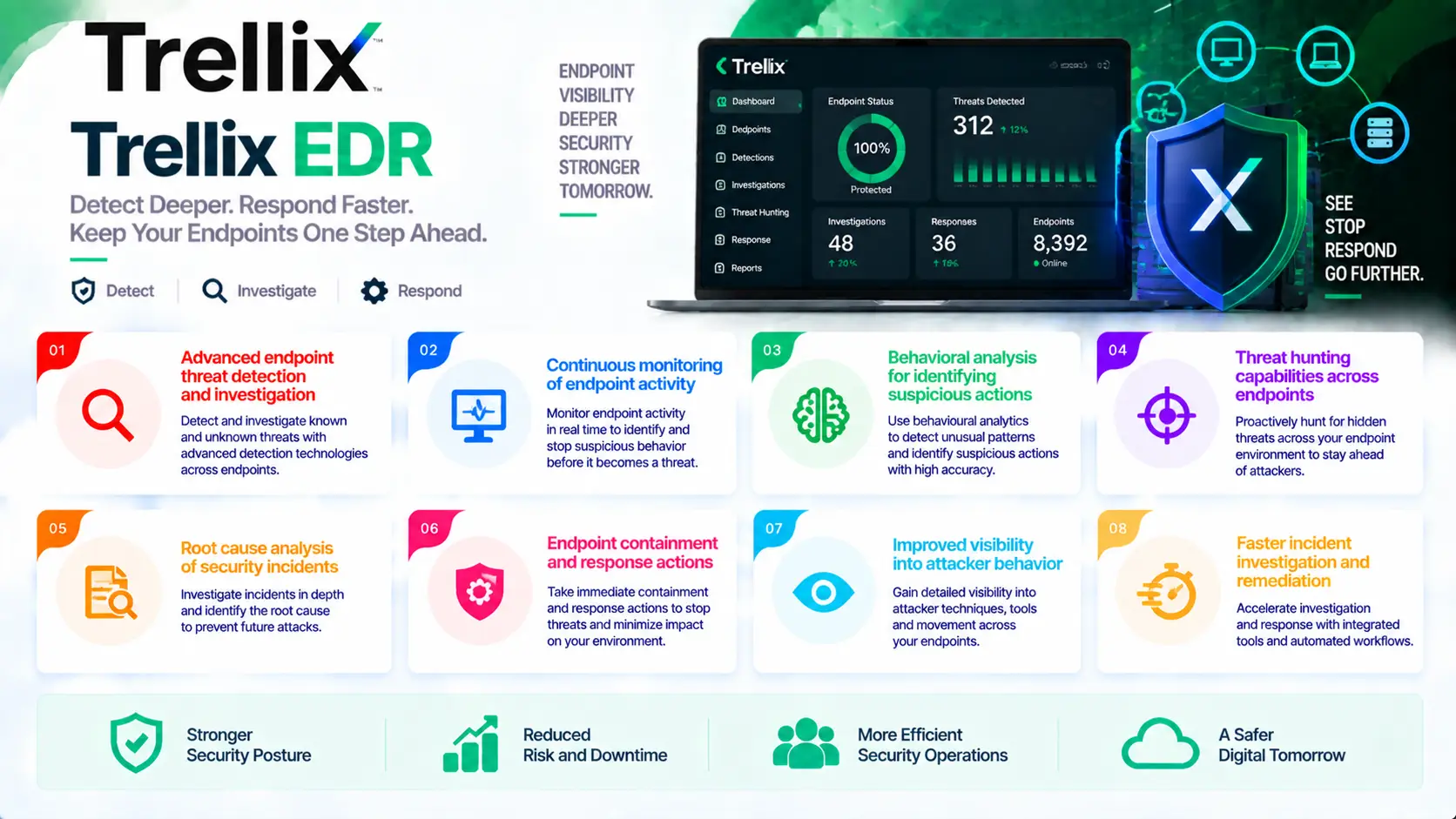
- Advanced endpoint threat detection and investigation
- Continuous monitoring of endpoint activity
- Behavioral analysis for identifying suspicious actions
- Threat hunting capabilities across endpoints
- Root cause analysis of security incidents
- Endpoint containment and response actions
- Improved visibility into attacker behavior
- Faster incident investigation and remediation
Trellix EDR At a Glance
What it is: Endpoint Detection and Response Platform
Product name: Trellix Endpoint Detection and Response (EDR)
Parent category: Trellix License
Primary role: Detect, investigate, and respond to advanced endpoint threats
Solution category: Endpoint Detection and Response (EDR)
Management platform: Trellix security management platform and supported XDR ecosystem
Protected assets: Workstations, laptops, servers, and enterprise endpoints
Deployment model: Cloud-based, on-premises, and hybrid environments

License Overview
A Trellix EDR License provides organizations with the capabilities required to detect, investigate, and respond to suspicious endpoint activity. While endpoint protection platforms focus primarily on preventing threats, EDR solutions concentrate on understanding what happened during an attack and providing security teams with the information needed for response.
The licensing structure is generally based on the number of protected endpoints, required telemetry collection, data retention periods, integrations, and selected response capabilities. Organizations with large endpoint environments or advanced SOC operations may require broader visibility and longer investigation history.
When evaluating a Trellix EDR License, businesses should consider their current security maturity, incident response processes, and existing endpoint protection technologies. EDR is often deployed alongside endpoint prevention solutions such as Trellix ENS to create a layered security approach.
For security teams, the value of EDR comes from visibility. Instead of only receiving a blocked threat notification, analysts can investigate attack timelines, identify affected systems, understand attacker techniques, and take appropriate response actions. Proper licensing ensures that organizations collect the required endpoint data without creating unnecessary operational costs.
Product Overview
Endpoint Detection and Investigation
Modern cyberattacks often involve multiple stages, including initial access, privilege escalation, lateral movement, and data compromise.
Traditional endpoint protection may stop some threats but may not provide enough context when attackers use legitimate tools or advanced techniques.
Trellix EDR focuses on collecting endpoint activity data and analyzing behavior to identify suspicious patterns that require investigation.
This allows security teams to understand not only that an event occurred, but also how the activity developed and what systems may have been affected.
Behavioral Threat Detection
Attackers increasingly use techniques that avoid traditional malware detection, such as fileless attacks, credential abuse, and legitimate administrative tools.
Trellix EDR analyzes endpoint behavior to identify abnormal activity that may indicate malicious actions.
By examining processes, user activity, system changes, and communication patterns, the platform helps security teams detect threats that may not be identified through signature-based methods alone.
Threat Hunting Capabilities
Security teams often need to proactively search for signs of compromise rather than waiting for automated alerts.
Trellix EDR provides visibility that supports threat hunting activities by allowing analysts to investigate endpoint behavior, search historical activity, and identify indicators associated with attacks.
This is especially valuable for organizations facing advanced persistent threats or targeted campaigns.
Options and Licensing Models
| Licensing Option | Description | Suitable For |
|---|---|---|
| Endpoint-Based Subscription | Licensing based on the number of protected endpoints | Organizations requiring endpoint visibility |
| EDR Analytics Capability | Provides behavioral analysis and investigation features | SOC teams investigating advanced threats |
| Extended Data Retention | Stores endpoint telemetry for longer investigation periods | Organizations requiring historical analysis |
| Threat Hunting Capability | Enables proactive investigation across endpoints | Security teams performing active threat hunting |
| Response Features | Adds endpoint investigation and remediation capabilities | Organizations requiring faster incident response |
| XDR Integration | Connects endpoint intelligence with broader security data | Enterprises building extended detection strategies |
| Multi-Year Subscription | Provides longer-term endpoint security coverage | Enterprise deployments |
The correct Trellix EDR licensing model depends on endpoint quantity, investigation requirements, security operations maturity, and integration needs.
Features and Benefits
Trellix EDR helps organizations improve their ability to identify and respond to threats that bypass traditional prevention mechanisms. By collecting detailed endpoint telemetry and analyzing behavior, it provides security teams with greater visibility into suspicious activity.
One of the primary benefits of EDR is improved incident investigation. Instead of relying only on alerts, analysts can review activity timelines, understand attack progression, and determine the impact of security events.
Trellix EDR also supports proactive security operations through threat hunting capabilities. Security teams can search for indicators of compromise and investigate potential threats before they become larger incidents.
For organizations operating SOC environments, EDR provides valuable context that improves response decisions and reduces the time required to analyze endpoint-related security events.
When combined with endpoint prevention technologies such as Trellix ENS, EDR creates a stronger security approach by covering both prevention and post-detection response.
Compatibility and Requirements
Before deploying Trellix EDR, organizations should evaluate their endpoint environment and security operations requirements.
Important considerations include:
- Number of endpoints
- Supported operating systems
- Endpoint hardware resources
- Existing endpoint security solutions
- Data retention requirements
- SOC workflows
- Integration requirements
- Network connectivity
Organizations should ensure that endpoint telemetry collection aligns with investigation needs and privacy requirements. For large environments, pilot deployment and policy testing can help identify configuration adjustments before full rollout.
Activation and Deployment
Deployment begins after selecting the appropriate Trellix EDR License and preparing endpoint systems.
Typical deployment steps include:
- Activating the Trellix EDR subscription
- Deploying required endpoint components
- Connecting management platforms
- Configuring telemetry collection
- Defining investigation policies
- Testing detection and response workflows
Organizations commonly begin with high-value endpoints or critical systems before expanding coverage across the entire environment.
A phased deployment approach helps security teams validate visibility and response processes.
Pricing and Quote Process
Pricing for Trellix EDR depends mainly on the number of protected endpoints, required capabilities, data retention needs, integrations, and subscription duration.
Before requesting a quote, organizations should define:
- Number of endpoints
- Endpoint operating systems
- Required telemetry retention
- Threat hunting requirements
- SOC integration needs
- Response capabilities
- Subscription term
Trellix pricing depends on your security solution, endpoint coverage, threat protection modules, deployment model, license term, and support requirements.