

Trellix ENS (Endpoint Security) is an enterprise endpoint protection platform designed to defend workstations, servers, and user devices against malware, exploits, ransomware, and advanced cyber threats. By combining multiple endpoint security technologies with centralized management, Trellix ENS helps organizations strengthen endpoint defenses while maintaining visibility and control across their environment.
Quick Benefits
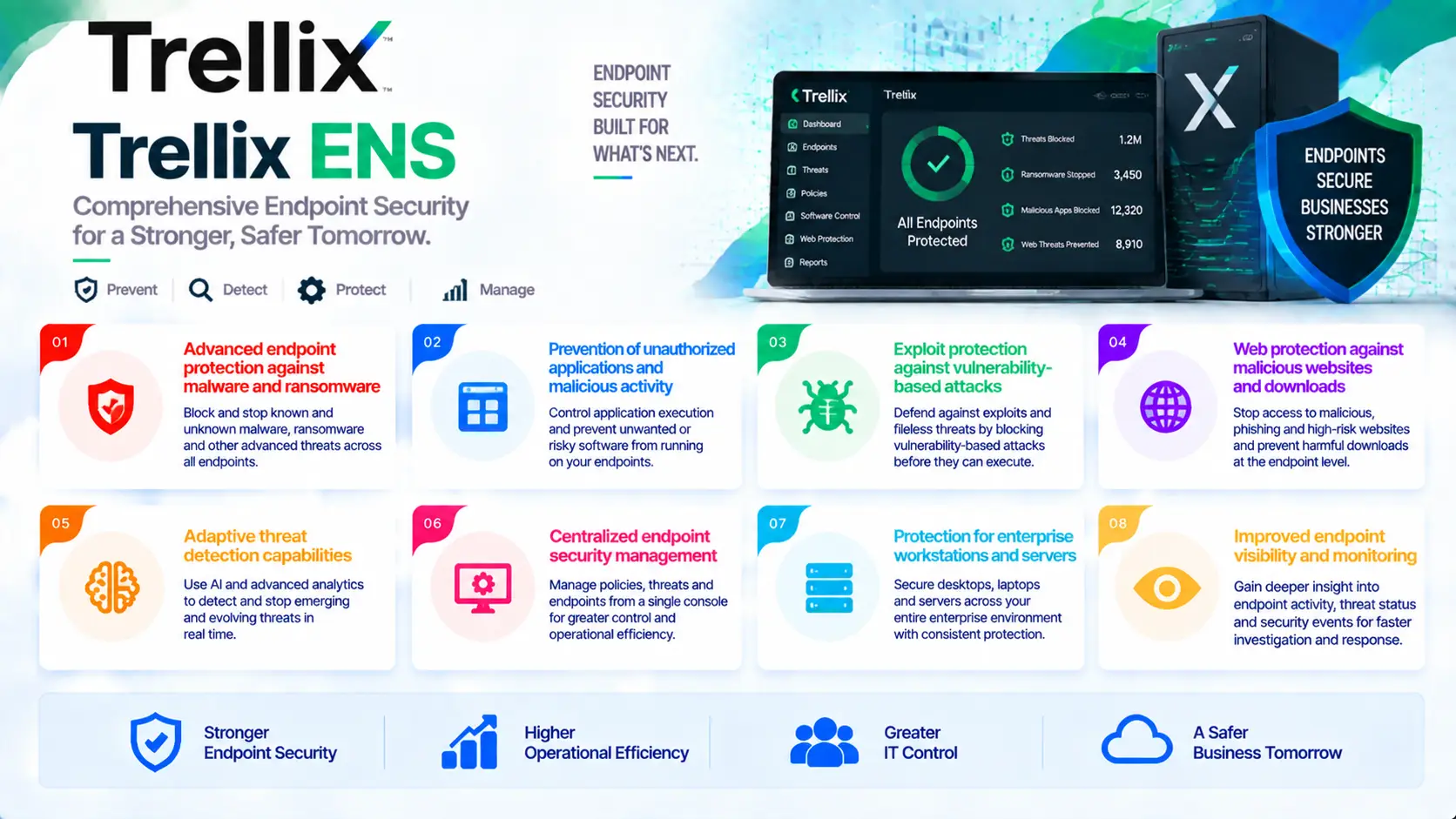
- Advanced endpoint protection against malware and ransomware
- Prevention of unauthorized applications and malicious activity
- Exploit protection against vulnerability-based attacks
- Web protection against malicious websites and downloads
- Adaptive threat detection capabilities
- Centralized endpoint security management
- Protection for enterprise workstations and servers
- Improved endpoint visibility and monitoring
Trellix ENS At a Glance
What it is: Enterprise Endpoint Security Platform
Product name: Trellix Endpoint Security (ENS)
Parent category: Trellix License
Primary role: Protect endpoints against malware, exploits, ransomware, and advanced threats
Solution category: Endpoint Protection Platform (EPP)
Management platform: Trellix ePolicy Orchestrator (ePO)
Protected assets: Workstations, laptops, servers, and enterprise endpoints
Deployment model: On-premises, cloud-managed, and hybrid environments
Security components: Threat Prevention, Firewall, Web Control, Adaptive Threat Protection, and Endpoint Security modules

License Overview
A Trellix ENS License provides access to endpoint security capabilities that protect organizational devices from a wide range of cyber threats. The platform follows a modular approach where organizations can select different endpoint protection components depending on their security requirements.
Unlike traditional antivirus solutions that mainly focus on known malware detection, Trellix ENS combines prevention technologies, behavioral analysis, web protection, and exploit mitigation to address more advanced attack methods.
The licensing model is typically based on the number of protected endpoints, subscription duration, and selected security modules. Organizations deploying ENS across hundreds or thousands of devices should evaluate endpoint types, operating systems, server workloads, and management requirements before selecting the appropriate license scope.
When planning a Trellix ENS License, businesses should consider their existing security architecture and whether they require additional capabilities such as centralized management, adaptive threat protection, or integration with broader Trellix security solutions. A correctly sized license helps organizations maintain consistent endpoint protection without over-provisioning unnecessary features.
Product Overview
Enterprise Endpoint Protection
Endpoints remain one of the most common entry points for cyberattacks. Attackers frequently target employee devices, servers, and unmanaged applications to gain access to business environments.
Trellix ENS provides multiple layers of endpoint protection designed to prevent malicious activity before it impacts systems.
The platform combines prevention, detection, and security control capabilities to help organizations protect critical devices across their infrastructure.
Threat Prevention and Malware Protection
Trellix ENS Threat Prevention capabilities help identify and block malicious files, suspicious processes, and harmful activities before they can compromise endpoints.
Instead of relying only on traditional malware signatures, the platform uses multiple detection techniques to identify known and emerging threats.
This helps organizations reduce exposure to malware campaigns, ransomware attempts, and unauthorized software execution.
Exploit Protection and Vulnerability Defense
Many modern attacks target software vulnerabilities rather than relying only on malicious files.
Trellix ENS provides exploit protection capabilities designed to detect and prevent suspicious behavior associated with vulnerability exploitation.
This adds an additional security layer for organizations that need protection between vulnerability discovery and patch deployment.
Options and Licensing Models
| Licensing Option | Description | Suitable For |
|---|---|---|
| Endpoint-Based Subscription | Licensing based on the number of protected devices | Organizations protecting workstations and servers |
| Threat Prevention Module | Provides malware and threat blocking capabilities | Businesses requiring endpoint protection |
| Adaptive Threat Protection | Adds advanced behavioral threat analysis | Organizations facing advanced attacks |
| Web Control Module | Provides web access security and content control | Enterprises managing internet usage risks |
| Firewall Module | Adds endpoint firewall capabilities | Organizations requiring additional device-level controls |
| ePO Management Licensing | Enables centralized endpoint administration | Large environments requiring policy management |
| Multi-Year Subscription | Provides extended protection coverage | Enterprise security deployments |
The correct Trellix ENS licensing configuration depends on endpoint numbers, required protection layers, operating systems, and security objectives.
Features and Benefits
Trellix ENS helps organizations create a stronger endpoint security foundation by combining multiple protection technologies into a single platform. Rather than relying only on malware scanning, it provides broader controls that address different stages of an attack.
One of the main advantages of ENS is layered endpoint protection. Malware prevention, exploit defense, web security, and adaptive analysis work together to reduce the possibility of successful attacks.
The platform also improves operational efficiency through centralized management. Security teams can apply policies, monitor endpoint status, and respond to security events from a unified management environment.
For organizations with large numbers of devices, Trellix ENS provides a scalable approach to maintaining consistent endpoint protection across users, servers, and distributed locations.
Compatibility and Requirements
Before deploying Trellix ENS, organizations should evaluate their endpoint environment and security requirements.
Important considerations include:
- Number of workstations and servers
- Supported operating systems
- Endpoint hardware resources
- Existing security software
- Trellix ePO requirements
- Network connectivity
- Update and policy distribution methods
- Required security modules
Organizations should review compatibility before deployment to prevent conflicts with existing security tools and ensure smooth operation. For large environments, testing policies and agent deployment procedures before full rollout is recommended.
Activation and Deployment
Deployment begins after selecting the appropriate Trellix ENS License and preparing the endpoint environment.
Typical deployment steps include:
- Activating the Trellix subscription
- Configuring ePO management
- Deploying ENS agents
- Installing required security modules
- Applying endpoint policies
- Validating protection and reporting
Organizations usually begin deployment with pilot systems before expanding protection across all endpoints. A phased rollout helps identify policy adjustments and reduces operational impact.
Pricing and Quote Process
Pricing for Trellix ENS depends mainly on the number of protected endpoints, selected modules, subscription duration, and management requirements.
Before requesting a quote, organizations should define:
- Number of workstations and servers
- Required ENS modules
- Operating system distribution
- Deployment model
- Subscription term
- Support requirements
- Existing Trellix environment
Accurate endpoint sizing helps organizations select the correct licensing level and avoid purchasing unnecessary capacity. Organizations should also consider future growth because additional users, devices, and workloads may affect endpoint licensing requirements.
Trellix pricing depends on your security solution, endpoint coverage, threat protection modules, deployment model, license term, and support requirements.