

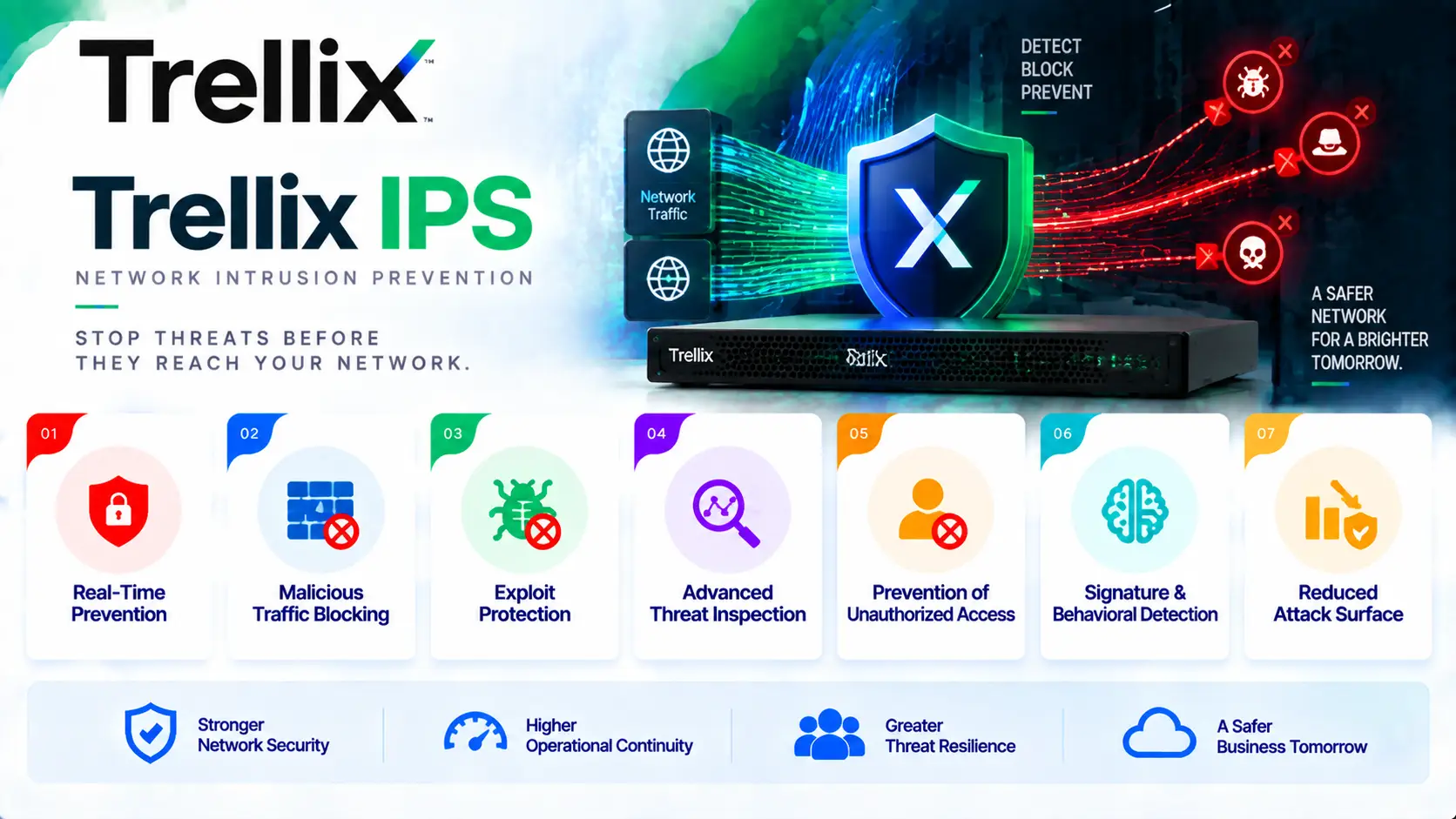
Trellix IPS (Intrusion Prevention System) is a network security solution designed to detect and block malicious traffic, exploits, and unauthorized attack attempts before they impact enterprise systems. By inspecting network communication in real time and applying threat prevention policies, Trellix IPS helps organizations strengthen their network defense against known and emerging cyber threats.
Quick Benefits
- Real-time network intrusion prevention
- Detection and blocking of malicious traffic
- Protection against exploits and vulnerability attacks
- Advanced network threat inspection
- Prevention of unauthorized access attempts
- Signature-based and behavioral threat detection
- Reduced exposure to network-based attacks
- Support for enterprise security architectures
- Improved visibility into suspicious network activity
Trellix IPS At a Glance
What it is: Network Intrusion Prevention System
Product name: Trellix Intrusion Prevention System (IPS)
Parent category: Trellix License
Primary role: Detect and block network-based attacks before compromise occurs
Solution category: Network Security and Intrusion Prevention
Management platform: Trellix security management ecosystem
Protected environment: Enterprise networks, data centers, internet gateways, and critical infrastructure
Deployment model: Network-based security appliance or integrated network security deployment
Core capabilities: Traffic inspection, exploit prevention, threat detection, attack blocking, and security monitoring

License Overview
A Trellix IPS License provides access to network intrusion prevention capabilities that help organizations identify and block malicious activity before it reaches critical systems. Unlike monitoring-only security solutions, IPS platforms actively enforce security policies by analyzing traffic and taking prevention actions when suspicious activity is detected. This makes IPS an important layer for organizations that need real-time protection against network-based attacks.
The licensing model is typically influenced by factors such as network throughput, deployment size, protected interfaces, enabled security capabilities, and subscription duration.
When selecting a Trellix IPS License, organizations should evaluate their network architecture, traffic volume, security requirements, and placement strategy. A firewall deployment, data center gateway, or internal network segment may require different sizing considerations depending on traffic patterns and inspection needs.
Trellix IPS is commonly deployed alongside other security solutions such as endpoint protection, EDR, and XDR. While those technologies focus on endpoint activity and broader threat correlation, IPS provides an additional prevention layer directly within network traffic flows. Proper licensing ensures that the solution can inspect required traffic volumes while maintaining the expected security performance.
Product Overview
Network-Based Threat Prevention
Networks remain a major target for attackers attempting to exploit vulnerabilities, gain unauthorized access, or move between systems.
Traditional security controls may detect some threats after compromise, but intrusion prevention focuses on stopping malicious activity before it reaches its destination.
Trellix IPS analyzes network traffic and applies security policies to identify and block suspicious communication patterns.
Real-Time Traffic Inspection
Effective intrusion prevention requires continuous analysis of network activity.
Trellix IPS examines traffic flows to identify malicious patterns, exploit attempts, and known attack techniques.
By inspecting communication before it reaches protected systems, the platform provides an additional security layer between attackers and critical infrastructure.
Exploit and Vulnerability Protection
Many cyberattacks target known vulnerabilities in applications, operating systems, and network services.
Trellix IPS helps reduce exposure by detecting exploit attempts and blocking malicious activity associated with vulnerability exploitation.
This provides protection during periods when systems may not yet be patched or when organizations need additional defensive controls.
Options and Licensing Models
| Licensing Option | Description | Suitable For |
|---|---|---|
| Throughput-Based Licensing | Licensing based on inspected network traffic capacity | High-volume enterprise networks |
| Network Interface Capacity | Coverage based on protected network connections | Organizations with multiple network segments |
| Threat Prevention Subscription | Provides updated security intelligence and detection capabilities | Organizations requiring continuous protection |
| Advanced Security Updates | Access to updated threat signatures and protections | Environments facing evolving threats |
| Enterprise Deployment Licensing | Supports larger-scale security architectures | Data centers and large organizations |
| Multi-Year Subscription | Provides extended protection coverage | Enterprise security programs |
The appropriate Trellix IPS licensing model depends on traffic volume, network architecture, security requirements, and deployment scale.
Features and Benefits
Trellix IPS helps organizations strengthen their network security by preventing malicious traffic before it reaches critical systems. Instead of relying only on detection after an attack begins, IPS provides active blocking capabilities designed to reduce exposure.
One of the key advantages of Trellix IPS is its ability to protect against network-based attacks such as exploit attempts, unauthorized access attempts, and malicious communication patterns.
The platform also improves security operations by providing visibility into blocked threats and suspicious network activity. This information can support investigation processes and help teams understand attack trends.
For organizations managing complex networks, Trellix IPS provides an additional prevention layer that complements endpoint protection, EDR, and XDR solutions.
Compatibility and Requirements
Before deploying Trellix IPS, organizations should evaluate their network design and performance requirements.
Important considerations include:
- Network bandwidth capacity
- Traffic inspection requirements
- Deployment location
- Number of protected network segments
- High availability requirements
- Existing security infrastructure
- Security policy requirements
- Logging and monitoring needs
Organizations should determine where IPS inspection provides the greatest security value, such as internet gateways, data centers, or critical internal network zones. Proper sizing is important because insufficient capacity may affect performance, while excessive capacity may increase unnecessary costs.
Activation and Deployment
Deployment begins after selecting the appropriate Trellix IPS License and preparing the network environment.
Typical deployment steps include:
- Activating the Trellix IPS subscription
- Configuring network connections
- Defining inspection policies
- Updating security intelligence
- Testing prevention rules
- Monitoring traffic behavior
Organizations often begin with monitoring or alerting modes before enabling full blocking policies. This approach allows security teams to validate configurations and reduce the risk of blocking legitimate business traffic.
Pricing and Quote Process
Pricing for Trellix IPS depends on network throughput, deployment architecture, required security capabilities, subscription duration, and support requirements.
Before requesting a quote, organizations should define:
- Expected traffic volume
- Required inspection capacity
- Number of deployment points
- Security update requirements
- High availability needs
- Subscription term
Trellix pricing depends on your security solution, endpoint coverage, threat protection modules, deployment model, license term, and support requirements.