

Trellix NDR (Network Detection and Response) is a network security solution designed to identify suspicious activity, detect advanced threats, and provide visibility into network behavior across enterprise environments. By analyzing network traffic, communication patterns, and threat indicators, Trellix NDR helps security teams discover attacks that may bypass traditional endpoint-focused protection.
Quick Benefits
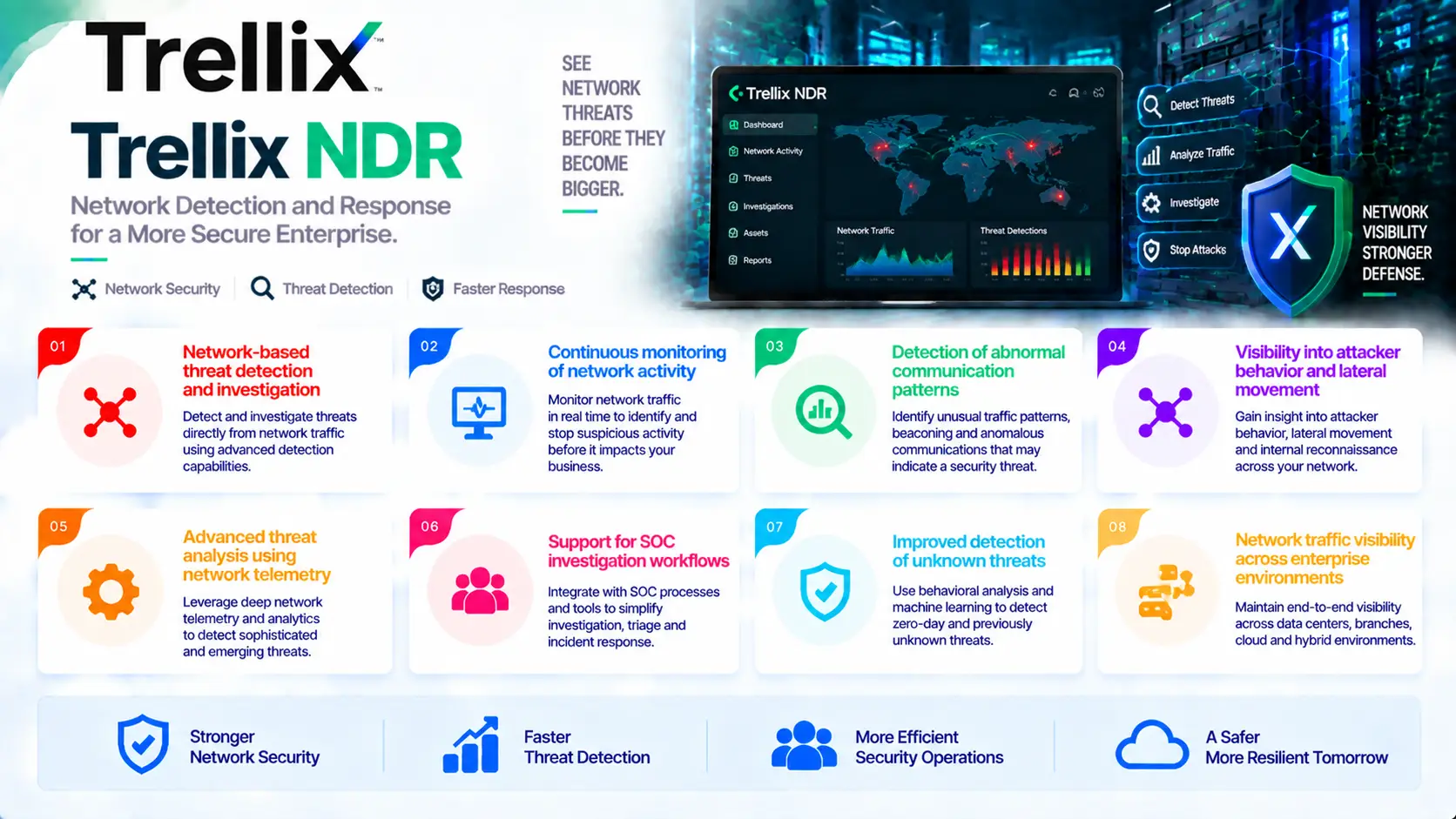
- Network-based threat detection and investigation
- Continuous monitoring of network activity
- Detection of abnormal communication patterns
- Visibility into attacker behavior and lateral movement
- Advanced threat analysis using network telemetry
- Support for SOC investigation workflows
- Improved detection of unknown threats
- Network traffic visibility across enterprise environments
Trellix NDR At a Glance
What it is: Network Detection and Response Platform
Product name: Trellix Network Detection and Response (NDR)
Parent category: Trellix License
Primary role: Detect and investigate threats through network traffic analysis
Solution category: Network Detection and Response (NDR)
Management platform: Trellix security operations ecosystem
Protected environment: Enterprise networks, data centers, branches, and distributed infrastructures
Deployment model: Network-based deployment with supported monitoring architectures

License Overview
A Trellix NDR License provides organizations with network visibility and threat detection capabilities designed to identify malicious activity that may not be visible through endpoint security solutions alone. Modern attacks often involve network communication between compromised systems, command-and-control infrastructure, unauthorized data transfers, and lateral movement across internal environments. NDR solutions focus on analyzing these network behaviors to identify suspicious patterns and provide additional context for security investigations.
The licensing model is generally based on factors such as monitored network capacity, deployment locations, traffic volume, sensors, data retention requirements, and integration needs. When evaluating a Trellix NDR License, organizations should consider their network architecture, available monitoring points, security objectives, and existing detection technologies.
For example, organizations with multiple data centers or branch locations may require broader network visibility, while smaller deployments may focus on protecting critical network segments. Proper licensing ensures that security teams receive meaningful network intelligence without collecting unnecessary data that increases operational complexity.
Product Overview
Network Visibility Beyond Endpoint Protection
Endpoints are an important part of cybersecurity, but many attacks involve network activity that occurs before or after endpoint compromise.
Attackers may use legitimate tools, move between systems, or communicate with external infrastructure in ways that traditional endpoint solutions cannot fully explain.
Trellix NDR provides visibility into network behavior, allowing security teams to identify suspicious communication patterns and investigate potential threats.
Network Traffic Analysis
A key capability of NDR platforms is analyzing network traffic to understand normal and abnormal behavior.
Trellix NDR examines communication patterns, connections, and network activity to identify deviations that may indicate malicious actions.
This helps security teams detect threats that may not rely on known malware signatures.
Detection of Advanced Threat Activity
Modern cyber threats often involve multiple stages, including reconnaissance, lateral movement, command-and-control communication, and data exfiltration.
Trellix NDR helps identify these activities by analyzing network-level indicators and suspicious behaviors.
By providing additional context around network events, security teams can investigate incidents more effectively.
Options and Licensing Models
| Licensing Option | Description | Suitable For |
|---|---|---|
| Traffic Capacity Licensing | Licensing based on monitored network throughput or traffic volume | Organizations monitoring high-volume networks |
| Network Sensor Licensing | Based on deployed monitoring sensors or collection points | Distributed enterprise environments |
| Data Retention Licensing | Provides longer storage for network investigation data | Organizations requiring historical analysis |
| Threat Analytics Capability | Adds advanced detection and behavioral analysis features | SOC teams investigating complex threats |
| Integration Licensing | Connects NDR data with security platforms and workflows | Enterprises using multiple security technologies |
| Multi-Year Subscription | Provides long-term network security coverage | Enterprise security deployments |
The correct Trellix NDR licensing model depends on network size, monitoring requirements, security objectives, and operational needs.
Features and Benefits
Trellix NDR helps organizations strengthen security visibility by focusing on network activity that may reveal threats missed by endpoint-focused solutions. By analyzing communication patterns and behavioral indicators, the platform provides additional insight into how attackers operate within an environment.
One of the main benefits of NDR is improved threat discovery. Security teams can identify suspicious network behavior, investigate potential compromises, and understand attack movement across systems.
The platform also supports more effective SOC operations by providing network context during investigations. Instead of analyzing isolated alerts, analysts can review how systems communicate and identify relationships between different security events.
For organizations with complex infrastructures, Trellix NDR provides an additional security layer that complements endpoint protection, EDR, and XDR solutions.
Compatibility and Requirements
Before deploying Trellix NDR, organizations should evaluate their network architecture and monitoring requirements.
Important considerations include:
- Network bandwidth and traffic volume
- Number of monitoring locations
- Data center and branch architecture
- Available TAP/SPAN monitoring points
- Retention requirements
- Existing security platforms
- Integration requirements
- Compliance requirements
Organizations should identify critical network segments and determine where visibility provides the highest security value. Proper planning helps ensure effective monitoring without unnecessary infrastructure complexity.
Activation and Deployment
Deployment begins after selecting the appropriate Trellix NDR License and preparing network monitoring infrastructure.
Typical deployment steps include:
- Activating the Trellix NDR subscription
- Deploying network sensors or monitoring components
- Connecting traffic sources
- Configuring detection policies
- Integrating security workflows
- Validating network visibility
Organizations typically begin monitoring critical network areas before expanding coverage across additional locations. A phased approach helps security teams optimize detection policies and reduce operational impact.
Pricing and Quote Process
Pricing for Trellix NDR depends on monitored traffic volume, number of sensors, deployment locations, retention requirements, integrations, and subscription duration.
Before requesting a quote, organizations should define:
- Network bandwidth requirements
- Number of monitoring points
- Expected traffic volume
- Required retention period
- Integration requirements
- SOC investigation needs
- Subscription term
Accurate sizing helps organizations select the appropriate NDR capacity while maintaining predictable security costs. Future network expansion should also be considered because additional locations or increased traffic may affect licensing requirements.
Trellix pricing depends on your security solution, endpoint coverage, threat protection modules, deployment model, license term, and support requirements.