

Trellix XDR (Extended Detection and Response) is a security operations platform designed to correlate threat information across multiple security layers, including endpoints, networks, email, cloud environments, and other data sources. By combining security analytics, threat intelligence, and automated investigation capabilities, Trellix XDR helps organizations improve threat visibility and respond to complex cyber incidents more efficiently.
Quick Benefits
- Extended detection across multiple security environments
- Correlation of endpoint, network, email, and cloud security events
- Improved visibility into advanced attack campaigns
- Faster incident investigation and response
- Centralized security analytics and monitoring
- Threat intelligence-driven detection
- Reduced alert fatigue for SOC teams
- Support for enterprise security operations
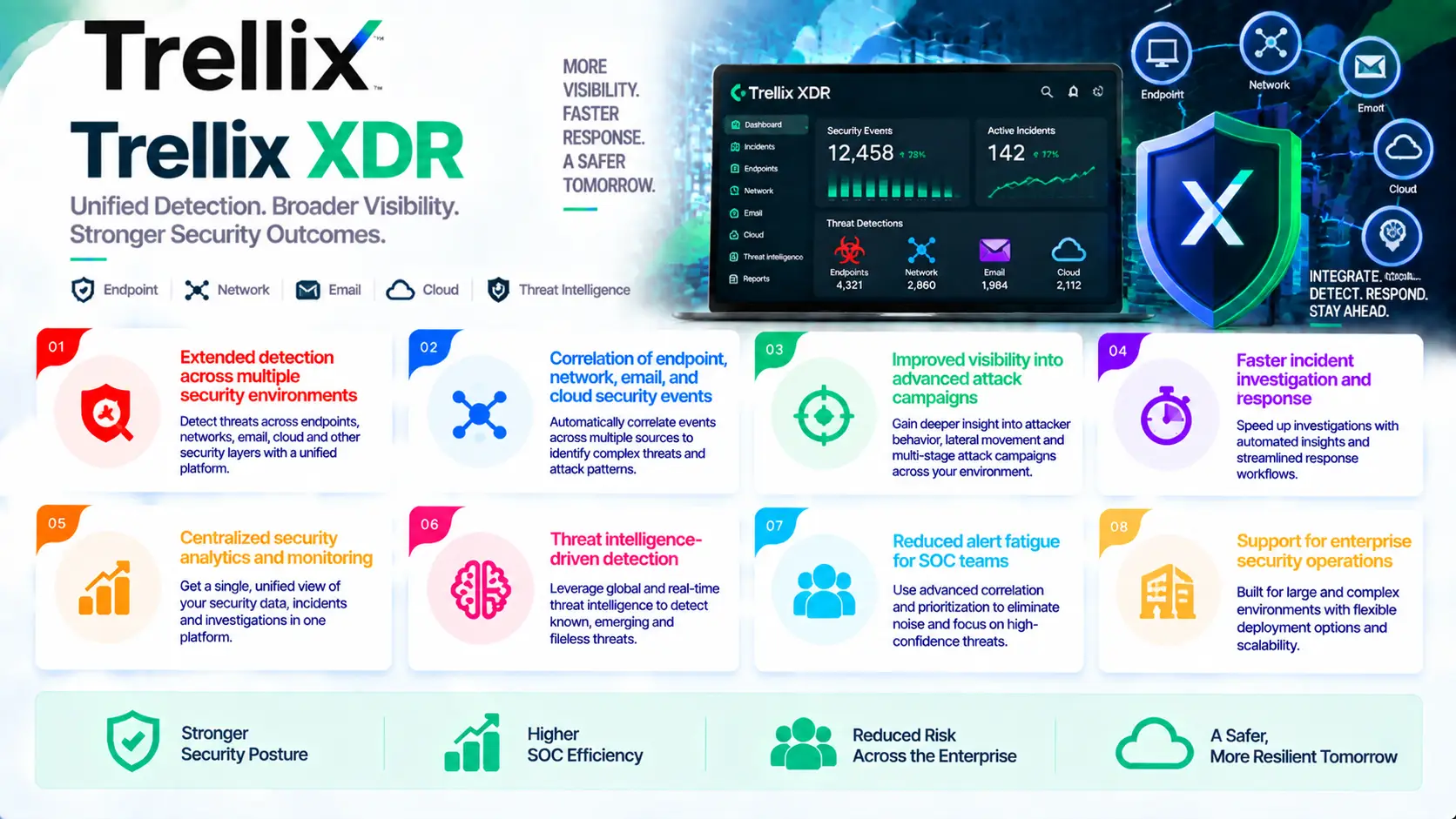
Trellix XDR At a Glance
What it is: Extended Detection and Response Platform
Product name: Trellix Extended Detection and Response (XDR)
Parent category: Trellix License
Primary role: Detect, correlate, investigate, and respond to threats across multiple security layers
Solution category: Extended Detection and Response (XDR)
Management platform: Trellix security operations platform
Security data sources: Endpoint, network, email, cloud, identity, and third-party security systems
Deployment model: Cloud-based and hybrid security operations environments

License Overview
A Trellix XDR License provides organizations with the capabilities required to analyze security events across different layers of their environment and identify threats that may not be visible through individual security tools.
Unlike traditional security solutions that operate independently, XDR platforms focus on connecting information from multiple sources. This allows security teams to understand the relationship between endpoint activity, network behavior, email threats, cloud events, and other security signals.
The licensing structure is generally based on factors such as the number of protected assets, connected security sources, data volume, retention requirements, and required analytics capabilities.
When evaluating a Trellix XDR License, organizations should consider their current security architecture and the visibility gaps they want to address. Companies with multiple security products often benefit from XDR because it reduces the need to manually compare alerts across separate platforms.
For security operations teams, the value of XDR comes from context. Instead of reviewing isolated alerts, analysts can investigate incidents using correlated information from multiple environments.
Proper licensing planning ensures that organizations collect the necessary security data while maintaining predictable operational costs.
Product Overview
Extended Detection Across Security Layers
Modern cyberattacks rarely rely on a single technique or target one system. Attackers may compromise an endpoint, move through the network, target user accounts, and attempt data access through multiple stages.
Trellix XDR addresses this challenge by connecting security signals from different parts of the organization and creating a broader view of potential threats.
This approach allows security teams to detect attack patterns that may remain hidden when each security product operates separately.
Cross-Environment Security Correlation
One of the main capabilities of XDR is the ability to correlate events from different security domains.
For example, suspicious endpoint behavior combined with unusual network communication and a malicious email event may indicate a larger attack campaign.
Trellix XDR analyzes these relationships to provide security teams with more complete incident context.
This reduces investigation time and helps analysts prioritize the threats that require immediate attention.
Security Operations Visibility
SOC teams often manage large volumes of alerts generated by multiple security solutions.
Without centralized visibility, analysts may spend significant time collecting information from different systems before they can determine whether an incident is serious.
Trellix XDR provides a unified view of security events, allowing teams to investigate incidents more efficiently and improve response coordination.
Options and Licensing Models
| Licensing Option | Description | Suitable For |
|---|---|---|
| Endpoint Data Integration | Adds endpoint telemetry and security events to XDR analysis | Organizations using endpoint security solutions |
| Network Security Integration | Provides visibility into network-based threats and activity | Enterprises requiring network-level detection |
| Email Security Integration | Correlates email threats with other security events | Organizations facing phishing and email attacks |
| Cloud Security Integration | Adds visibility into cloud workloads and services | Businesses operating hybrid cloud environments |
| Third-Party Data Sources | Connects external security platforms and tools | Organizations with complex security ecosystems |
| Extended Data Retention | Maintains historical security data for investigation | Enterprises requiring forensic analysis |
| Multi-Year Subscription | Provides long-term security platform access | Large security operations environments |
Features and Benefits
Trellix XDR helps organizations move from isolated security monitoring toward a more connected security operations approach. By combining information from multiple security layers, it provides analysts with better context when investigating suspicious activity.
A major benefit of XDR is improved incident prioritization. Instead of treating every alert as an independent event, the platform helps security teams understand which activities may represent coordinated attacks.
Trellix XDR also improves operational efficiency by reducing manual correlation between different security products. Analysts can investigate incidents faster because related information is presented together.
For organizations with complex infrastructures, XDR provides a scalable approach to improving threat visibility and strengthening security operations without relying only on individual security solutions.
Compatibility and Requirements
Before deploying Trellix XDR, organizations should evaluate their security environment and operational requirements.
Important considerations include:
- Existing Trellix security products
- Endpoint security coverage
- Network security sources
- Email and cloud environments
- Number of protected assets
- Data volume requirements
- Retention needs
- SOC workflows
- Integration capabilities
Organizations should identify which security sources provide the most valuable visibility before deployment. Proper planning ensures that XDR collects meaningful security information rather than unnecessary data.
Activation and Deployment
Deployment begins after selecting the appropriate Trellix XDR License and preparing required integrations.
Typical deployment steps include:
- Activating the Trellix XDR subscription
- Connecting security data sources
- Configuring analytics and correlation rules
- Defining incident workflows
- Testing investigation processes
- Reviewing response procedures
Organizations commonly begin with critical security sources before expanding XDR visibility across additional environments. A phased deployment approach helps security teams optimize configurations and improve operational efficiency.
Pricing and Quote Process
Pricing for Trellix XDR depends on the number of connected security sources, data volume, protected assets, retention requirements, integrations, and subscription duration.
Before requesting a quote, organizations should define:
- Required security data sources
- Number of endpoints and systems
- Expected event volume
- Retention requirements
- SOC requirements
- Integration needs
- Subscription term
Accurate sizing helps organizations select an XDR configuration that matches their security operations goals. Organizations should also consider future expansion because additional systems, users, and security sources may increase licensing requirements.
Trellix pricing depends on your security solution, endpoint coverage, threat protection modules, deployment model, license term, and support requirements.