

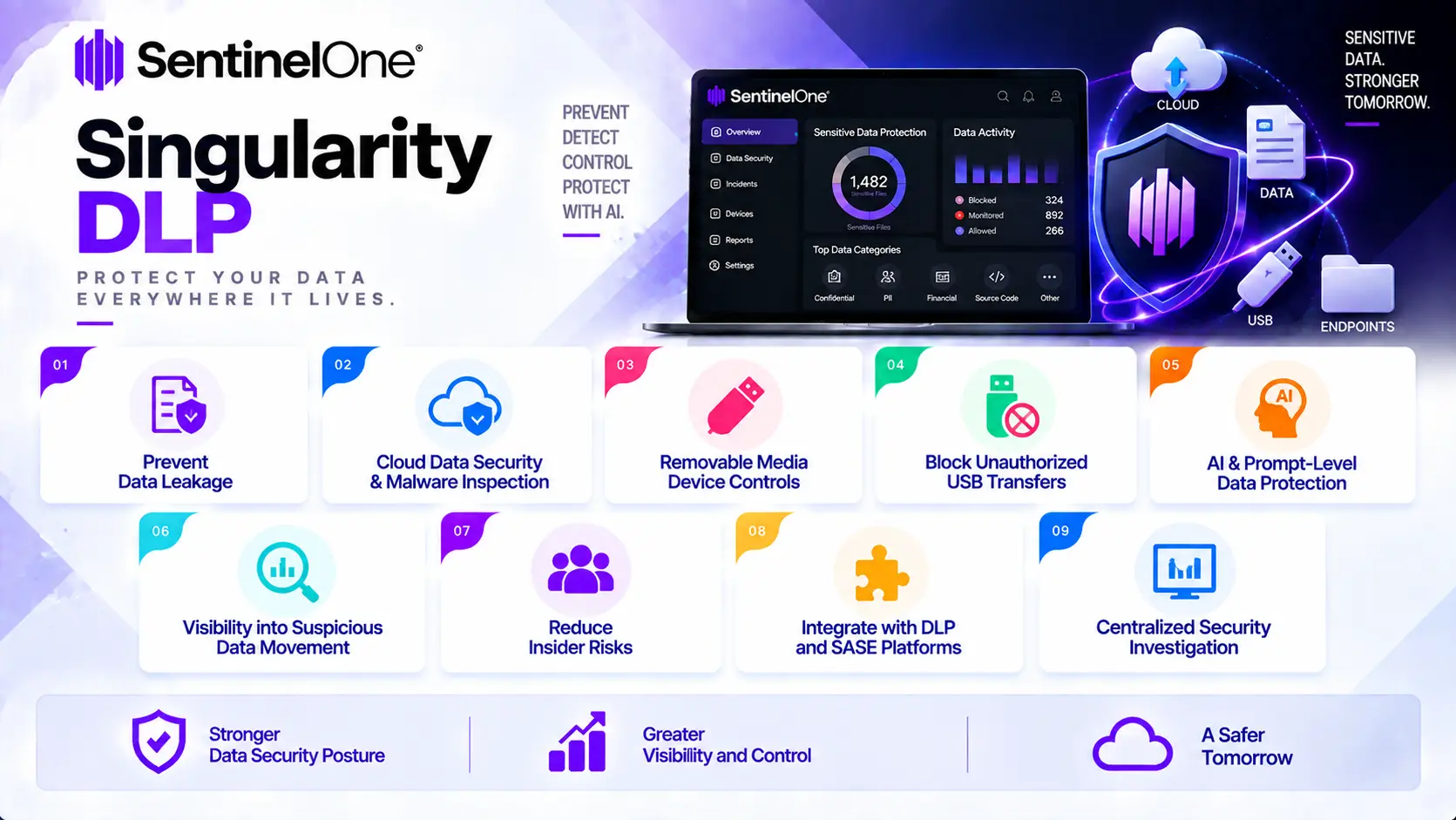
Singularity DLP refers to the data loss prevention capabilities available across SentinelOne’s Singularity security ecosystem. Rather than relying on a single DLP component, SentinelOne combines cloud data security, endpoint controls, AI data protection, behavioral detection, and third-party integrations to help organizations reduce accidental or malicious data exposure.
Quick Benefits
- Protection against sensitive data leakage
- Cloud data security and malware inspection
- Endpoint device controls for removable media
- Prevention of unauthorized USB data transfers
- AI and prompt-level data protection
- Visibility into suspicious data movement
- Support for insider-risk reduction
- Integration with external DLP and SASE platforms
- Centralized security investigation through Singularity
Singularity DLP At a Glance
What it is: Data protection and data loss prevention capabilities across the SentinelOne Singularity ecosystem
Product family: SentinelOne Singularity
Parent category: SentinelOne Singularity License
Primary role: Reduce unauthorized, accidental, and malicious data exposure
Primary data-security components: Singularity Cloud Data Security, Singularity Endpoint controls, Prompt Security, and supported third-party DLP integrations
Endpoint controls: USB and removable-media device policies, read-only access, blocking, and endpoint containment
Cloud data protection: AI-powered scanning of cloud and network data stores
AI data protection: Prompt and output inspection for supported generative AI workflows
Integration model: Singularity Marketplace and XDR integrations with external security platforms
Deployment model: Cloud, endpoint, hybrid, and integrated enterprise environments
License Overview
A Singularity DLP License should be planned according to the data channels an organization actually needs to protect. Because SentinelOne distributes DLP-related functionality across several components, licensing is not simply based on a single universal “DLP user” metric.
For cloud storage, SentinelOne positions Singularity Cloud Data Security as a solution for detecting malicious files and reducing data-loss risks across cloud and network data stores. Its current platform supports environments such as Amazon S3, Azure storage, NetApp, and other supported repositories.
For endpoints, SentinelOne uses Device Control to restrict removable devices such as USB storage. Policies can be configured by device class, vendor, product, or serial number, and administrators can allow read-only operation where appropriate for DLP policies. AI usage introduces another licensing consideration. SentinelOne Prompt Security provides controls for AI applications and employee AI usage, including data-loss prevention around prompts, outputs, shadow AI, and sensitive information exposure. When selecting a Singularity DLP License, buyers should therefore define whether the primary requirement is endpoint data control, cloud storage protection, AI data protection, external DLP integration, or a combination of these areas.
Product Overview
Data Protection Across Multiple Security Surfaces
Sensitive information no longer remains inside a file server or corporate network.
Employees copy files to removable media, upload information to cloud storage, work through SaaS platforms, and increasingly share data with generative AI applications. A modern DLP strategy therefore needs visibility across several different paths.
Singularity DLP capabilities address this by combining controls from different areas of the SentinelOne platform instead of relying on one isolated enforcement point.
Cloud Data Security
Cloud storage can become a major source of data exposure when files are uploaded, shared, or processed without proper security controls.
Singularity Cloud Data Security scans files at ingestion and is designed to detect known and zero-day threats before malicious content spreads through cloud or network storage. SentinelOne positions the service around object stores, file storage, and NAS environments.
For data-security teams, this provides another control point for protecting repositories that may sit outside traditional endpoint boundaries.
Endpoint Device Control
Removable media remains one of the simplest ways for sensitive information to leave an organization.
SentinelOne Singularity Control can restrict USB and other peripheral devices through granular policies. Administrators can allow approved hardware, deny unauthorized devices, or permit read-only access where users need to retrieve information without copying new files onto removable storage.
This gives endpoint teams a practical way to reduce accidental transfers and insider-driven exfiltration without blocking every peripheral device.
Options and Licensing Models
| Licensing Option | Description | Suitable For |
|---|---|---|
| Singularity Endpoint Device Control | Restricts USB and other removable devices and can enforce read-only or blocking policies | Organizations concerned with endpoint data transfers |
| Singularity Cloud Data Security | Protects cloud and network data stores through AI-powered file scanning and automated response | Cloud-heavy and storage-intensive environments |
| Prompt Security | Provides AI usage visibility, prompt/output controls, and sensitive-data protection for generative AI | Organizations adopting enterprise AI tools |
| Singularity XDR Integration | Correlates data-loss activity with endpoint, identity, cloud, and other security signals | SOC teams investigating data-exfiltration incidents |
| Third-Party DLP Integration | Ingests external DLP and SASE alerts through supported Marketplace integrations | Enterprises with existing DLP investments |
| Extended Security Data Retention | Preserves related telemetry for longer investigations and compliance workflows | Security, forensic, and compliance teams |
| Multi-Year Subscription | Provides longer-term coverage for selected SentinelOne capabilities | Enterprise security programs |
The correct configuration depends on where sensitive information resides and how users move it. A company mainly concerned about USB transfers requires a different licensing scope from one protecting cloud object storage and employee AI usage.
Features and Benefits
The main benefit of Singularity DLP is the ability to connect data-security events with wider security context.
A blocked USB transfer may be an innocent user mistake, or it may occur immediately after account compromise and suspicious endpoint behavior. When DLP-related events are examined alongside endpoint, identity, cloud, and XDR telemetry, analysts gain more information about intent and risk.
SentinelOne’s approach also allows data protection to be adapted to different channels. Endpoint controls can restrict physical transfer paths, Cloud Data Security protects stored files, and Prompt Security addresses new AI-driven exposure scenarios.
For organizations already using dedicated DLP products, Singularity integrations can improve investigation without forcing an immediate platform replacement. External DLP alerts can contribute to a broader XDR incident where analysts can review endpoint and user context at the same time.
Compatibility and Requirements
Before planning Singularity DLP capabilities, organizations should map where sensitive information is stored and how it can leave the environment.
Important considerations include:
- Number of protected endpoints
- Windows, macOS, and Linux endpoint requirements
- Removable-media usage
- Cloud storage platforms
- NAS and object-storage environments
- Generative AI applications in use
- Sensitive data types
- Existing DLP or SASE solutions
- Compliance requirements
- Incident investigation workflows
- Retention requirements
Endpoint device-control capabilities should also be tested against legitimate business hardware before broad enforcement to prevent unnecessary disruption.
Activation and Deployment
Deployment depends on which DLP-related capabilities are selected.
Typical steps include:
- Activate the required SentinelOne subscription
- Identify sensitive data channels
- Configure endpoint device-control policies
- Connect supported cloud storage environments
- Enable Prompt Security where AI protection is required
- Integrate existing DLP or SASE platforms
- Define alert and investigation workflows
- Test blocking and exception policies
A monitoring-first approach is useful for endpoint and AI policies because it reveals legitimate usage patterns before stricter enforcement is applied.
Pricing and Quote Process
Pricing for a Singularity DLP License depends on the combination of SentinelOne capabilities required rather than one fixed DLP metric.
Before requesting a quote, define:
- Number of protected endpoints
- USB and device-control requirements
- Cloud data stores requiring protection
- Storage platforms and deployment locations
- Generative AI usage
- Prompt Security requirements
- Existing DLP integrations
- Security data retention
- Compliance requirements
- Subscription duration
SentinelOne pricing depends on your security solution, endpoint coverage, XDR capabilities, threat detection requirements, deployment model, license term, and support needs.