

SentinelOne Singularity License gives organizations access to SentinelOne’s unified AI-powered security platform for protecting endpoints, cloud workloads, identities, and security operations. Rather than operating as a collection of disconnected tools, Singularity brings prevention, detection, investigation, and response into a shared security environment.
Quick Benefits
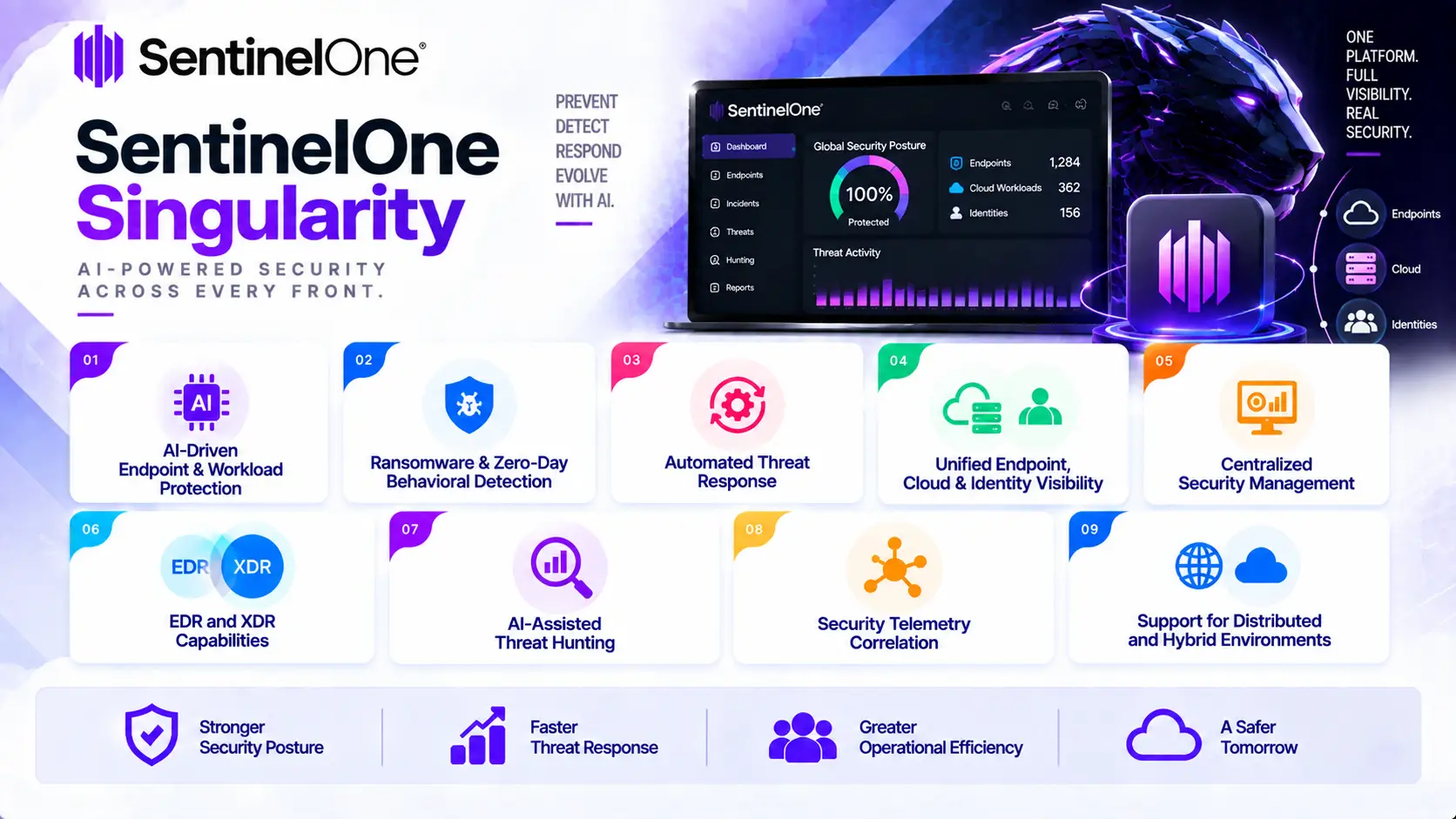
- AI-driven endpoint and workload protection
- Behavioral detection of ransomware and zero-day threats
- Automated threat response and remediation
- Unified endpoint, cloud, and identity visibility
- Centralized security management
- EDR and XDR capabilities
- AI-assisted threat hunting and investigation
- Security telemetry correlation across protected assets
- Support for distributed and hybrid environments
SentinelOne Singularity At a Glance
What it is: Unified AI-driven cybersecurity platform
Product name: Singularity Platform
Parent category: SentinelOne License
Primary role: Prevention, detection, investigation, and response across multiple security surfaces
Security areas: Endpoint, Cloud, Identity, AI Security, SIEM/XDR, and Exposure Management
Management model: Centralized cloud-based Singularity console
Protected assets: Endpoints, servers, cloud workloads, identities, and connected security data sources
Core technologies: Static AI, behavioral AI, EDR, automated remediation, threat hunting, and security analytics
Current primary packages: Singularity Complete, Singularity Commercial, and Singularity Enterprise
License model: Subscription-based licensing, commonly calculated per protected endpoint for packaged endpoint offerings
License Overview
A SentinelOne Singularity License determines which protection, detection, investigation, and management capabilities an organization can use within the Singularity Platform. The licensing decision should therefore begin with the security coverage required rather than simply counting endpoint agents.
For endpoint-focused deployments, SentinelOne currently offers packaged tiers including Singularity Complete, Singularity Commercial, and Singularity Enterprise. Complete provides AI-powered endpoint and cloud workload protection with real-time detection and response. Commercial expands that package with capabilities including Identity Detection & Response, longer data retention, and managed threat hunting. Enterprise adds functionality aimed at larger security operations, including automated AI-driven triage and deeper visibility and forensics.
The wider Singularity ecosystem can extend beyond endpoints into cloud security, identity protection, AI SIEM, threat intelligence, vulnerability management, and other security functions. This means two companies with the same endpoint count may require very different license configurations depending on their operational model.
For buyers, the practical question is not simply “How many licenses do we need?” It is also whether the environment requires endpoint prevention only, full EDR, identity monitoring, cloud workload protection, extended telemetry retention, or broader SOC capabilities.
Product Overview
One Security Platform Instead of Isolated Controls
Many enterprise security environments have grown by adding individual products whenever a new threat or operational requirement appeared. Over time, that can leave teams switching between endpoint consoles, identity tools, cloud security systems, and investigation platforms.
SentinelOne Singularity takes a different approach. SentinelOne describes the platform as a unified architecture with a common data layer, a single console, and AI capabilities operating across multiple security surfaces.
The practical benefit is context. Endpoint activity can be evaluated alongside cloud, identity, and other security signals rather than remaining trapped inside separate tools.
AI-Powered Endpoint Protection
Endpoint security remains a central part of Singularity.
SentinelOne uses static and behavioral AI to identify malicious activity on protected systems. Its current Singularity Complete offering covers workstations, servers, and cloud workloads and is designed to detect malware, ransomware, zero-day behavior, and fileless attacks.
This makes the platform suitable for organizations replacing traditional antivirus as well as businesses building more mature endpoint detection and response programs.
Detection, Investigation, and Threat Hunting
Prevention cannot stop every security event, particularly when attackers abuse legitimate tools, credentials, or administrative functions.
Singularity provides EDR capabilities that give analysts access to endpoint telemetry, attack context, investigation data, and threat-hunting workflows. SentinelOne also integrates Purple AI into its security experience to assist with natural-language investigation and event analysis.
For a SOC team, this changes the workflow from simply receiving a malware alert to understanding the sequence of activity that led to the incident.
Options and Licensing Models
| Licensing Option | Description | Suitable For |
|---|---|---|
| Singularity Complete | AI-powered endpoint and cloud workload protection with real-time detection and response | Organizations needing strong EPP and EDR coverage |
| Singularity Commercial | Adds capabilities such as Identity Detection & Response, longer retention, and managed threat hunting | Security teams requiring wider investigation coverage |
| Singularity Enterprise | Adds advanced SOC-oriented capabilities, deeper forensics, and AI-driven triage | Large and globally distributed enterprises |
| Extended Data Retention | Increases historical telemetry available for investigation and hunting | SOC and compliance-focused environments |
| Cloud Security Capabilities | Extends protection to cloud workloads and cloud-native environments | Organizations operating public or hybrid cloud |
| Identity Security | Adds identity exposure and attack detection capabilities | Businesses concerned with credential and account compromise |
| Additional Platform Modules | Expands Singularity into areas such as AI SIEM, threat intelligence, and exposure management | Organizations consolidating security operations |
Features and Benefits
The main advantage of SentinelOne Singularity is not simply that it contains multiple security features. Its value comes from having protection, telemetry, investigation, and response operating through the same platform.
That matters during real incidents. A ransomware process detected on one endpoint is more useful when analysts can immediately see related behaviors, affected workloads, identity activity, and the sequence of events around the attack.
Automation also reduces operational pressure. Endpoint security teams do not need to manually respond to every routine detection when policy-driven remediation can handle appropriate actions automatically.
For organizations trying to simplify their security stack, Singularity can also reduce console fragmentation. Endpoint, identity, cloud, and security operations capabilities can be expanded without building an entirely separate management layer for every new requirement.
Compatibility and Requirements
Before ordering a SentinelOne Singularity deployment, the environment should be reviewed carefully rather than sizing licenses from employee count alone.
Important checks include:
- Number of workstations and laptops
- Server and workload count
- Operating systems and agent versions
- Cloud workload requirements
- Identity security requirements
- Required EDR telemetry retention
- Existing SIEM, SOC, and security integrations
- Disconnected or restricted-network endpoints
- Data residency and compliance requirements
Activation and Deployment
Deployment normally starts by creating or provisioning the Singularity environment and deploying the SentinelOne agent to the systems included in the subscription.
Typical steps include:
- Activate the purchased subscription
- Configure sites, groups, and administrative roles
- Deploy the SentinelOne agent
- Define protection and response policies
- Enable required platform modules
- Verify telemetry and detection
- Integrate SOC or third-party tools where required
For large environments, a staged rollout is preferable so policy behavior, application compatibility, network connectivity, and remediation settings can be validated before organization-wide deployment.
Pricing and Quote Process
Pricing for SentinelOne Singularity License depends on the selected package and the scale of protection required. SentinelOne currently publishes per-endpoint annual pricing for some packages, while Enterprise configurations require a custom sales quote.
Before requesting pricing, define:
- Total endpoint quantity
- Workstation and server mix
- Cloud workloads requiring protection
- Required Singularity package
- Identity security requirements
- EDR data-retention period
- MDR or managed threat-hunting requirements
- Additional platform modules
- Subscription duration
A good quote should reflect the actual security architecture, not simply the number of devices. An organization requiring endpoint prevention alone should not be sized the same way as a SOC that also needs identity detection, long-term forensic data, cloud protection, and managed threat hunting.
SentinelOne pricing depends on your security solution, endpoint coverage, XDR capabilities, threat detection requirements, deployment model, license term, and support needs.