

SentinelOne License provides access to an enterprise cybersecurity platform focused on endpoint protection, threat detection, incident response, and autonomous security operations. Through the Singularity Platform, SentinelOne delivers AI-powered security capabilities across endpoints, cloud workloads, identities, and extended security environments.
Quick Benefits
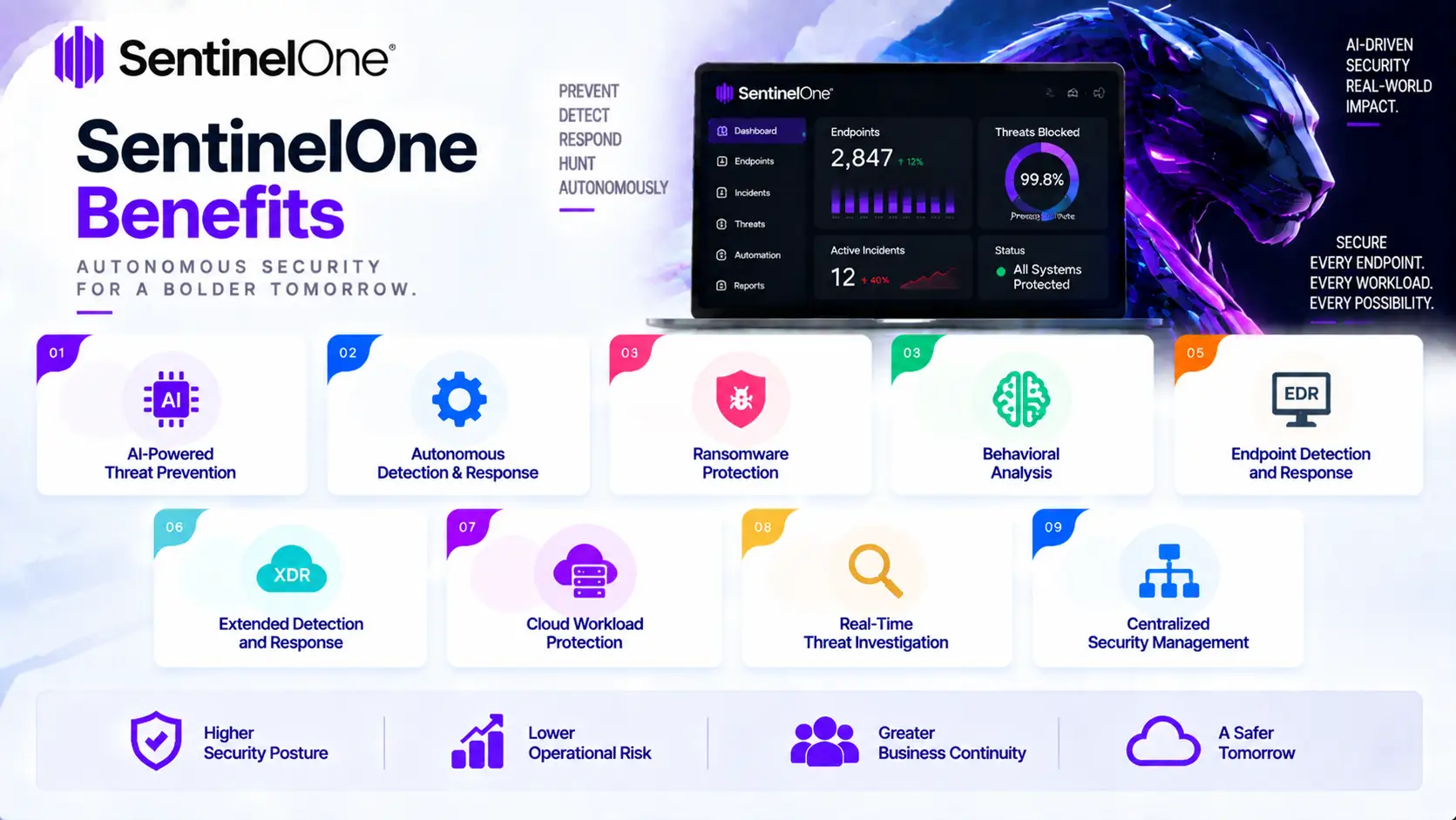
- AI-powered endpoint protection and threat prevention
- Autonomous detection and response capabilities
- Protection against ransomware and advanced attacks
- Behavioral analysis for identifying suspicious activity
- Endpoint Detection and Response (EDR) capabilities
- Extended Detection and Response (XDR) support
- Cloud workload protection capabilities
- Real-time threat investigation and remediation
- Centralized security management
SentinelOne License At a Glance
What it is: Enterprise cybersecurity licensing portfolio
Main security areas: Endpoint Security, EDR, XDR, Cloud Security, Identity Protection, and Security Operations
Core platform: SentinelOne Singularity Platform
License type: Subscription-based security licensing
Primary licensing factors: Endpoints, servers, workloads, users, data sources, and selected security capabilities
Deployment models: Cloud-based and hybrid environments
Management platform: SentinelOne Singularity Console
License Overview
A SentinelOne License provides organizations with access to security solutions designed to protect against modern cyber threats through prevention, detection, investigation, and automated response capabilities.
SentinelOne follows a subscription-based licensing model where organizations select security capabilities according to their operational requirements. Licensing is typically influenced by the number of protected assets, including endpoints, servers, cloud workloads, identities, and other security resources.
Unlike traditional antivirus products that mainly focus on signature-based malware detection, SentinelOne solutions use AI-driven behavioral analysis to identify suspicious activities and respond to threats automatically.
When selecting a SentinelOne License, organizations should evaluate their security goals, existing protection tools, infrastructure size, and required visibility level. A company focusing on endpoint protection may require Singularity EDR capabilities, while larger security teams may need broader XDR functionality and additional security modules. Proper license planning ensures organizations receive the required protection level while maintaining predictable security costs.
How SentinelOne Licensing Works
SentinelOne licensing is based on the security capabilities an organization requires and the assets that need protection. After selecting the appropriate Singularity solution, licensing is generally calculated according to factors such as the number of endpoints, servers, cloud workloads, users, required modules, and subscription duration.
Organizations can expand their security coverage by adding additional capabilities as their environment grows. For example, a business may begin with endpoint protection and later extend coverage with EDR, XDR, identity protection, or cloud security features.
The licensing approach allows companies to build a security architecture that matches their risk profile rather than purchasing a fixed security package. Before selecting a license, organizations should evaluate current threats, compliance requirements, operational needs, and future expansion plans.
SentinelOne Security Portfolio Overview
SentinelOne provides a range of cybersecurity solutions through the Singularity Platform, covering endpoint protection, threat detection, cloud security, and security operations.
| Solution Family | Purpose |
|---|---|
| SentinelOne Singularity Core | AI-based endpoint protection and prevention capabilities |
| SentinelOne Singularity Control | Advanced endpoint security management and policy control |
| SentinelOne Singularity Complete | Combined endpoint protection, EDR, and advanced response capabilities |
| SentinelOne Singularity EDR | Endpoint detection, investigation, and response |
| SentinelOne Singularity XDR | Cross-layer threat detection and security event correlation |
| SentinelOne Cloud Security | Protection for cloud workloads and environments |
| SentinelOne Identity Security | Detection and protection against identity-based threats |
| SentinelOne Ranger | Network discovery and unmanaged asset visibility |
Licensing Options and Models
| Licensing Model | Description | Suitable For |
|---|---|---|
| Endpoint-Based Licensing | Licensing based on protected workstations, laptops, and servers | Organizations deploying endpoint security |
| Workload-Based Licensing | Coverage based on cloud workloads and server environments | Cloud and hybrid infrastructures |
| Identity-Based Licensing | Protection based on users and identity security requirements | Organizations focusing on identity threats |
| EDR Subscription Licensing | Provides endpoint investigation and response capabilities | SOC teams requiring advanced detection |
| XDR Licensing | Enables correlation across multiple security data sources | Enterprises requiring broader visibility |
| Add-On Security Modules | Additional capabilities added to existing deployments | Organizations expanding security coverage |
| Multi-Year Subscription | Long-term security coverage with predictable planning | Enterprise security programs |
Features and Benefits
SentinelOne provides organizations with an AI-driven approach to cybersecurity by combining prevention, detection, investigation, and response capabilities within a unified platform. Instead of relying only on traditional threat signatures, SentinelOne analyzes behavior patterns to identify suspicious activity and respond quickly. One of the main advantages of the platform is autonomous response. Security teams can reduce manual investigation efforts by allowing automated actions to contain and remediate threats based on defined policies.
SentinelOne also improves visibility across modern IT environments. Organizations can monitor endpoints, cloud workloads, and identity-related risks through centralized management, making it easier to understand security incidents and respond effectively. For enterprises managing complex infrastructures, SentinelOne provides flexible security options that can scale from endpoint protection to broader XDR-based security operations.
Compatibility and Requirements
Before selecting a SentinelOne License, organizations should evaluate their technical environment and security requirements.
Important considerations include:
- Number of endpoints and servers
- Supported operating systems
- Cloud workload requirements
- Existing security solutions
- Identity infrastructure
- Required integrations
- Compliance requirements
- Security operations workflows
Different SentinelOne solutions have different deployment requirements, so organizations should evaluate compatibility before implementation. Proper planning ensures security agents, integrations, and management capabilities operate effectively within the existing environment.
Activation and Deployment
Activation begins after selecting the required SentinelOne solutions and completing the licensing process.
Typical deployment steps include:
- Activating the SentinelOne subscription
- Accessing the Singularity Console
- Deploying security agents
- Configuring protection policies
- Connecting additional security modules
- Validating detection and response capabilities
Organizations commonly begin deployment with critical endpoints before expanding coverage across the entire infrastructure. A phased rollout helps security teams validate policies and minimize operational disruption.
Pricing and Quote Process
Pricing for a SentinelOne License depends on the selected security solutions, number of protected assets, subscription duration, required capabilities, and deployment scope.
Before requesting a quote, organizations should define:
- Number of endpoints and servers
- Required SentinelOne modules
- Cloud workload requirements
- Identity protection needs
- Integration requirements
- Subscription duration
- Support requirements
Accurate sizing helps organizations select the appropriate security coverage without unnecessary licensing costs. Future growth should also be considered because additional users, workloads, and security requirements may affect licensing needs.
SentinelOne pricing depends on your security solution, endpoint coverage, XDR capabilities, threat detection requirements, deployment model, license term, and support needs.