

Singularity EDR is SentinelOne’s endpoint detection and response capability for organizations that need continuous endpoint visibility, behavioral threat detection, investigation, threat hunting, and rapid remediation. Delivered through the Singularity platform, it gives security teams more context than traditional antivirus by turning endpoint telemetry into connected attack stories and actionable response workflows.
Quick Benefits
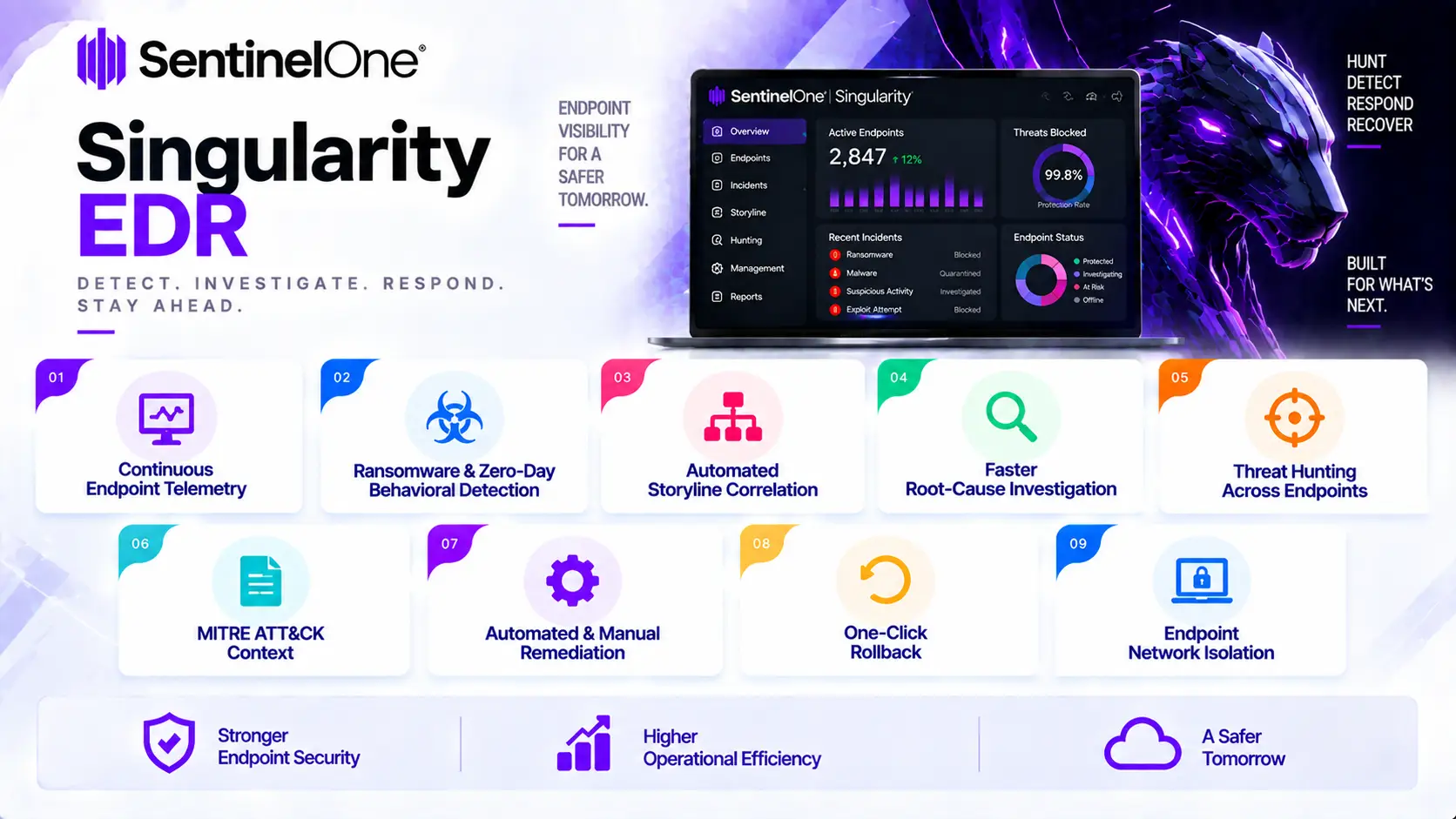
- Continuous endpoint telemetry collection
- Behavioral detection of ransomware and zero-day attacks
- Automated Storyline attack correlation
- Faster root-cause investigation
- Threat hunting across endpoint activity
- MITRE ATT&CK-aligned investigation context
- Automated and manual remediation actions
- One-click rollback for supported incidents
- Endpoint network isolation capabilities
Singularity EDR At a Glance
What it is: Enterprise Endpoint Detection and Response capability
Product family: SentinelOne Singularity
Parent category: SentinelOne Singularity License
Primary role: Detect, investigate, contain, and remediate threats across protected endpoints
Main EDR package: Singularity Complete and higher Singularity packages
Protected assets: Workstations, servers, and supported cloud workloads
Core technologies: Behavioral AI, static AI, Storyline correlation, threat hunting, endpoint telemetry, and automated remediation
Investigation capabilities: Incident timelines, event correlation, Deep Visibility, Storyline context, and Purple AI-assisted analysis
Response capabilities: Kill, quarantine, remediate, rollback, network isolation, and remote investigation actions where supported
Standard historical EDR retention: 14 days with Singularity Complete
License Overview
A Singularity EDR License provides organizations with the endpoint visibility and response capabilities needed to investigate attacks that are not fully explained by preventive security alerts. In SentinelOne’s current commercial structure, enterprise EDR is primarily delivered through Singularity Complete, while Commercial and Enterprise packages add broader retention, identity, hunting, and SOC-oriented capabilities.
Licensing is therefore closely tied to the number of protected endpoints and the level of investigation required. Two organizations with 1,000 endpoints may still need different configurations if one only requires endpoint detection and response while the other needs 90-day retention, identity detection, managed threat hunting, or deeper forensic visibility.
This distinction matters because EDR generates continuous security telemetry. The longer that telemetry must remain searchable, the more useful it becomes for retrospective investigation, but retention also becomes an important commercial consideration.
A buyer evaluating a Singularity EDR License should therefore count protected workstations and servers, review existing endpoint security coverage, decide how much historical telemetry is needed, and determine whether response will be handled internally or supported through managed threat hunting or MDR services.
Product Overview
Behavioral Detection Instead of Signature-Only Security
Many modern attacks avoid dropping obvious malware files. Attackers may abuse PowerShell, scripts, remote administration tools, legitimate credentials, or living-off-the-land techniques.
Singularity EDR addresses this by using behavioral AI alongside static detection. SentinelOne states that its behavioral models analyze suspicious and malicious patterns in real time across workstations, servers, and workloads, including ransomware, zero-day attacks, fileless malware, and other advanced behaviors.
This gives analysts visibility into activity that could look harmless when viewed as isolated events.
Storyline Attack Correlation
A large part of EDR value comes from understanding how an incident developed.
SentinelOne’s Storyline technology automatically connects related processes, files, users, IP addresses, domains, and other endpoint activity into a structured attack narrative. Instead of requiring analysts to manually reconstruct hundreds of events, the platform groups relevant activity into a more understandable investigation path.
This becomes particularly useful during multi-stage attacks where initial access, persistence, credential activity, and lateral movement may occur at different times.
Threat Hunting and Deep Investigation
Singularity EDR also supports proactive threat hunting.
Security teams can search endpoint telemetry to investigate indicators, suspicious behavior, or newly discovered attack techniques. SentinelOne currently highlights Purple AI natural-language querying, event summaries, and investigation notebooks as part of the Singularity Complete investigation experience.
Threat hunting becomes especially valuable when a security team receives a new indicator of compromise and needs to determine whether the behavior appeared earlier in the environment.
Options and Licensing Models
| Licensing Option | Description | Suitable For |
|---|---|---|
| Singularity Complete | Provides enterprise-grade EDR, AI-powered endpoint protection, threat hunting, response, and standard EDR retention | Organizations requiring full endpoint detection and response |
| Singularity Commercial | Includes Complete capabilities plus Identity Detection & Response, 90-day retention, and managed threat hunting | Teams requiring longer investigations and broader security coverage |
| Singularity Enterprise | Extends Commercial with deeper visibility, forensic capabilities, automated AI triage, and enterprise onboarding | Large SOC and globally distributed environments |
| Extended Data Retention | Increases the period available for historical endpoint investigation | Compliance, forensic, and threat-hunting teams |
| Managed Threat Hunting / MDR | Adds expert monitoring and proactive threat investigation | Organizations without continuous internal SOC coverage |
| Cloud Workload Coverage | Extends endpoint-style telemetry and detection to supported cloud workloads | Hybrid and cloud-heavy environments |
| Multi-Year Subscription | Provides longer-term coverage and procurement predictability | Enterprise licensing programs |
Features and Benefits
The value of Singularity EDR becomes most obvious after an initial detection. A basic endpoint product may report that a suspicious file was blocked; EDR should explain what executed, which processes were involved, what changed on the system, whether other endpoints show related behavior, and what action should happen next.
Storyline reduces the manual work involved in building that context. Behavioral AI adds another layer by identifying malicious sequences rather than depending only on known signatures.
For SOC teams, the result is shorter investigation time and better prioritization. Analysts can spend less time collecting basic endpoint evidence and more time deciding whether an incident represents an isolated event or a broader compromise.
Automated remediation also changes the operational model. Common response actions can happen quickly, while analysts retain manual control for incidents that require investigation before containment.
Compatibility and Requirements
Before deploying Singularity EDR, the endpoint environment should be reviewed carefully.
Important considerations include:
- Total workstation and laptop count
- Physical and virtual server count
- Supported operating systems
- Current SentinelOne agent versions
- Endpoint hardware and resource constraints
- Required telemetry retention
- Remote or disconnected systems
- Existing endpoint security software
- SIEM or security data export requirements
- SOC and incident response workflows
SentinelOne positions its Singularity Endpoint architecture as covering workstations, cloud workloads, and mobile devices with a unified security approach, but exact operating-system and feature support should be checked against current compatibility documentation before rollout.
Activation and Deployment
Deployment starts after selecting the appropriate EDR-capable Singularity package and provisioning the management environment.
Typical steps include:
- Activate the SentinelOne subscription
- Configure sites and endpoint groups
- Deploy the SentinelOne agent
- Apply detection and response policies
- Confirm endpoint telemetry collection
- Configure retention and security integrations
- Test containment and remediation workflows
A pilot group is useful before full deployment, especially where servers, specialist applications, or existing endpoint security tools are involved.
Pricing and Quote Process
Pricing for a Singularity EDR License depends primarily on endpoint quantity, selected Singularity package, retention requirements, server/workload coverage, managed services, and subscription term.
Before requesting a quote, define:
- Number of workstations
- Number of servers
- Cloud workloads requiring coverage
- Required EDR package
- Historical data-retention period
- Threat-hunting requirements
- MDR or managed security requirements
- SIEM and third-party integrations
- Subscription duration
Endpoint count alone should not be used to finalize the quote. Retention is particularly important: SentinelOne currently provides 14 days of historical EDR retention with Complete, while Commercial includes 90 days, and additional retention options can extend the investigation window further.
SentinelOne pricing depends on your security solution, endpoint coverage, XDR capabilities, threat detection requirements, deployment model, license term, and support needs.