

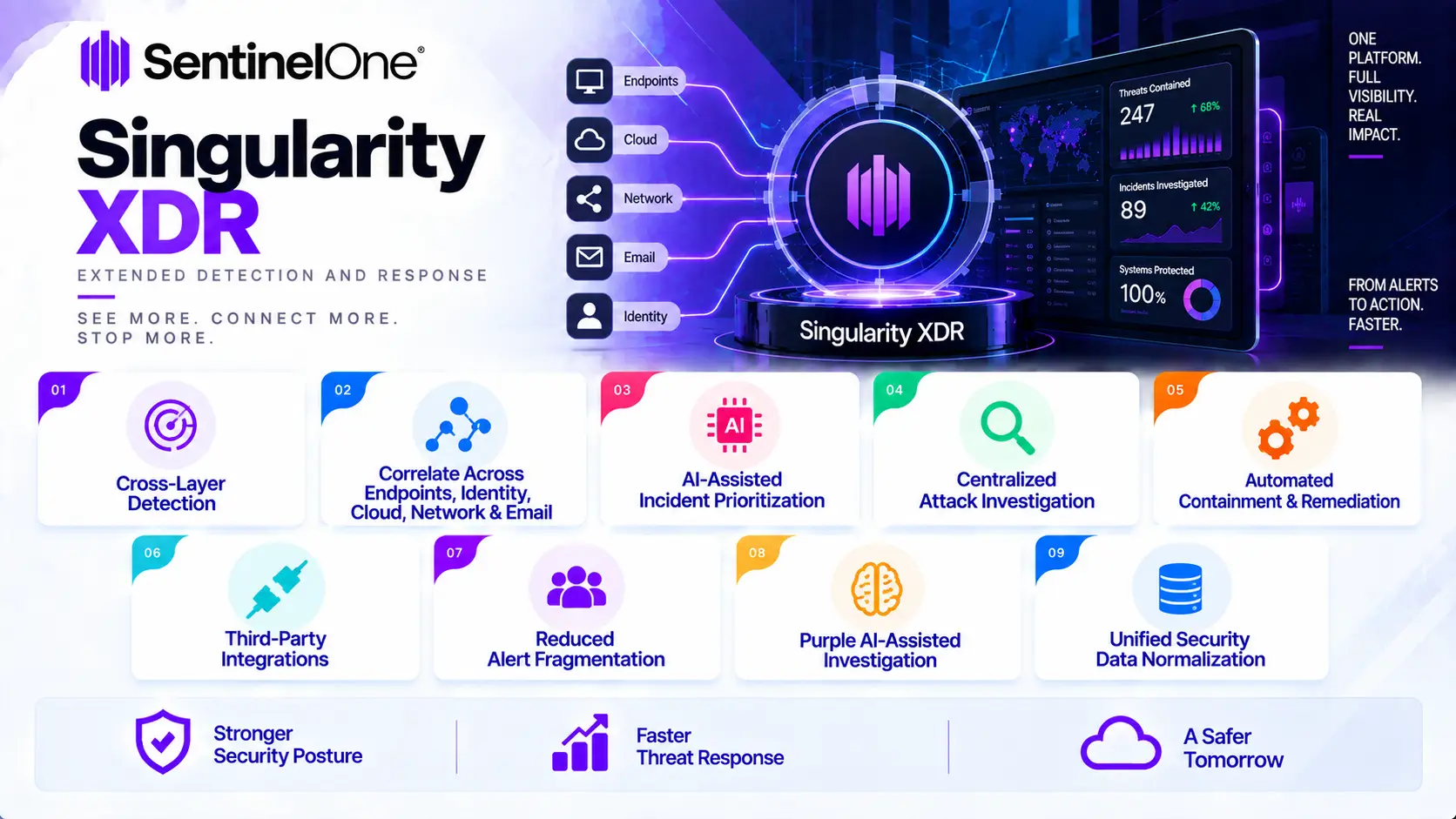
Singularity XDR is SentinelOne’s extended detection and response approach for correlating security activity across endpoints, identities, cloud workloads, network sources, email systems, AI environments, and third-party security tools. Built on the Singularity Platform, it gives SOC teams a unified investigation layer instead of forcing analysts to reconstruct an attack across multiple disconnected consoles.
Quick Benefits
- Cross-layer detection across multiple attack surfaces
- Correlation of endpoint, identity, cloud, network, and email signals
- AI-assisted incident prioritization
- Centralized investigation of complex attacks
- Automated containment and remediation workflows
- Integration with third-party security technologies
- Reduced alert fragmentation for SOC teams
- Purple AI-assisted investigation and threat hunting
- Unified security data normalization
Singularity XDR At a Glance
What it is: Extended Detection and Response capability delivered through the SentinelOne Singularity Platform
Product family: SentinelOne Singularity
Parent category: SentinelOne Singularity License
Primary role: Correlate, investigate, and respond to attacks spanning multiple security surfaces
Native security surfaces: Endpoint, Identity, Cloud, and AI security environments
Additional data sources: Email, network, firewall, SaaS, and third-party security technologies through integrations
Data architecture: Unified Singularity data layer with normalized security telemetry
Investigation capabilities: Cross-surface correlation, incident prioritization, root-cause investigation, Storyline context, and Purple AI
Response capabilities: Automated containment, remediation, and security actions across supported surfaces
Integration model: Open XDR through Singularity Marketplace

License Overview
A Singularity XDR License should be planned around the security surfaces and data sources an organization wants to correlate rather than treated as a simple endpoint count alone. SentinelOne currently does not describe XDR as a separate standalone SKU. Instead, XDR outcomes are delivered through the Singularity Platform. Organizations typically start with Singularity Endpoint or Singularity Complete and extend XDR by connecting additional sources such as identity, cloud, network, email, and external security products.
This structure makes licensing more flexible, but it also means that two companies with the same number of endpoints can require very different configurations. One may only need endpoint and identity correlation, while another may ingest network alerts, cloud telemetry, email events, SaaS activity, and several third-party tools.
The underlying Singularity package also matters. SentinelOne currently publishes Singularity Complete, Commercial, and Enterprise packages. Complete includes endpoint and cloud workload protection with real-time detection and response; Commercial adds Identity Detection & Response, 90-day retention, and managed threat hunting; Enterprise adds deeper visibility, forensics, and AI-driven SOC capabilities. Before purchasing a Singularity XDR License, buyers should therefore map their required telemetry sources, retention period, SOC workflows, and existing security tools rather than sizing only from employee or device count.
Product Overview
Cross-Surface Threat Detection
Sophisticated attacks rarely remain inside one security domain.
An attacker may begin with a compromised identity, execute malicious activity on an endpoint, access a cloud resource, communicate with external infrastructure, and later move laterally through the network.
If each activity is handled by a separate security platform, analysts may receive several unrelated alerts.
Singularity XDR addresses this by ingesting and normalizing security information into a unified data layer and automatically correlating signals across connected surfaces.
The result is a more complete attack view rather than a collection of isolated alerts.
Endpoint and Identity as the Native Foundation
SentinelOne positions endpoint and identity security as important native foundations for its XDR architecture.
Endpoint telemetry provides process, file, behavioral, and system context, while identity information can expose suspicious credential activity and account-related risks.
When these signals are correlated, an analyst can see whether suspicious endpoint behavior is associated with an unusual login, compromised identity, or broader attack sequence rather than investigating each event separately.
Cloud, Network, and Email Visibility
XDR becomes more valuable as additional security surfaces are connected.
SentinelOne states that its platform can unify alerts from endpoint, identity, cloud, email, and network environments into a single prioritized view. Third-party security data can also be normalized through the Singularity Marketplace.
This is useful for organizations that already have investments in network security, email protection, cloud monitoring, or SaaS security and do not want to replace those systems simply to gain XDR functionality.
Options and Licensing Models
| Licensing Option | Description | Suitable For |
|---|---|---|
| Singularity Complete Foundation | Provides endpoint and cloud workload protection with real-time detection and response as a starting point for broader XDR | Organizations beginning with endpoint-driven XDR |
| Singularity Commercial | Adds Identity Detection & Response, 90-day retention, and managed threat hunting | Teams requiring identity context and longer investigations |
| Singularity Enterprise | Adds deeper network visibility, forensics, and AI-driven SOC capabilities | Large and globally distributed security operations |
| Third-Party Data Integrations | Adds external email, network, firewall, SaaS, and other security data through Marketplace integrations | Enterprises with existing security tools |
| Additional Security Surfaces | Extends correlation into identity, cloud, network, AI, or other supported domains | Organizations requiring broader attack visibility |
| Extended Data Retention | Keeps security telemetry available for longer investigation windows | SOC, threat hunting, forensic, and compliance use cases |
| AI SIEM Expansion | Adds longer-term log retention, compliance reporting, and broader querying while retaining XDR capabilities | Organizations moving beyond real-time XDR into security data operations |
Features and Benefits
The main benefit of Singularity XDR is not simply collecting more security data. Its value comes from connecting signals that would otherwise require manual correlation.
A suspicious endpoint process may not appear critical by itself. If the same user account has abnormal identity activity, the endpoint connects to an unusual destination, and a related cloud event appears shortly afterward, the combined incident tells a very different story.
This broader context can shorten root-cause analysis and reduce the number of console changes required during an investigation.
Open integrations are another important advantage. Organizations do not necessarily need to replace existing email, network, cloud, or SIEM investments to gain XDR value. Those technologies can contribute signals and, in supported workflows, participate in response actions through the Singularity ecosystem.
For mature SOC teams, Singularity XDR can also become a stepping stone toward AI SIEM when longer retention, regulatory reporting, and larger-scale security data analysis become necessary. SentinelOne currently describes AI SIEM as combining XDR capabilities with long-term log retention and queryable data for up to seven years.
Compatibility and Requirements
Before deploying Singularity XDR, organizations should document which security systems will contribute useful telemetry.
Important considerations include:
- Number of protected endpoints and servers
- Existing Singularity package
- Identity platforms
- Cloud workloads and cloud services
- Network security products
- Email security platforms
- Firewalls and SaaS applications
- Third-party detection tools
- Data ingestion requirements
- Required retention period
- SOC investigation workflows
- Automated response integrations
The goal is not to connect every available log source. High-value sources should be prioritized according to the attack scenarios the SOC needs to detect and investigate.
Activation and Deployment
Deployment normally starts with the organization’s existing Singularity protection and then expands into additional security surfaces.
Typical steps include:
- Activate the appropriate Singularity subscription
- Deploy endpoint protection where required
- Connect identity and cloud sources
- Add relevant Marketplace integrations
- Configure third-party data ingestion
- Validate event normalization and correlation
- Configure investigation workflows
- Test containment and response actions
SentinelOne specifically recommends a progressive approach: start with existing endpoint coverage, connect additional data sources, and then expand into identity, cloud, third-party integrations, or AI SIEM as security requirements grow.
Pricing and Quote Process
Pricing for a Singularity XDR License depends on more than the number of endpoints. The underlying Singularity package is one factor, but additional security surfaces, external integrations, retention, security data ingestion, and managed services can materially change the final configuration.
Before requesting a quote, define:
- Endpoint and server quantity
- Current Singularity package
- Identity security requirements
- Cloud environments
- Network and email security sources
- Third-party integrations
- Required telemetry ingestion
- Historical retention period
- Threat-hunting requirements
- MDR or managed security services
- Subscription duration
SentinelOne pricing depends on your security solution, endpoint coverage, XDR capabilities, threat detection requirements, deployment model, license term, and support needs.