

Cisco PLR License refers to Cisco Permanent License Reservation, a Smart Licensing reservation method used to activate supported Cisco products in restricted, offline, secure, or air-gapped environments. Unlike normal connected Smart Licensing, Cisco PLR License does not depend on continuous communication with Cisco licensing systems after the reservation process is completed. It is mainly used when a Cisco product must be activated in a controlled environment where internet-based license communication is not allowed or not practical.
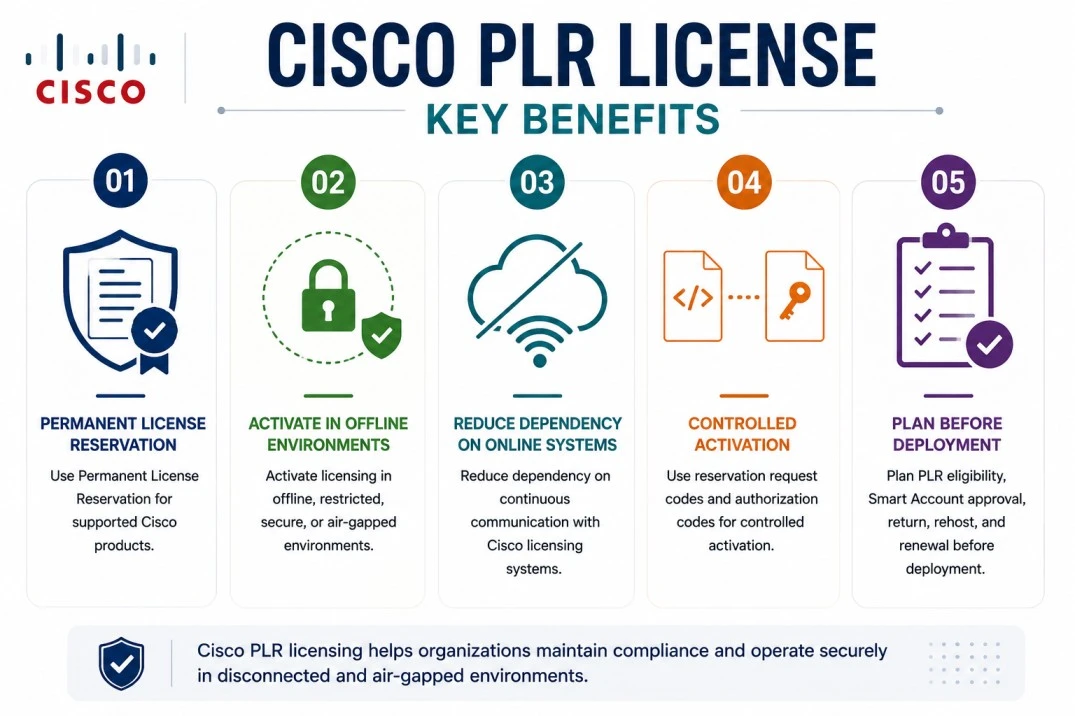
Key Benefits
- Use Permanent License Reservation for supported Cisco products
- Activate licensing in offline, restricted, secure, or air-gapped environments
- Reduce dependency on continuous communication with Cisco licensing systems
- Use reservation request codes and authorization codes for controlled activation
- Plan PLR eligibility, Smart Account approval, return, rehost, and renewal before deployment
Cisco PLR License At a glance
What it does : Cisco PLR License allows supported Cisco products to activate licensed capabilities through a permanent reservation-style authorization process.
License behavior : PLR is used to reserve or authorize licensed features on a supported Cisco product without requiring regular online license communication after activation.
Where it applies : Supported Cisco routing, switching, security, collaboration, data center, virtual appliance, and software-based products where PLR is available.
Who needs it : Organizations with secure, offline, restricted, government, defense, industrial, or air-gapped environments that need Cisco product activation without continuous cloud connectivity.
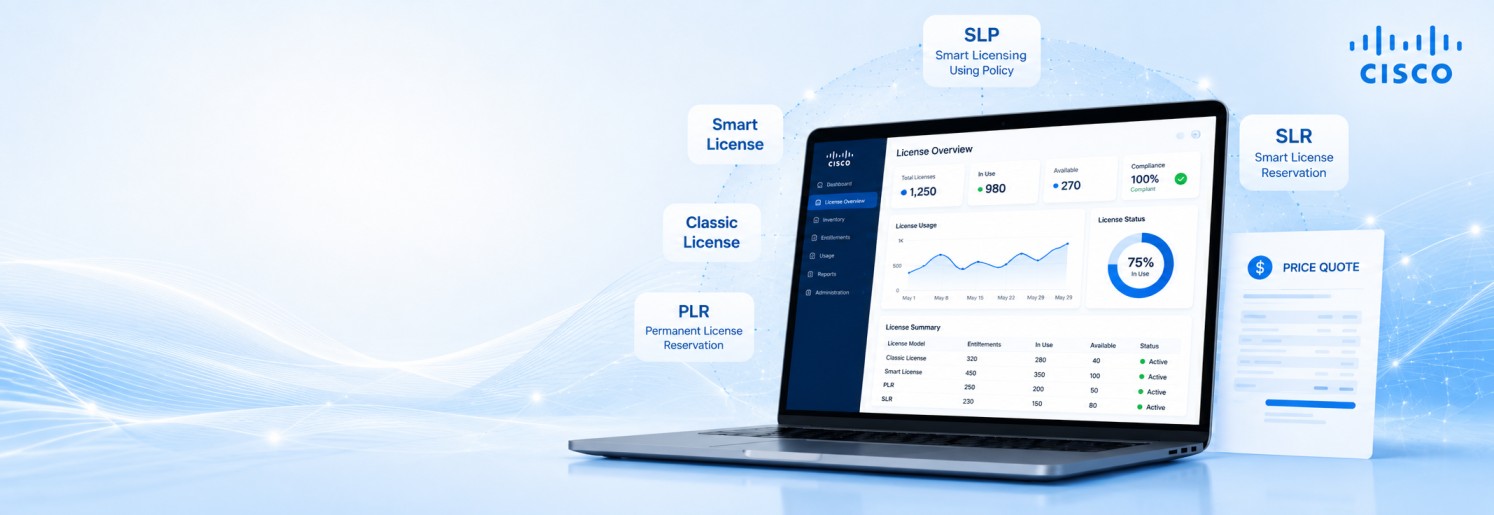
License Model Overview
Cisco PLR License is part of Cisco Smart Licensing, but it is designed for environments where normal Smart Licensing communication is not suitable. In a standard Smart Licensing model, a product may register, report usage, or communicate with Cisco licensing tools through a connected or managed workflow. PLR uses a different approach.
With Permanent License Reservation, the license activation is handled through a reservation process. The Cisco product generates a request code, the administrator uses that code in Cisco licensing tools, and an authorization code is created. After the authorization code is installed on the Cisco product, the product can use the reserved licensed capabilities without needing normal continuous communication with Cisco licensing systems.
Cisco PLR License is usually considered for highly controlled environments. These may include air-gapped networks, secure data centers, military environments, government networks, industrial networks, and enterprise systems where licensing traffic cannot be sent to external cloud services.
The main difference between Cisco PLR License and Cisco SLR License is the scope of reservation. SLR usually reserves specific licenses or selected entitlements. PLR is broader and is commonly used as a permanent reservation-style activation method where supported by the product and approved by Cisco. Because PLR is not available for every Cisco product or every customer environment, eligibility should always be confirmed before planning deployment. Product support, software version, Smart Account status, license type, and Cisco approval requirements must be reviewed carefully.
How Cisco PLR License Works
Cisco PLR License works through a controlled offline reservation process. First, the Cisco product must support Permanent License Reservation. The administrator enables or starts the reservation workflow on the product, and the device or software instance generates a reservation request code. This code represents the product instance that needs PLR activation.
Next, the request code is entered into Cisco licensing tools, such as Cisco Smart Software Manager or the supported Cisco licensing portal. If the Smart Account and product are eligible for PLR, the required reservation can be created. After the reservation is completed, Cisco licensing tools generate an authorization code. This authorization code is then installed on the Cisco product. Once the code is accepted, the product can use the licensed capabilities allowed by the PLR workflow.
In some environments, a confirmation or return process may also be required. This is important if the product is replaced, decommissioned, moved, upgraded, or if the reservation needs to be returned to the Smart Account. In simple terms, Cisco PLR License works like this: the product requests reservation, Cisco licensing tools generate an authorization code, the code is installed on the product, and the product continues operating with the reserved license state without regular online licensing communication.
Where This License Model Is Used
Cisco PLR License is mainly used in environments where connected Smart Licensing is not possible or not allowed. This can happen because of strict security rules, compliance requirements, isolated networks, no internet access, or internal policy restrictions. PLR may be used with supported Cisco products in routing, switching, security, collaboration, virtual appliance, data center, and enterprise software environments. Examples may include Cisco routers, Cisco virtual routers, Cisco security products, Cisco collaboration products, Cisco Catalyst platforms, Cisco data center platforms, and other supported Cisco software-based deployments.
It is especially useful when the product must remain operational in a network that cannot regularly communicate with Cisco Smart Software Manager, Cisco licensing services, or external cloud systems. However, Cisco PLR License should not be assumed to be available for every product. Some Cisco platforms support Smart Licensing Using Policy, some support SLR, some support PLR, and some may require other licensing methods. The correct model depends on the Cisco product, software release, license entitlement, and customer eligibility.
Cisco PLR License Activation
The Cisco PLR License activation process usually follows a reservation-based workflow.
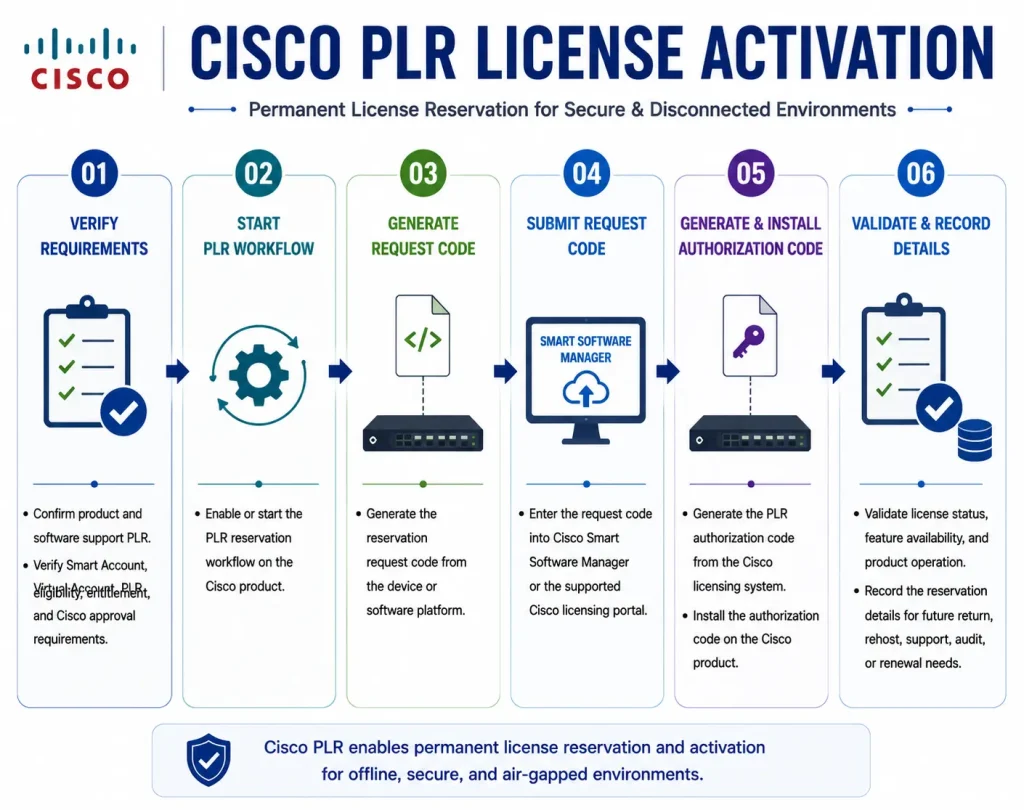
The most important point is to confirm eligibility before starting. PLR is a powerful activation method, but it is controlled and product-dependent. If the product, software version, or Smart Account is not approved for PLR, another licensing model may be required.
Features & Benefits
Cisco PLR License gives organizations a practical way to activate supported Cisco products in secure and disconnected environments. One major benefit is offline operation. After the reservation process is completed, the product does not need normal continuous communication with Cisco licensing systems. This is useful for networks where internet access is blocked, restricted, or not allowed by policy.
Another benefit is operational continuity. In high-security environments, licensing should not interrupt production services or force the product to connect to an external licensing cloud. PLR helps keep activation controlled while allowing the product to continue operating with the required licensed capabilities.
Cisco PLR License is also useful for long-term isolated deployments. Some organizations run Cisco infrastructure in environments where devices may remain disconnected for months or years. A reservation-style activation model can be easier to manage than a reporting-based licensing workflow.
PLR can also simplify activation for certain controlled deployments because the administrator handles the request code and authorization code manually. This gives the organization more control over how licensing information moves between the Cisco product and Cisco licensing tools. The main limitation is that PLR must be planned carefully. If hardware is replaced, the product instance changes, or the reservation must be returned, the organization may need to follow Cisco’s return, rehost, or support process.
System Requirements
Common environments
- Air-gapped enterprise networks
- Government and defense environments
- Secure data centers
- Industrial and critical infrastructure networks
- Offline Cisco routing or security deployments
- Restricted virtual appliance environments
- Cisco products without allowed internet connectivity
- Environments where continuous Smart Licensing communication is not permitted
Technical requirements
- Supported Cisco product and software version
- Cisco Smart Account and Virtual Account access
- PLR eligibility and approval where required
- Correct license entitlement and product scope
- Reservation request code generated from the Cisco product
- Authorization code generated through Cisco licensing tools
- Access to the product CLI, GUI, or management interface for installation
- Return, rehost, renewal, or support process planning
Pricing factors + quote process
Pricing for Cisco PLR License depends on the Cisco product, required license entitlement, software version, feature level, quantity, support coverage, and subscription or renewal term. PLR itself is an activation and reservation method. The actual price is normally based on the Cisco license being reserved or activated. A router license, firewall license, virtual appliance license, Catalyst license, collaboration license, or data center license may all have different pricing even when PLR is used as the activation method.
The main pricing factors usually include product family, license tier, feature set, device count, throughput level, user count, software version, support term, renewal status, and whether the environment requires offline or restricted activation support. During the quote process, the Cisco product and deployment condition are reviewed first. Then the required entitlement, PLR eligibility, Smart Account status, activation workflow, support coverage, and renewal timing are mapped into the correct quote.
After you request a quote
- We review your Cisco product, model, and software version
- Confirm whether Cisco PLR License is supported for your environment
- Check Smart Account, entitlement, PLR eligibility, and activation requirements
- Review request code, authorization code, return, rehost, or renewal needs
- Provide pricing, delivery details, and activation guidance
Cisco PLR pricing depends on your router series, license type, deployment model and support requirements.