

Cisco APIC License refers to the licensing and entitlement structure used for Cisco Application Policy Infrastructure Controller environments within Cisco ACI deployments. Cisco APIC is the main controller used to manage ACI policy, automation, fabric operations, health monitoring, tenant configuration, and application-centric data center networking, while license-dependent APIC and ACI-related software features must be activated with the correct Cisco license, such as Smart Licensing or Smart Licensing Using Policy, including PLR License and SLR License where applicable.
Key Benefits
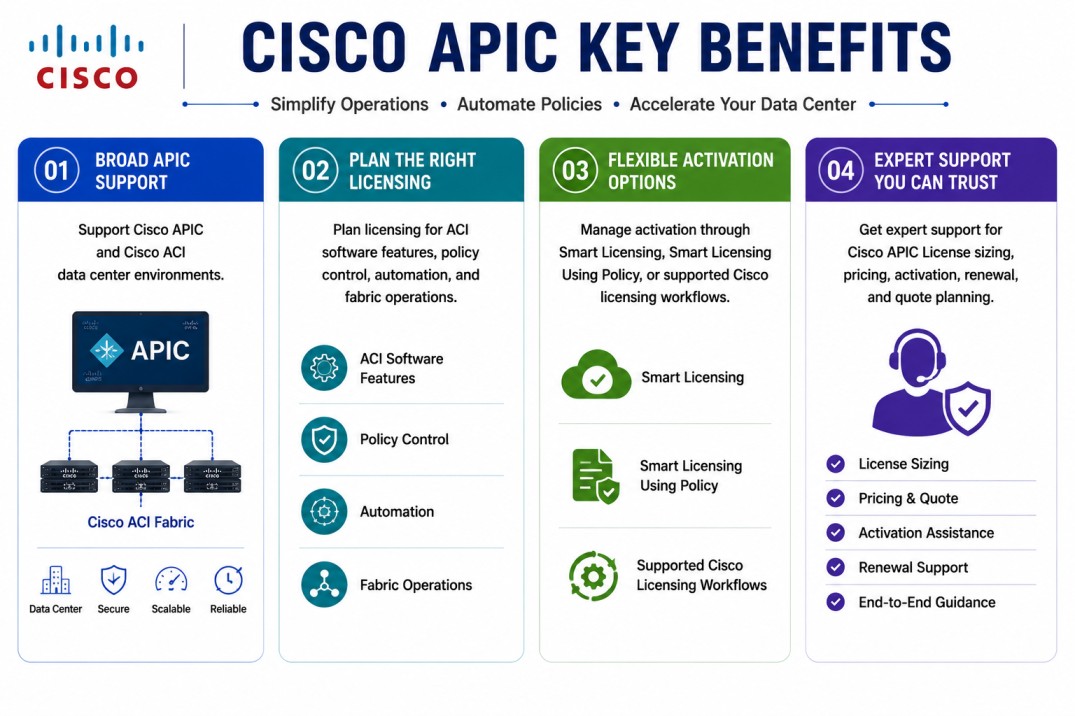
- Support Cisco APIC and Cisco ACI data center environments
- Plan licensing for ACI software features, policy control, automation, and fabric operations
- Manage activation through Smart Licensing, Smart Licensing Using Policy, or supported Cisco licensing workflows
- Get expert support for Cisco APIC License sizing, pricing, activation, renewal, and quote planning
Review Cisco APIC Price List and request a quote tailored to your licensing needs.
Cisco APIC At a glance
What it does : Cisco APIC License helps organizations manage license-dependent Cisco APIC and ACI-related software features used for policy-based data center networking, automation, segmentation, and operational visibility.
Product category : Cisco data center controller and ACI licensing.
Main Cisco platforms : Cisco APIC, Cisco ACI, Cisco Nexus switches, Cisco Nexus Dashboard, and Cisco Data Center Networking software subscriptions.
License type : Licensing depends on the ACI environment, software release, required features, Cisco Data Center Networking tier, Smart Licensing model, and support coverage.
Who needs it : Organizations using Cisco APIC to manage Cisco ACI fabrics, data center policy, application connectivity, automation, segmentation, tenant operations, and centralized fabric control.

License Overview
Cisco APIC licensing should be understood as part of the wider Cisco ACI model within the Cisco Networking portfolio. APIC is the controller and management platform for Cisco ACI, but the actual licensing scope usually depends on the ACI fabric, Cisco Nexus switches, software features, data center networking subscriptions, and operational services required in the environment.
A Cisco APIC License may involve Cisco ACI product licenses, Data Center Networking subscription tiers, Smart Licensing Using Policy, Smart Account registration, support coverage, and renewal planning. The exact license requirement can vary based on software version, ACI deployment size, feature usage, and whether the environment requires advanced automation, segmentation, visibility, or operational tools.
In many modern Cisco ACI environments, licensing is managed through Cisco Smart Licensing or Smart Licensing Using Policy. These workflows help administrators track license usage, validate entitlement status, and manage compliance across Cisco ACI product licenses.
Because APIC is central to ACI operations, license planning should not be done separately from the fabric design. The number of switches, required ACI features, Nexus Dashboard services, support term, and software version can all affect the final licensing scope. A properly planned Cisco APIC License helps organizations avoid activation issues, missing feature entitlement, support gaps, renewal confusion, and operational limitations in Cisco ACI environments.
Product Overview
Cisco APIC, or Cisco Application Policy Infrastructure Controller, is the main controller used in Cisco ACI environments. It provides centralized policy management, automation, fabric configuration, health monitoring, and operational control for application-centric data center networking. In a traditional data center network, administrators may need to configure many switches, VLANs, routing policies, access rules, and application segments manually. Cisco APIC changes this model by allowing administrators to define policies centrally and apply them across the ACI environment.
Cisco APIC is used to manage tenants, VRFs, bridge domains, endpoint groups, contracts, application profiles, fabric policies, and operational settings. These elements help translate application and business requirements into network behavior. APIC is also important for visibility and control. It gives administrators a central interface to monitor fabric health, review faults, manage configuration, and operate the ACI environment more efficiently. The main value of Cisco APIC is that it helps organizations manage complex data center networks with a more centralized, automated, and policy-driven approach.
Core technical flow
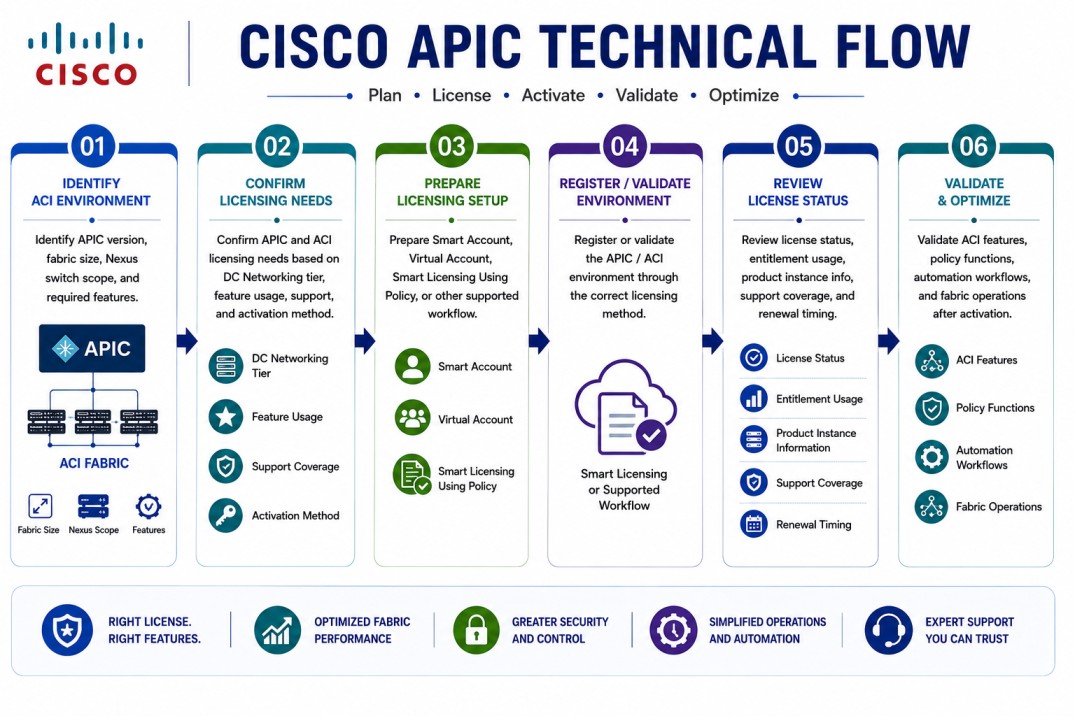
- Identify the Cisco ACI environment, including APIC version, fabric size, Cisco Nexus switch scope, and required software features.
- Confirm the APIC and ACI licensing requirements based on Data Center Networking tier, feature usage, support coverage, and activation method.
- Prepare Cisco Smart Account, Virtual Account, Smart Licensing Using Policy, or another supported Cisco licensing workflow.
- Register or validate the APIC / ACI environment through the correct licensing method.
- Review license status, entitlement usage, product instance information, support coverage, and renewal timing.
- Validate that the required ACI features, policy functions, automation workflows, and fabric operations are available after activation.
Options & Licensing Models
| Licensing model | Best for | Typical scope | What affects pricing |
|---|---|---|---|
| Cisco ACI licensing | APIC-managed ACI fabrics | ACI product licenses and fabric-related software capabilities | Fabric size, features, and software release |
| Data Center Networking Essentials | Foundational ACI environments | Core data center networking and ACI functions | Switch scope and required base features |
| Data Center Networking Advantage | Advanced ACI environments | Broader automation, segmentation, operations, and fabric capabilities | Feature depth and deployment scale |
| Data Center Networking Premier | Advanced visibility and operations | Deeper insights, assurance, and Day-2 operational capabilities | Nexus Dashboard and operational requirements |
| Smart Licensing Using Policy | Modern ACI licensing management | License reporting, usage visibility, and entitlement compliance | Software version and licensing workflow |
| PLR License / SLR License | Offline or restricted activation scenarios | Reservation-based activation options where applicable | Cisco eligibility, platform support, and customer environment |
| Support and renewal coverage | Ongoing APIC and ACI operations | Software access, technical support, lifecycle planning, and renewal continuity | Term, support level, and product scope |
Features & Benefits
Cisco APIC License planning helps organizations keep ACI controller operations, software entitlement, support coverage, and feature access aligned with the real data center environment. One major benefit is centralized policy control. With Cisco APIC, administrators can define how applications, tenants, network segments, and services communicate across the ACI environment.
Another benefit is automation. APIC helps reduce manual configuration by applying policies and fabric settings from a central controller instead of managing every switch and network rule separately. Cisco APIC also supports better operational visibility. Administrators can monitor fabric health, review faults, check policy behavior, and manage the ACI environment from a unified interface.
Licensing also supports lifecycle control. The correct license and support coverage help ensure that required software capabilities, updates, and operational features remain available during deployment, expansion, and renewal cycles. For organizations using Cisco ACI, Cisco Nexus switches, APIC clusters, and Nexus Dashboard services, a properly planned licensing model helps reduce deployment risk and keep the data center fabric aligned with business and application requirements.
System Requirements
Common environments
- Cisco ACI data center fabrics
- Cisco APIC controller clusters
- Cisco Nexus switch environments running in ACI mode
- Cisco Nexus Dashboard operations and visibility environments
- Multi-tenant and application-centric data center networks
- Enterprise data center automation and segmentation projects
Technical requirements
- Supported Cisco APIC version and ACI software release
- Cisco Nexus switch compatibility with ACI deployment requirements
- Cisco Smart Account and Virtual Account access where applicable
- Correct Data Center Networking or ACI license tier
- Smart Licensing, Smart Licensing Using Policy, PLR License, or SLR License workflow where applicable
- Support contract, subscription term, and renewal requirement
How activation works
Cisco APIC license activation depends on the Cisco ACI software version, licensing model, and connectivity method used in the environment. In modern Cisco ACI environments, Smart Licensing Using Policy can be used to manage Cisco ACI product licenses. This helps administrators track license usage and maintain entitlement visibility without interrupting network operations.
Activation usually starts by confirming the Cisco Smart Account, Virtual Account, APIC software version, ACI license tier, and required product entitlements. The APIC environment can then be configured for the supported licensing workflow. For connected environments, license usage may be reported through Cisco licensing tools. For controlled or restricted environments, offline or reservation-based options such as PLR License or SLR License may be used where applicable.
After activation, administrators should validate license status, product instance information, feature availability, fabric health, support coverage, and renewal timing. This is important because a missing Cisco APIC License or ACI entitlement can affect software feature access, license compliance, operational visibility, and long-term support readiness.
Pricing factors + quote process
Pricing for Cisco APIC License depends on the ACI environment, Cisco Nexus switch scope, software tier, required features, Smart Licensing workflow, support level, and subscription or renewal term. A small ACI deployment may need a different licensing scope than a larger enterprise fabric with multiple APIC controllers, more Cisco Nexus switches, advanced segmentation, Nexus Dashboard visibility, and broader automation requirements.
The main pricing factors usually include ACI fabric size, required Data Center Networking tier, Cisco Nexus switch count, APIC software version, Nexus Dashboard requirements, support coverage, PLR License or SLR License activation needs, and renewal timing. During the quote process, the Cisco APIC and ACI environment is reviewed first. Then the required software features, licensing model, activation workflow, support coverage, and renewal requirements are mapped into the correct quote.
After you request a quote
- We review your Cisco APIC and ACI environment
- Identify the required Cisco APIC License model and license scope
- Check ACI software, Nexus switch scope, Smart Licensing, PLR License, and SLR License considerations
- Provide pricing, delivery details, and activation guidance
Cisco APIC pricing depends on your license type, deployment model and support requirements.