

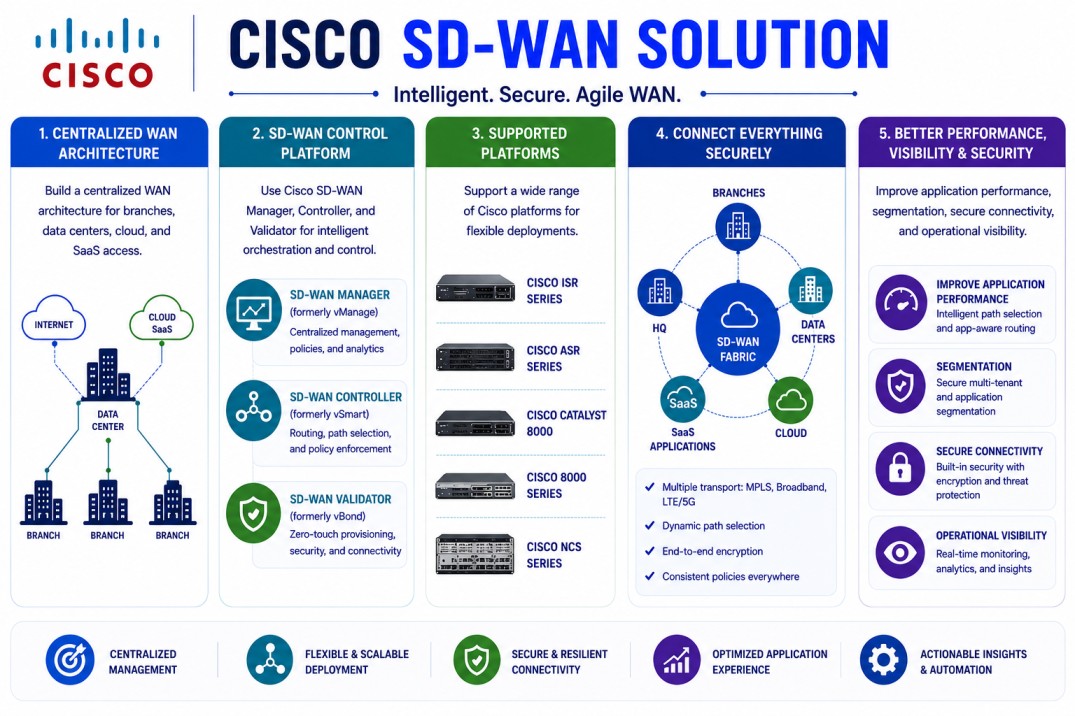
Cisco SD-WAN, now commonly presented by Cisco as Cisco Catalyst SD-WAN, is Cisco’s software-defined wide area networking solution for connecting branches, campuses, data centers, cloud services, and SaaS applications through a centrally managed WAN architecture. It is mainly built around Cisco SD-WAN Manager (formerly vManage), Cisco SD-WAN Controller (formerly vSmart), Cisco SD-WAN Validator (formerly vBond), and WAN Edge platforms such as Cisco ISR, Cisco ASR, Cisco Catalyst 8000, Cisco 8000 Series, Cisco NCS, and other supported Cisco Edge Routers. License-dependent Cisco SD-WAN components and related software features must be activated with the correct Cisco license, such as Smart License, including PLR License and SLR License.
Solution Highlights
- Build a centralized WAN architecture for branches, data centers, cloud, and SaaS access
- Use Cisco SD-WAN Manager (formerly vManage), Cisco SD-WAN Controller (formerly vSmart), Cisco SD-WAN Validator (formerly vBond)
- Support Cisco ISR, Cisco ASR, Cisco Catalyst 8000, Catalyst 8000 Series and Cisco NCS
- Improve application performance, segmentation, secure connectivity, and operational visibility
Cisco SD-WAN At a glance
What it does : Cisco SD-WAN helps organizations connect multiple sites, users, data centers, and cloud applications through a centrally managed WAN overlay.
Solution type : Cisco WAN, branch, cloud connectivity, and secure networking solution, not a single hardware product.
Main Cisco software and controllers : Cisco SD-WAN is mainly built around Cisco SD-WAN Manager for centralized management, Cisco SD-WAN Controller for control-plane policy and routing, and Cisco SD-WAN Validator for authentication and orchestration.
Related Cisco platforms : Cisco SD-WAN can be used with WAN Edge platforms such as Cisco ISR, Cisco ASR, Cisco Catalyst 8000, Cisco 8000 series , Cisco NCS and other supported Cisco routers.
Who needs it : Organizations that need centralized WAN management, branch connectivity, cloud access, SaaS optimization, encrypted tunnels, segmentation, application-aware routing, and secure direct internet access.
Cisco SD-WAN Overview
Cisco SD-WAN is designed to simplify how organizations connect remote sites, branches, data centers, cloud services, and users. Instead of managing every WAN router separately, Cisco SD-WAN allows network teams to define policies centrally and apply them across the WAN environment.
The solution is different from Cisco ACI. Cisco ACI is mainly focused on policy-based networking inside the data center, while Cisco SD-WAN is focused on wide area networking between locations, cloud platforms, and business applications. At the center of Cisco SD-WAN is Cisco SD-WAN Manager. It provides the main management interface for device onboarding, templates, configuration, monitoring, policies, certificates, and operational visibility.
Cisco SD-WAN Controller manages the control plane of the SD-WAN overlay. It helps distribute routes, policies, and control information between WAN Edge devices. Cisco SD-WAN Validator supports authentication, device validation, and the initial connection process between edge devices and control components.
WAN Edge routers are the platforms that forward traffic at branch offices, campuses, data centers, cloud locations, or remote sites. These can include Cisco ISR, Cisco ASR, Cisco Catalyst 8000, Cisco 8000 Series, Cisco NCS and other supported Cisco edge platforms. The main value of Cisco SD-WAN is that it helps organizations build a more flexible, secure, and application-aware WAN. It is especially useful when the environment uses multiple transport links, such as internet, MPLS, LTE, 5G, or cloud connectivity.
How Cisco SD-WAN Works
Cisco SD-WAN works by creating a secure overlay network across different WAN transport links. These links may include internet, MPLS, LTE, 5G, broadband, or private connectivity. In simple terms, Cisco SD-WAN helps network teams define how WAN traffic should behave, choose the best available path for applications, and manage branch-to-cloud connectivity from a more centralized model.
Cisco SD-WAN Manager : is used to configure and monitor the environment from a central interface. Administrators can create device templates, apply policies, onboard routers, monitor traffic, and review network health without configuring every router manually.
Cisco SD-WAN Controller : distributes routing and policy information between WAN Edge devices. This allows the WAN to understand which paths are available and how traffic should move across the overlay.
Cisco SD-WAN Validator : helps WAN Edge devices and control components authenticate and discover each other. It is especially important during the onboarding process and when devices are behind NAT.
WAN Edge routers : build secure tunnels between sites and forward user, application, voice, cloud, and business traffic. These edge devices can apply routing, segmentation, security, and application-aware policies.
Core technical flow
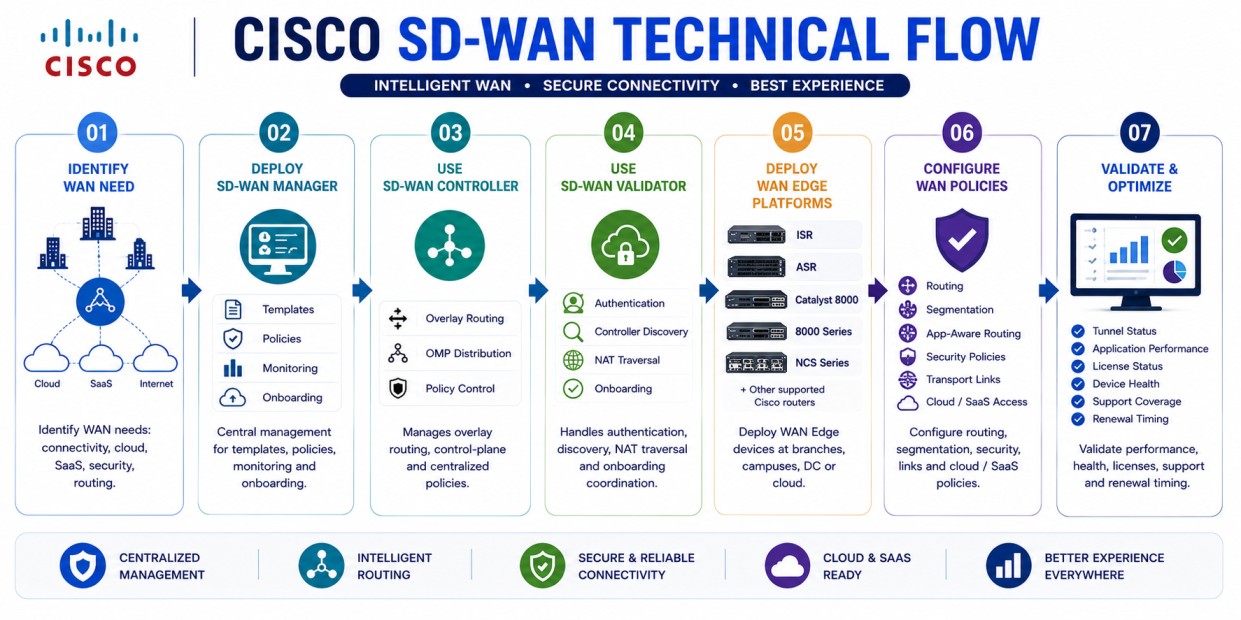
- Identify the WAN requirement, such as branch connectivity, cloud access, SaaS optimization, secure internet breakout, or multi-site routing.
- Deploy Cisco SD-WAN Manager as the main management platform for templates, policies, monitoring, and device onboarding.
- Use Cisco SD-WAN Controller to manage overlay routing, control-plane communication, OMP route distribution, and centralized policy behavior.
- Use Cisco SD-WAN Validator for device authentication, controller discovery, NAT traversal support, and onboarding coordination.
- Add WAN Edge platforms such as ISR, ASR, Cisco Catalyst 8000 Cisco 8000 series and Cisco NCS other supported Cisco routers at branches, campuses, data centers, or cloud locations.
- Configure routing, segmentation, application-aware routing, security policies, transport links, and cloud/SaaS access policies.
- Validate tunnel status, application performance, license status, device health, support coverage, and renewal timing after deployment.
Cisco Products Used with Cisco SD-WAN
| Cisco products (Platforms) | Role in Cisco SD-WAN environment | Why it matters |
|---|---|---|
| Cisco SD-WAN Manager (vManage) | Acts as the central management platform for Cisco SD-WAN. | It is used for device onboarding, templates, configuration, monitoring, policy management, certificates, and operational visibility. |
| Cisco SD-WAN Controller (vSmart) | Provides the control-plane function for the SD-WAN overlay. | It distributes routes, policies, and control information between WAN Edge devices so the SD-WAN environment can operate as one controlled WAN architecture. |
| Cisco SD-WAN Validator (vBond) | Supports device authentication, controller discovery, NAT traversal, and onboarding coordination. | It helps WAN Edge devices and SD-WAN control components find and authenticate each other during the initial connection process. |
| Cisco ISR (vEdge) |
Used as a WAN Edge platform for branch and remote-site SD-WAN deployments, depending on model and software compatibility. | ISR routers are commonly used in distributed enterprise networks where branch routing, WAN connectivity, and SD-WAN migration are required. |
| Cisco ASR (vEdge) |
Used for larger WAN edge, aggregation, and data center edge environments. | ASR routers are useful where higher routing scale, stronger performance, and WAN aggregation are required. |
| Cisco Catalyst 8000 (vEdge) |
Used as a modern WAN Edge platform for SD-WAN, cloud access, secure branch connectivity, and enterprise edge routing. | Catalyst 8000 platforms are designed for software-defined WAN, application visibility, security services, and cloud-first connectivity. |
| Cisco 8000 Series (vEdge) |
Used in small branch, remote office, and compact WAN edge environments where supported. | Cisco 8000 Series routers can fit smaller locations that need routing and WAN connectivity with a compact platform design. |
| Cisco NCS (vEdge) |
Used in service provider, aggregation, and high-scale networking environments where supported for WAN or edge roles. | Cisco NCS platforms are relevant when the SD-WAN or WAN design requires carrier-grade routing, high scalability, or advanced network edge capacity. |
Cisco SD-WAN Manager (vManage)
Cisco SD-WAN Manager, formerly known as vManage, is the main management platform in a Cisco SD-WAN environment. It gives administrators a central place to onboard devices, create templates, configure policies, monitor network health, and manage WAN Edge Routers. Instead of configuring each branch router separately, network teams can use Cisco SD-WAN Manager to push consistent configurations and policies across multiple sites. This is especially useful for organizations with many branches, cloud connections, remote offices, or distributed users. Cisco SD-WAN Manager also provides visibility into tunnel status, device health, application traffic, transport links, alarms, certificates, and operational performance. In simple terms, it is the main interface used to manage and operate the Cisco SD-WAN solution.
Cisco SD-WAN Controller (vSmart)
Cisco SD-WAN Controller, formerly known as vSmart, is responsible for the control plane of the Cisco SD-WAN overlay. Its main job is to distribute routing information, policies, and control messages between WAN Edge devices. The controller helps the SD-WAN environment understand which sites are available, which routes should be used, and how traffic should be handled across the WAN. It also plays an important role in centralized policy control, segmentation, and application-aware routing. Cisco SD-WAN Controller does not normally forward user traffic directly. Instead, it controls how WAN Edge routers communicate and exchange routing information. This allows the SD-WAN network to operate as one organized overlay instead of many separately managed routers.
Cisco SD-WAN Validator (vBond)
Cisco SD-WAN Validator, formerly known as vBond, supports the initial connection, authentication, and orchestration process in a Cisco SD-WAN deployment. It helps WAN Edge routers and SD-WAN control components find and authenticate each other. This component is especially important when WAN Edge devices are deployed in remote branches, behind NAT, or across different internet and private WAN connections. It helps devices securely join the SD-WAN environment and connect to the correct SD-WAN Manager and Controller components. Cisco SD-WAN Validator does not manage daily configuration like SD-WAN Manager and does not control routing like SD-WAN Controller. Its main role is to support secure onboarding, device validation, and initial control-plane connectivity.
Cisco SD-WAN Edge Routers
Cisco SD-WAN Edge routers are the physical or virtual platforms that forward traffic inside the SD-WAN environment. These devices are deployed at branches, campuses, data centers, cloud locations, or remote sites, and they build secure connections across WAN links such as internet, MPLS, LTE, 5G, or private connectivity. Cisco SD-WAN can work with different edge platforms depending on the design, including Cisco ISR, Cisco ASR, Cisco Catalyst 8000, Cisco 800 Series, Cisco NCS, and other supported Cisco Edge Routers. Each platform has a different role: Cisco ISR and Cisco 8000 Series routers are commonly used for branch and remote-site connectivity, Cisco ASR and Cisco NCS platforms are more suitable for larger WAN, aggregation, or high-scale environments, Cisco Catalyst 8000 platforms are commonly used for modern enterprise SD-WAN and cloud-ready edge routing.
Features & Benefits
Cisco SD-WAN helps organizations manage wide area networking with a more centralized, secure, and application-aware approach. One of the main benefits is centralized WAN control. Instead of configuring every branch router separately, administrators can use Cisco SD-WAN Manager to apply templates, policies, and operational changes across many sites. Another important benefit is application-aware routing. Cisco SD-WAN can choose better paths for business applications based on performance conditions such as latency, loss, jitter, and service-level requirements.
Cisco SD-WAN also improves segmentation. Different traffic types, business units, users, guests, or services can be separated across the WAN to improve control and reduce unnecessary exposure. Security is another important advantage. Cisco SD-WAN can support encrypted tunnels, secure local internet breakout, firewall features, DNS/web security integrations, and cloud-delivered security models depending on the design. Cloud and SaaS access can also be improved. Cisco SD-WAN can help organizations connect branches and users to cloud applications more efficiently, especially when using features such as Cloud OnRamp, direct internet access, and application optimization. Overall, Cisco SD-WAN helps organizations reduce WAN complexity, improve application performance, support cloud adoption, strengthen branch security, and manage distributed networks from a more centralized operational model.
How deployment and activation works
Deploying Cisco SD-WAN starts with preparing the main control components: Cisco SD-WAN Manager (formerly vManage), Cisco SD-WAN Controller (formerly vSmart), and Cisco SD-WAN Validator (formerly vBond). These components handle management, control-plane communication, authentication, onboarding, templates, policies, and operational visibility. After the control components are prepared, Cisco SD-WAN Edge routers are added to the environment. These can include Cisco ISR, Cisco ASR, Cisco Catalyst 8000, Cisco 8000 Series, Cisco NCS and other supported Cisco edge routers depending on the branch, WAN, cloud, or aggregation requirement.
Cisco SD-WAN Manager is then used to onboard devices, apply configuration templates, define routing and security policies, monitor tunnel status, and manage the WAN environment from a centralized interface. WAN Edge routers build secure connections across available transport links such as internet, MPLS, LTE, 5G, or private WAN services. License-dependent Cisco SD-WAN components and related software features must be activated with the correct Cisco license, such as Smart Licensing, with PLR License or SLR License activation options available where applicable. After deployment, administrators should validate device onboarding, tunnel status, routing behavior, application performance, segmentation, license status, system health, support coverage, and renewal timing.
Pricing factors + quote process
Pricing for Cisco SD-WAN depends on the size of the WAN environment, the Cisco platforms involved, the selected subscription tier, the required software features, and the support or subscription term selected for the project. The main factors usually include the number of WAN Edge devices, Cisco Catalyst 8000 or ISR/ASR router models, virtual edge requirements, SD-WAN Manager deployment model, WAN Essentials or WAN Advantage tier, security features, cloud connectivity needs, and support coverage.
A small branch SD-WAN deployment may need a different license and support scope than a larger enterprise WAN with many sites, multiple transports, cloud access, application-aware routing, advanced segmentation, and stronger security requirements.
During the quote process, the Cisco SD-WAN environment is reviewed first. Then the required Cisco platforms, software features, licensing model, support coverage, and activation requirements are mapped into the correct quote.
After you request a quote
- We review your Cisco SD-WAN environment and WAN requirements
- Identify the required Cisco platforms, software features, and license scope
- Check SD-WAN Manager, Controller, Validator, WAN Edge routers considerations
- Provide pricing, delivery details, and activation guidance