

Cisco ACI (Application Centric Infrastructure) is Cisco’s data center networking solution for building a centralized, policy-based architecture across applications, servers, storage, and enterprise data center environments. It is commonly used with Cisco APIC and Nexus Dashboard to manage policy, automation, operations, and visibility, while also supporting data center environments that include Cisco MDS switches, Cisco Nexus switches and Cisco UCS servers.
License-dependent Cisco ACI components and related software features must be activated with the correct Cisco license, such as Smart Licensing, including PLR License or SLR License activation options where applicable.
Solution Highlights
- Build a centralized, policy-based Cisco data center environment
- Use Cisco APIC and Nexus Dashboard for control, automation, visibility, and operations
- Integrate with related data center platforms such as Cisco UCS Servers, virtual environments, and storage networks where required.
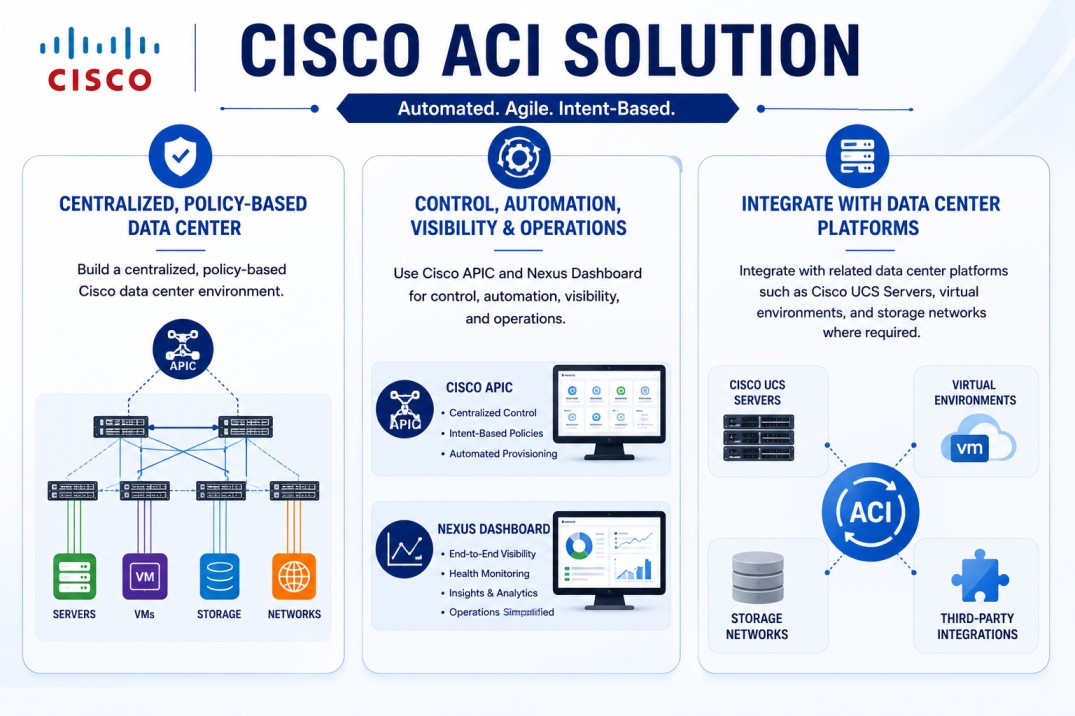
Cisco ACI At a glance
What it does : Cisco ACI helps organizations manage data center networking through centralized policy, automation, segmentation, and operational visibility instead of configuring every network component separately.
Solution type : Cisco data center networking and automation solution
Main Cisco software and controllers : Cisco ACI is mainly built around Cisco APIC for policy management and Cisco Nexus Dashboard for operations, visibility, orchestration, and infrastructure insights.
Who needs it : Organizations that need centralized data center network control, application-aware policy, segmentation, automation, and better visibility across enterprise data center environments.
Cisco ACI Overview
Cisco ACI is designed to simplify how data center networks are controlled, automated, and operated. Instead of managing every switch, server connection, security policy, and application path separately, Cisco ACI allows organizations to manage network behavior through a centralized policy model.
At the center of Cisco ACI is Cisco APIC, which acts as the main policy controller for the ACI environment. Administrators use APIC to define how applications, servers, network segments, and services should communicate inside the data center. This makes the network easier to control because policies can be created centrally and then applied across the infrastructure.
Cisco Nexus Dashboard can also be used with Cisco ACI to improve visibility, operations, monitoring, and orchestration. It gives network teams a clearer view of the data center environment. Cisco ACI can also support environments that include Cisco MDS switches, Cisco UCS servers, virtual environments and Cisco Nexus switches.
How Cisco ACI Works
Cisco ACI works by moving data center network control from separate device-by-device configuration into a centralized policy-based model. Instead of configuring every network path manually, administrators define the required policies in Cisco APIC, and ACI applies those policies across the data center environment.
Cisco APIC is the main control and management point of Cisco ACI. It is used to create tenants, network segments, application policies, contracts, and communication rules. These policies define how different parts of the data center are allowed to communicate with each other.
Cisco Nexus Dashboard can be added to improve operational visibility and management. It helps teams monitor the environment, review health, analyze issues, and manage data center operations with better insight. Cisco Nexus switches provide the switching infrastructure that carries traffic inside the ACI environment. They work under the control of APIC, so network behavior can be managed through policy instead of isolated switch configuration. Cisco ACI can also be used in environments that include Cisco UCS servers, virtual environments, Cisco MDS switches, and storage systems.
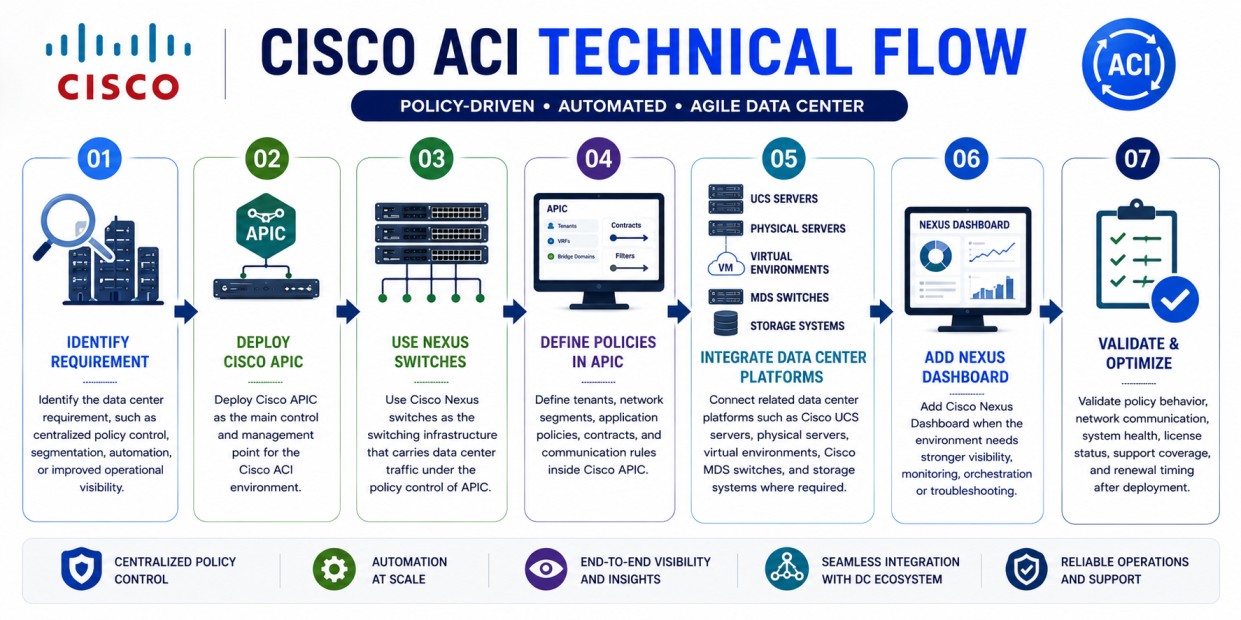
Core technical flow
- Identify the data center requirement, such as centralized policy control, segmentation, automation, or improved operational visibility.
- Deploy Cisco APIC as the main control and management point for the Cisco ACI environment.
- Use Cisco Nexus switches as the switching infrastructure that carries data center traffic under the policy control of APIC.
- Define tenants, network segments, application policies, contracts, and communication rules inside Cisco APIC.
- Connect related data center platforms such as Cisco UCS servers, physical servers, virtual environments, Cisco MDS switches, and storage systems where required.
- Add Cisco Nexus Dashboard when the environment needs stronger visibility, monitoring, orchestration or troubleshooting
- Validate policy behavior, network communication, system health, license status, support coverage, and renewal timing after deployment.
Cisco Products Used with Cisco ACI
| Cisco product / platform | Role in Cisco ACI environment | Why it matters |
| Cisco APIC | Acts as the main controller and policy management platform for Cisco ACI. | APIC is where administrators define tenants, network segments, application policies, contracts, and communication rules for the ACI environment. |
| Cisco Nexus Dashboard | Provides operational visibility, monitoring, insights, orchestration, and Day-2 management for Cisco data center environments. | Nexus Dashboard helps teams manage ACI operations more efficiently by improving visibility, troubleshooting, and infrastructure control. |
| Cisco MDS switches | Used for storage networking and SAN environments that may exist alongside the ACI data center architecture. | MDS switches support Fibre Channel and storage connectivity, making them important in data centers where ACI is used for Ethernet and application networking while MDS handles storage traffic. |
| Cisco Nexus switches | Provide the switching infrastructure used inside the Cisco ACI environment. | Nexus switches carry data center traffic and operate under the policy control of Cisco APIC in an ACI deployment. |
| Cisco UCS Servers | Provides compute infrastructure that can connect into a Cisco ACI-based data center environment. | UCS servers can host applications, virtual machines, and workloads that use the ACI network for policy-based connectivity and segmentation. |
Cisco APIC and Cisco ACI
Cisco APIC is the main control and management platform for Cisco ACI. It is used to define and manage the policies that control how applications, servers, workloads, and services communicate inside the data center.
Through APIC, administrators can create tenants, network segments, bridge domains, contracts, endpoint groups, and application policies. These elements help translate business and application requirements into network behavior.
In simple terms, Cisco APIC is the brain of the Cisco ACI environment. It provides the central point where policies are created, applied, monitored, and adjusted across the ACI infrastructure.
Cisco Nexus Dashboard and Cisco ACI
Cisco Nexus Dashboard adds an operational layer to Cisco ACI environments. While APIC controls the ACI fabric, Nexus Dashboard helps improve visibility, monitoring, troubleshooting, orchestration, and Day-2 operations.
It is especially useful for teams that manage larger data center environments or multiple sites. Nexus Dashboard can help administrators review health, detect issues, analyze infrastructure behavior, and manage operational tasks from a more centralized interface.
For Cisco ACI, Nexus Dashboard is not the main controller. That role belongs to APIC. Its value is in helping teams operate, observe, and manage the ACI environment more effectively after deployment.
Cisco MDS Switches and Cisco ACI
Cisco MDS is used for storage networking, especially SAN and Fibre Channel environments. It is not a core Cisco ACI fabric component, but it can exist alongside ACI in the same enterprise data center architecture.
In many data centers, Cisco ACI is used for Ethernet networking and application communication, while Cisco MDS switches are used for storage traffic and SAN connectivity. Both can support the same overall data center strategy, but they serve different technical roles.
This relationship is important because modern data centers often need both application networking and storage networking. Cisco ACI can manage the policy-based data center network, while Cisco MDS supports reliable storage connectivity for servers and applications.
Cisco Nexus Switches and Cisco ACI
Cisco Nexus switches provide the main switching infrastructure used inside a Cisco ACI environment. They connect servers, storage-facing networks, service devices, and other data center systems while operating under the policy control of Cisco APIC.
In a Cisco ACI design, Nexus switches do not work only as traditional standalone switches. They become part of a centralized architecture where forwarding, segmentation, and communication behavior are managed through policies defined in APIC.
This makes Cisco Nexus switches important for organizations that want to move from manual switch-by-switch configuration to a more automated and policy-based data center network.
Cisco UCS Servers and Cisco ACI
Cisco UCS servers can be used as the compute layer in a data center environment that also uses Cisco ACI. UCS servers may host applications, databases, virtual machines, and business workloads that connect into the ACI network.
Cisco ACI helps control how these workloads communicate across the data center by applying centralized network policies. This is useful when organizations need consistent segmentation, controlled communication, and better visibility across server and application environments.
Cisco UCS server is not a replacement for APIC or Nexus switches. It is a compute platform that can benefit from the policy-based networking model provided by Cisco ACI.
Options & Licensing Models
| Licensing Model | Best for | Typical Scope | What affects pricing |
| DCN Essentials | Foundational ACI environments | Core data center networking and base ACI capabilities | Switch model, fabric size, and required features |
| DCN Advantage | Advanced ACI fabrics | Broader policy, automation, multi-site, and operational capabilities | Feature depth and deployment scale |
| DCN Premier | Advanced operations and insights | Includes deeper Day-2 operations and Nexus Dashboard-related capabilities | Assurance, insights, and operational visibility |
| Smart Licensing | Modern entitlement visibility | License ownership, reporting, and compliance workflows | Smart Account and activation method |
Features & Benefits
Cisco ACI helps organizations manage data center networking with a more centralized and policy-based approach. Instead of configuring network behavior separately on different devices, teams can define policies through Cisco APIC and apply them across the ACI environment.
One of the main benefits is better control over network policies. Administrators can define how applications, servers, and services should communicate, then manage those rules from a central point. This reduces manual configuration and helps keep the network more consistent.
Another important benefit is automation. Cisco ACI can help speed up data center changes by allowing teams to create and apply network policies more efficiently. This is useful when new applications, servers, or services need to be added to the environment.
How deployment and activation work
Deploying Cisco ACI starts with preparing the main data center components, including Cisco APIC for policy management and Cisco Nexus switches for the ACI switching environment. Cisco Nexus Dashboard can also be added when the organization needs stronger visibility, monitoring, and operational control.
After deployment, Cisco APIC is used to manage tenants, network segments, endpoint groups, contracts, and application policies. These settings define how applications, servers, and services communicate inside the data center.
If the environment includes Cisco UCS servers, Cisco MDS switches or storage systems, they should be reviewed as part of the wider data center design.
Activation and licensing depend on the Cisco products, software features, and subscription model used in the environment. After setup, administrators should validate policy behavior, network communication, license status, system health, support coverage, and renewal timing.
Pricing factors + quote process
Pricing for Cisco ACI depends on the size of the data center environment, the Cisco products involved, the required software features, and the support or subscription term selected for the project. The main factors usually include Cisco APIC requirements, Cisco Nexus switch models and quantities, Nexus Dashboard capabilities, required software features, fabric size, support level, and subscription term.
During the quote process, the Cisco ACI environment is reviewed first. Then the required Cisco products, software features, licensing model, support coverage, and activation requirements are mapped into the correct quote.
After you request a quote
- We review your Cisco ACI environment and data center requirements
- Identify the required Cisco products, software features, and license scope
- Check APIC, Nexus Dashboard, Nexus switches, UCS servers , and MDS switches considerations
- Provide pricing, delivery details, and activation guidance