

Tenable Attack Surface Management helps organizations discover and monitor internet-facing assets, improving visibility into external exposure risks across dynamic environments.
Quick benefits
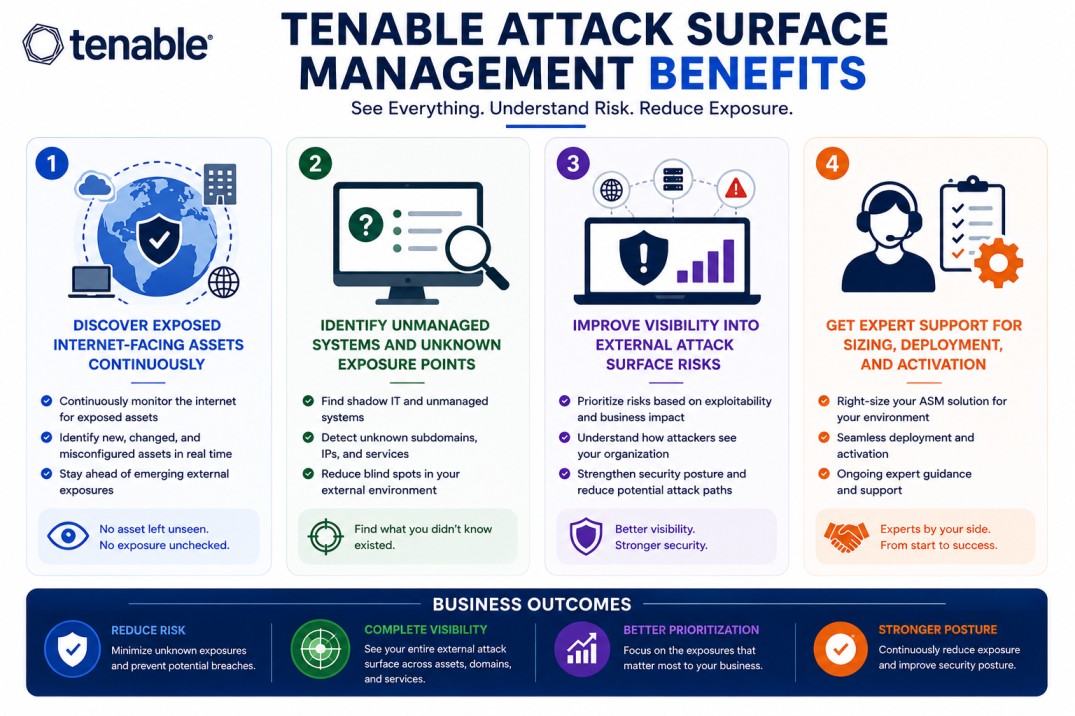
- Discover exposed internet-facing assets continuously
- Identify unmanaged systems and unknown exposure points
- Improve visibility into external attack surface risks
- Get expert support for sizing, deployment, and activation
Tenable Attack Surface Management At a glance
What it does : Tenable Attack Surface Management continuously identifies and monitors externally exposed assets across internet-facing environments.
License type : Subscription-based (asset/domain-based)
Typical term : 1 year · 3 years · 5 years
Activation method : Cloud-managed activation via Tenable platform
Who needs it : Organizations that want visibility into external exposure risks, internet-facing systems, and unmanaged assets
License Overview
The Tenable Attack Surface Management license is generally aligned with the number of internet-facing assets, domains, and externally exposed systems being monitored. Because external environments change continuously, licensing should reflect the real scope of publicly exposed infrastructure rather than static inventories alone. Organizations with cloud expansion, distributed services, or multiple internet-facing environments often require broader discovery coverage.
Tenable Attack Surface Management is designed to provide continuous external visibility across dynamic infrastructures, helping organizations understand which assets are reachable from the internet and how exposure changes over time. A properly sized license helps ensure that internet-facing systems, cloud assets, and unmanaged services remain visible within the monitoring scope as environments scale.
Product Overview
Tenable Attack Surface Management is designed to help organizations understand what parts of their infrastructure are exposed externally and potentially reachable by attackers.
In practice, the platform continuously discovers internet-facing assets such as domains, cloud services, public IPs, and externally accessible systems. This helps security teams identify assets that may not be fully tracked through internal inventories alone.
One of the key advantages is continuous discovery. As new systems, cloud workloads, or services become exposed, the platform updates visibility automatically instead of relying on periodic manual assessments.
The platform also helps organizations identify unmanaged or shadow IT assets that may introduce additional exposure risk without being formally monitored.
For growing or highly distributed environments, this visibility supports more proactive external exposure management and security prioritization.
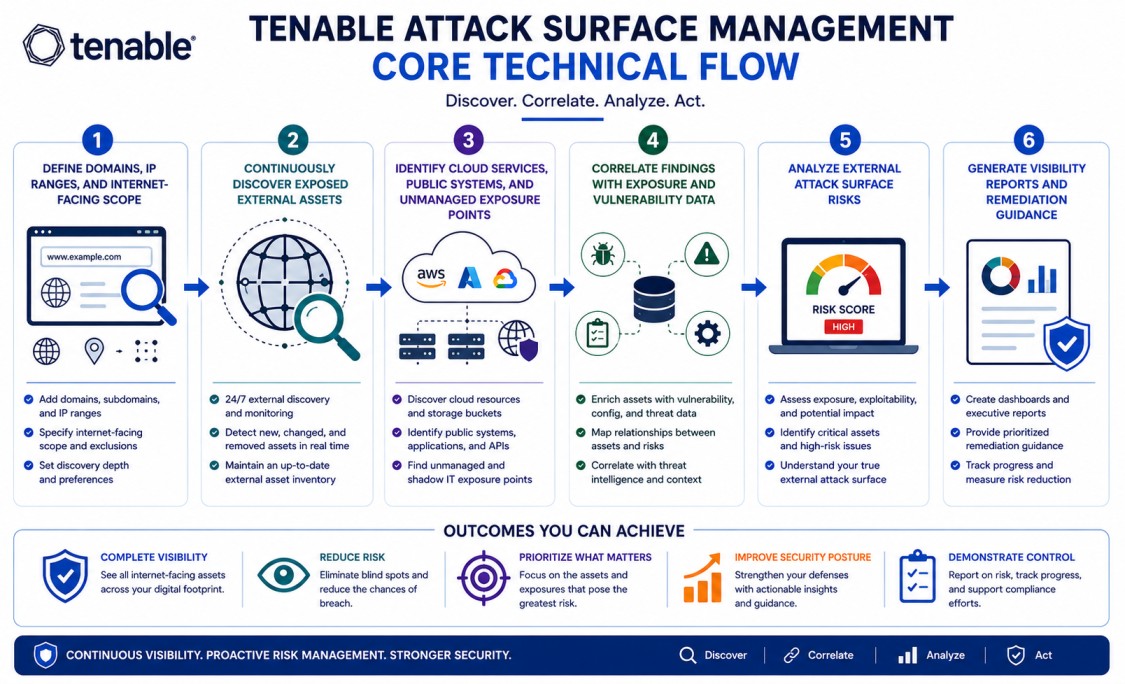
Core technical flow
- Define domains, IP ranges, and internet-facing scope
- Continuously discover exposed external assets
- Identify cloud services, public systems, and unmanaged exposure points
- Correlate findings with exposure and vulnerability data
- Analyze external attack surface risks
- Generate visibility reports and remediation guidance
Options & Tiers
| Plan / Model | Best for | Key inclusions | What affects price |
|---|---|---|---|
| Standard external visibility | Most organizations | Internet-facing asset discovery | Asset scope, term |
| Cloud-focused deployment | Cloud-first environments | Public cloud exposure visibility | Cloud scale |
| Hybrid deployment | Mixed infrastructures | External + distributed asset monitoring | Integration scope |
| Enterprise deployment | Large environments | Scalable attack surface visibility | Environment complexity |
Features & Benefits
Tenable Attack Surface Management helps organizations improve visibility into external exposure risks that are often difficult to track across distributed environments. One of the main operational advantages is continuous asset discovery. Security teams can identify new internet-facing systems and services as environments evolve. It also helps reduce blind spots by identifying unmanaged or shadow IT assets that may not appear in traditional internal inventories. Over time, this leads to stronger awareness of external exposure risks and more consistent attack surface monitoring across cloud and internet-facing infrastructure.
Compatibility & Requirements
Supported Environments
- Cloud and hybrid infrastructures
- Internet-facing enterprise environments
- Distributed external services and applications
System Requirements
- Domain and external asset visibility
- Cloud or internet-facing infrastructure access
- Connectivity to Tenable cloud platform
How activation works
Activating Tenable Attack Surface Management typically starts with provisioning your Tenable cloud environment and applying the appropriate subscription license. Once the platform is active, administrators define the external scope to be monitored. This may include domains, public IP ranges, cloud environments, and internet-facing services. The platform then begins continuously discovering exposed assets and correlating findings with exposure intelligence and vulnerability context.
Because the service is cloud-managed, discovery and visibility updates are handled centrally without requiring extensive on-prem infrastructure deployment. As environments expand, organizations should periodically review monitored scope and asset coverage to ensure all internet-facing systems remain within the licensed visibility range.
Pricing factors + quote process
Pricing for Tenable Attack Surface Management is usually influenced by the number of internet-facing assets, domains, and externally exposed environments being monitored. Organizations with larger cloud footprints, distributed services, or rapidly changing infrastructures often require broader visibility coverage and discovery scope.
Other factors, such as deployment scale, cloud integrations, and subscription term, can also affect licensing scope. The quote process generally starts with reviewing your external infrastructure footprint, cloud exposure requirements, and attack surface visibility goals. From there, the appropriate licensing and monitoring approach can be recommended.
After you request a quote
- We review your external infrastructure scope
- Recommend the most suitable visibility model
- Provide official pricing and delivery details
- Share activation and deployment guidance
Tenable Pricing depends on your license edition, quantity, term, and deployment needs.