

Tenable Nessus Manager helps organizations centrally manage vulnerability scanning operations across distributed environments with improved visibility, scanner coordination, and assessment workflows.
Quick benefits
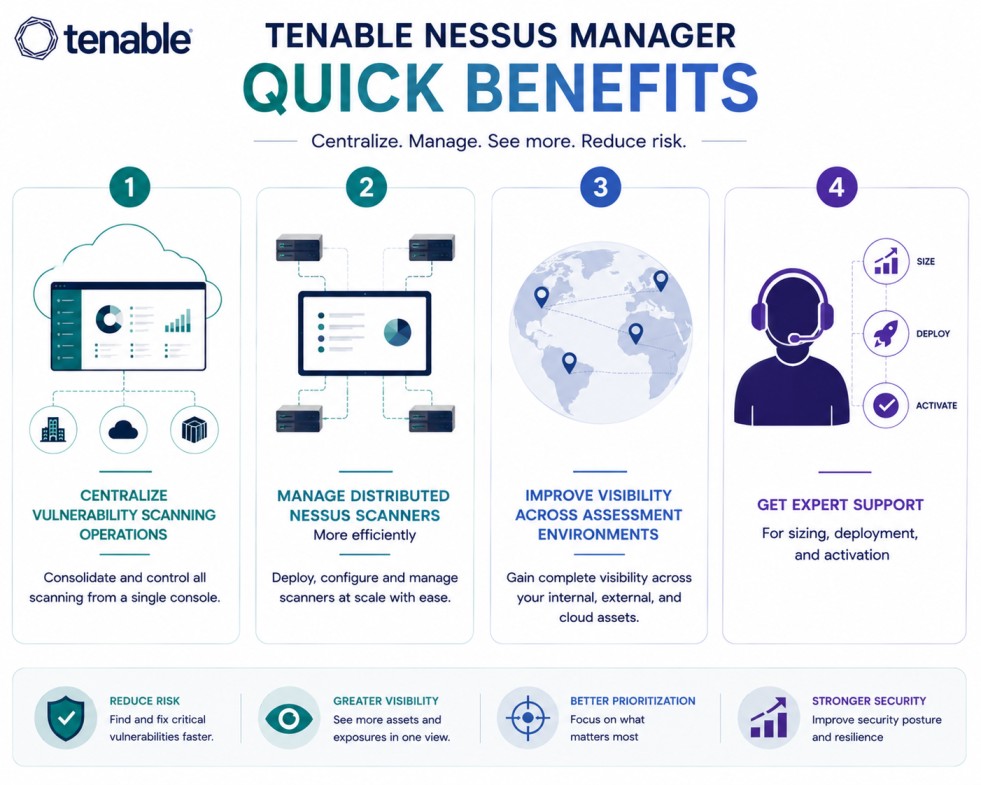
- Centralize vulnerability scanning operations
- Manage distributed Nessus scanners more efficiently
- Improve visibility across assessment environments
- Get expert support for sizing, deployment, and activation
Tenable Nessus Manager At a glance
What it does : Tenable Nessus Manager provides centralized management for Nessus scanning infrastructure and vulnerability assessment operations.
License type : Subscription-based (scanner/asset-based)
Typical term : 1 year · 3 years · 5 years
Activation method : On-prem or hybrid activation via Tenable platform
Who needs it : Organizations operating multiple Nessus scanners or distributed vulnerability assessment environments

License Overview
Organizations managing distributed vulnerability assessment environments often require licensing that aligns with scanner coordination, infrastructure visibility, and operational assessment scope rather than only standalone scanner usage. The Tenable Nessus Manager license is generally aligned with the number of managed scanners, infrastructure coverage requirements, and operational assessment environments included within the deployment.
Because many enterprise environments operate across multiple locations, network segments, or operational zones, deployment planning typically focuses on maintaining centralized scanner visibility and coordinated vulnerability assessment workflows. A properly aligned license helps organizations manage vulnerability scanning infrastructure more consistently while improving operational oversight across distributed assessment environments.
Product Overview
As vulnerability assessment environments expand across multiple sites and infrastructure segments, managing scanners individually can become increasingly difficult operationally.
Tenable Nessus Manager is designed to help organizations centralize vulnerability scanning operations across distributed environments and operational teams.
In practice, the platform helps coordinate Nessus scanners, assessment policies, and scanning workflows from a centralized management layer instead of relying on isolated scanner administration.
One of the key operational advantages is broader scanner visibility. Security teams can manage scanning coverage more consistently across infrastructure environments while simplifying vulnerability assessment coordination.
For organizations operating large or segmented infrastructures, this centralized management approach supports more scalable vulnerability operations and improved assessment consistency.
Core technical flow
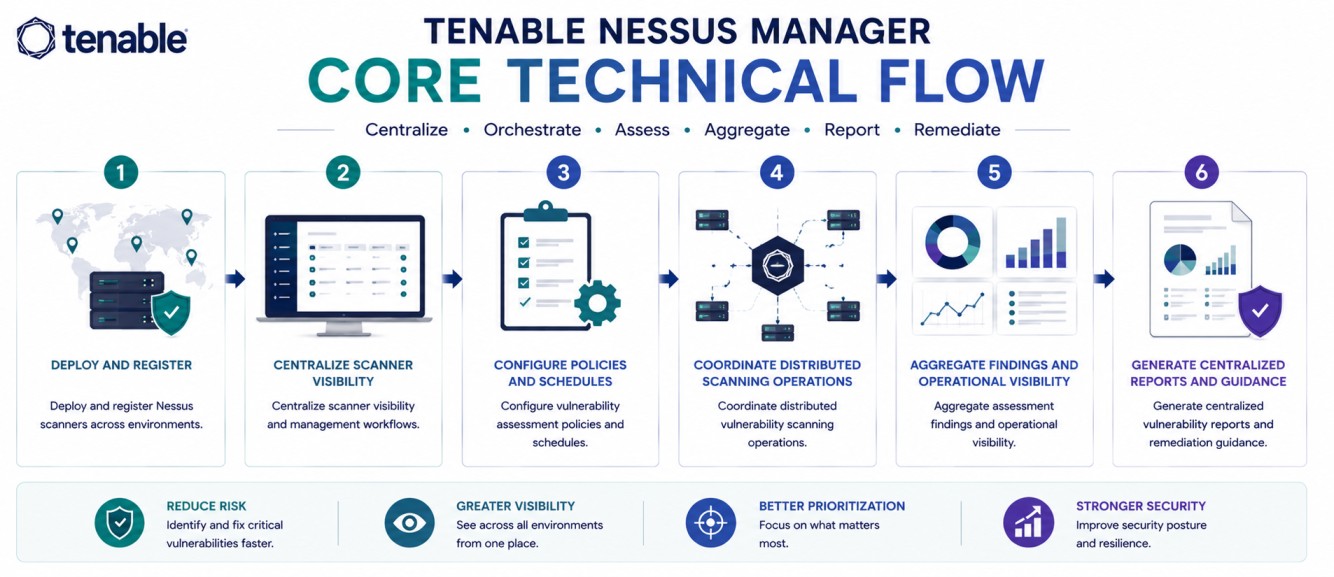
- Deploy and register Nessus scanners across environments
- Centralize scanner visibility and management workflows
- Configure vulnerability assessment policies and schedules
- Coordinate distributed vulnerability scanning operations
- Aggregate assessment findings and operational visibility
- Generate centralized vulnerability reports and remediation guidance
Options & Tiers
| Plan / Model | Best for | Key inclusions | What affects price |
|---|---|---|---|
| Standard scanner management | Most organizations | Centralized Nessus visibility | Scanner count, term |
| Distributed deployment | Multi-site infrastructures | Coordinated scanning workflows | Infrastructure scope |
| Hybrid deployment | Mixed environments | Centralized vulnerability operations | Deployment complexity |
| Enterprise deployment | Large organizations | Scalable scanner management | Operational scale |
Features & Benefits
As organizations deploy more vulnerability scanners across infrastructure environments, maintaining operational consistency and visibility can become more challenging over time. Tenable Nessus Manager helps simplify this process by centralizing scanner management and vulnerability assessment coordination across distributed operational environments.
One of the main advantages is improved operational oversight. Security teams can monitor scanning coverage, configure policies, and coordinate vulnerability assessments from a more unified management workflow. The platform also supports more scalable assessment operations by helping organizations standardize scanning practices across infrastructure segments and operational teams. Over time, this leads to more consistent vulnerability visibility and improved coordination across enterprise assessment environments.
System Requirements
Common environments
- Enterprise vulnerability management deployments
- Distributed infrastructure environments
- Multi-site assessment operations
- Hybrid vulnerability scanning ecosystems
Technical requirements
- Nessus scanner infrastructure
- Connectivity between scanners and management platform
- Access to operational assessment environments
How activation works
Activating Tenable Nessus Manager typically starts with deploying the management platform and applying the appropriate subscription license. Once the platform is operational, administrators register Nessus scanners and configure centralized visibility policies across the required assessment environments. Depending on the infrastructure architecture, this may include configuring scanner communication paths, network segmentation policies, and distributed assessment workflows.
The platform then begins coordinating scanner management operations and aggregating vulnerability assessment visibility across connected environments. Because many deployments involve distributed scanning infrastructure, activation usually includes validating scanner connectivity and operational coverage before broader rollout expansion. After activation, organizations should review scanner visibility scope and assessment coordination policies regularly to maintain consistent operational coverage across managed environments.
Pricing factors + quote process
Centralized vulnerability assessment environments can vary significantly depending on scanner distribution, infrastructure segmentation, and operational assessment scope. Because of this, licensing is usually aligned with how broadly vulnerability scanning operations must extend across managed environments rather than standalone scanner volume alone. Organizations operating distributed infrastructures or multi-site assessment operations often require broader centralized visibility and more scalable scanner coordination capabilities.
Additional considerations, such as deployment architecture, operational workflow requirements, infrastructure complexity, and subscription term, can also influence licensing scope. During the quote process, scanner deployment structure, operational visibility goals, and assessment coverage requirements are typically reviewed first so the deployment and licensing approach can align more accurately with the organization’s vulnerability management strategy.
After you request a quote
- We review your scanner infrastructure and visibility requirements
- Recommend the most suitable deployment approach
- Provide official pricing and delivery details
- Share activation and operational guidance
Tenable Pricing depends on your license edition, quantity, term, and deployment needs.