

Cisco Nexus Dashboard is Cisco’s unified automation and operations platform for managing data center networks, fabrics, switches, visibility, orchestration, and Day-2 operational workflows from a centralized environment. It is commonly used with Cisco ACI, Cisco NX-OS, Cisco Nexus switches, Cisco MDS environments, Nexus Dashboard Fabric Controller, Insights, and Orchestrator capabilities to simplify data center operations, improve visibility, and support more consistent infrastructure management.
Key Benefits
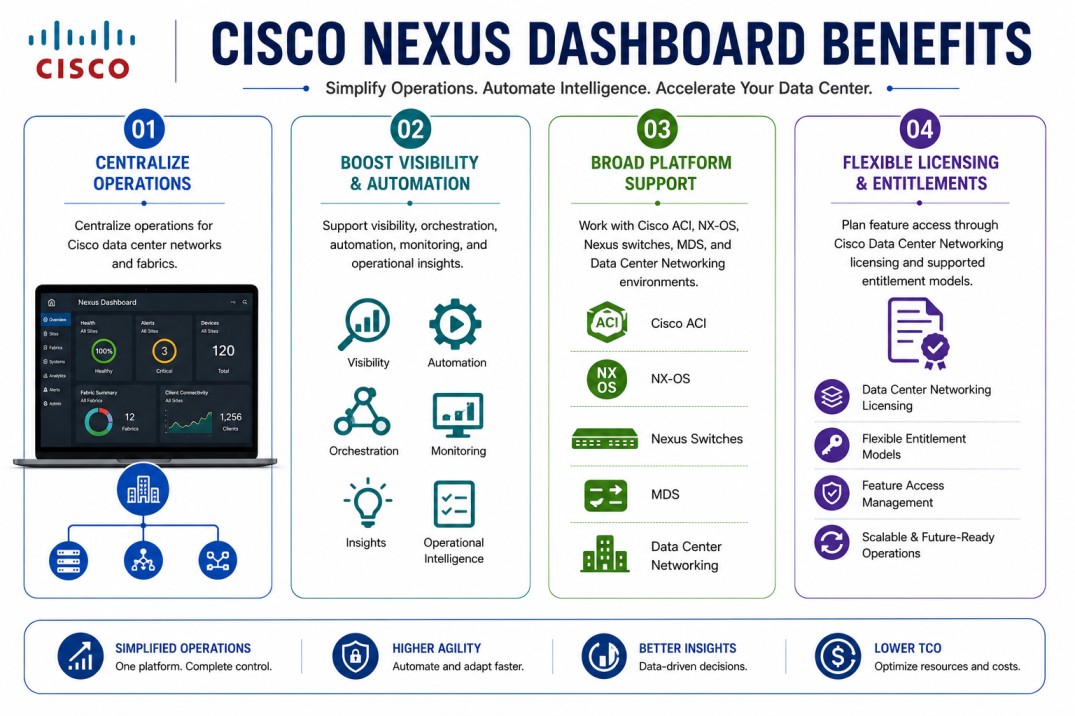
- Centralize operations for Cisco data center networks and fabrics
- Support visibility, orchestration, automation, monitoring, and operational insights
- Work with Cisco ACI, NX-OS, Nexus switches, MDS, and Data Center Networking environments
- Plan feature access through Cisco Data Center Networking licensing and supported entitlement models
Cisco Nexus Dashboard At a glance
What it does : Cisco Nexus Dashboard helps organizations provision, manage, monitor, and operate data center networks from a unified platform.
Product category : Cisco data center operations, automation, and management platform.
Main Cisco environments : Cisco ACI, Cisco NX-OS, Cisco Nexus switches, Cisco MDS, Nexus Dashboard Fabric Controller, Nexus Dashboard Insights, and Nexus Dashboard Orchestrator capabilities.
License type : Nexus Dashboard feature access is generally tied to Cisco Data Center Networking licensing entitlements and the licenses assigned to onboarded switches or fabrics.
Who needs it : Organizations that manage Cisco data center infrastructure and need centralized visibility, automation, fabric control, multi-site operations, troubleshooting, and lifecycle management.
License Overview
Cisco Nexus Dashboard licensing should be understood as part of the wider Cisco Data Center Networking licensing model. The platform itself is used to centralize operations, but feature access depends on the licensed capabilities available for the onboarded data center environment.
In practical terms, Cisco Nexus Dashboard may be used with Cisco ACI fabrics, NX-OS networks, Nexus switches, MDS environments, and related data center operations tools. The required licensing scope depends on the features the organization needs, such as fabric management, visibility, insights, orchestration, automation, or multi-site operations.
Cisco has also moved toward a more unified Nexus Dashboard model, where capabilities such as Fabric Controller, Insights, and Orchestrator are treated as features of the Nexus Dashboard product rather than completely separate standalone services in newer releases. This makes license planning important because the selected Data Center Networking entitlement can affect which capabilities are available.
For many environments, licensing is connected to the switch or fabric scope rather than only the Nexus Dashboard platform. This means the number of onboarded switches, selected DCN tier, software version, support term, and required features should be reviewed before quoting or activating the environment. A properly planned Cisco Nexus Dashboard licensing approach helps organizations avoid missing feature access, limited visibility, unsupported operations, renewal confusion, and deployment delays.
Product Overview
Cisco Nexus Dashboard is designed to simplify the way organizations manage data center infrastructure. Large data centers often include multiple switches, fabrics, sites, policies, faults, telemetry sources, and operational tools. Managing these separately can make troubleshooting and daily operations more difficult.
Cisco Nexus Dashboard brings these operational functions into a more centralized platform. It helps network teams manage data center fabrics, review infrastructure health, automate operational workflows, analyze issues, and gain better visibility across Cisco ACI, NX-OS, Nexus, and MDS environments.
For Cisco ACI environments, Nexus Dashboard can support visibility, orchestration, and Day-2 operations. For NX-OS and Nexus environments, it can help with fabric management, automation, monitoring, and operational control. For MDS environments, it can support data center operations where SAN and Fibre Channel infrastructure are part of the broader Cisco data center architecture. The main value of Cisco Nexus Dashboard is operational simplicity. Instead of using disconnected tools for management, visibility, troubleshooting, and orchestration, administrators can work from a unified data center operations platform.
Core technical flow
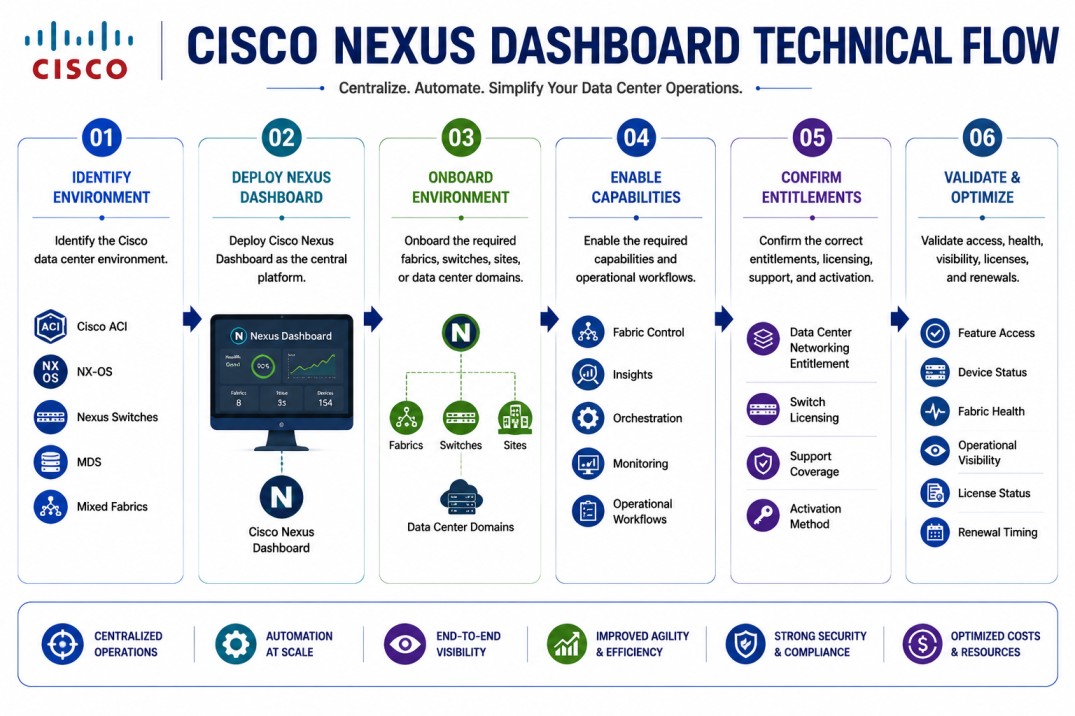
- Identify the Cisco data center environment, including ACI, NX-OS, Nexus switches, MDS, or mixed fabrics.
- Deploy Cisco Nexus Dashboard as the central platform for data center operations, visibility, and automation.
- Onboard the required fabrics, switches, sites, or data center domains into Nexus Dashboard.
- Enable the required capabilities, such as fabric control, insights, orchestration, monitoring, or operational workflows.
- Confirm the correct Data Center Networking entitlement, switch licensing, support coverage, and activation method.
- Validate feature access, onboarded device status, fabric health, operational visibility, license status, and renewal timing.
Options & Licensing Models
| Licensing model | Best for | Typical scope | What affects pricing |
|---|---|---|---|
| Nexus Dashboard platform access | Centralized data center operations | Platform deployment for managing Cisco data center environments | Deployment model and operational scope |
| Data Center Networking Essentials | Foundational data center operations | Core data center networking and basic operational capabilities | Switch scope and required base features |
| Data Center Networking Advantage | Advanced fabric and operations needs | Broader automation, orchestration, and fabric capabilities | Feature depth and environment scale |
| Data Center Networking Premier | Advanced visibility and Day-2 operations | Deeper insights, assurance, and operational analytics | Required insights, automation, and visibility level |
| Smart Licensing | Entitlement tracking where supported | License ownership, usage visibility, and product registration | Product support and activation method |
| PLR License / SLR License | Restricted or offline activation scenarios | Reservation-based activation options where applicable | Cisco eligibility, environment type, and supported workflow |
| Support and renewal coverage | Ongoing data center operations | Software access, technical support, updates, and lifecycle planning | Term, support level, and product scope |
Features & Benefits
Cisco Nexus Dashboard helps organizations manage data center operations with better visibility, consistency, and control. One major benefit is centralized operations. Network teams can manage data center fabrics, switches, sites, and operational workflows from a unified platform instead of relying on multiple disconnected tools.
Another benefit is improved visibility. Nexus Dashboard can help administrators review health, faults, telemetry, fabric status, and infrastructure behavior more clearly. This is especially useful in larger data centers where troubleshooting can become complex. Cisco Nexus Dashboard also supports automation and orchestration. Depending on the enabled features and licensing entitlement, organizations can simplify fabric management, policy coordination, site operations, and Day-2 operational tasks.
For environments using Cisco ACI, NX-OS, Nexus switches, and MDS infrastructure, Nexus Dashboard can help create a more organized operational model. It gives teams a better way to manage data center infrastructure, understand issues, and support growth. Overall, Cisco Nexus Dashboard helps reduce operational complexity, improve data center visibility, simplify troubleshooting, and support more scalable infrastructure management.
System Requirements
Common environments
- Cisco ACI data center fabrics
- Cisco NX-OS and Nexus switching environments
- Cisco MDS and SAN-related data center environments
- Multi-site data center operations
- Nexus Dashboard Fabric Controller environments
- Nexus Dashboard Insights and Orchestrator feature use cases
- Cisco Data Center Networking subscription environments
Technical requirements
- Supported Cisco Nexus Dashboard version and deployment model
- Supported Cisco ACI, NX-OS, Nexus, or MDS environment
- Correct Data Center Networking entitlement or switch licensing
- Cisco Smart Account and licensing workflow where applicable
- Network reachability between Nexus Dashboard and onboarded fabrics or devices
- Support coverage, software compatibility, and renewal readiness
How activation works
Cisco Nexus Dashboard activation depends on the deployment model, software version, onboarded environment, and required feature set. The process usually starts by deploying Nexus Dashboard and onboarding the Cisco data center environment. This may include Cisco ACI fabrics, NX-OS switches, Nexus networks, MDS environments, or other supported data center domains.
After the environment is onboarded, the required features are enabled based on the available licensing entitlement. In many cases, Nexus Dashboard feature access is connected to Cisco Data Center Networking licensing and the licenses assigned to the onboarded switches. For connected environments, licensing and entitlement visibility may be handled through Cisco licensing tools and Smart Licensing workflows. In restricted environments, PLR License or SLR License activation options may be considered where applicable.
After activation, administrators should validate onboarded device status, feature access, license status, system health, fabric visibility, support coverage, and renewal timing. This is important because missing or incorrect licensing can limit access to Nexus Dashboard features, operational visibility, automation capabilities, or long-term support readiness.
Pricing factors + quote process
Pricing for Cisco Nexus Dashboard depends on the data center environment, number of onboarded switches or fabrics, required features, Data Center Networking tier, support coverage, and subscription or renewal term. A small Nexus Dashboard deployment with basic visibility needs may require a different scope than a larger enterprise environment with multiple fabrics, advanced insights, orchestration, automation, and multi-site operations.
The main pricing factors usually include switch count, ACI or NX-OS environment size, MDS involvement, required Nexus Dashboard features, DCN Essentials / Advantage / Premier tier, Smart Licensing method, support level, and renewal timing. During the quote process, the Cisco Nexus Dashboard environment is reviewed first. Then the required feature set, onboarded switches, fabric type, licensing model, activation workflow, and support coverage are mapped into the correct quote.
After you request a quote
- We review your Cisco Nexus Dashboard environment and data center requirements
- Identify the required features, licensing model, and entitlement scope
- Check ACI, NX-OS, Nexus, MDS, Smart Licensing, PLR License, and SLR License considerations
- Provide pricing, delivery details, and activation guidance