

ManageEngine Enterprise Service Management (ESM) helps organizations bring structure and consistency to service delivery across the business, not just in IT. Instead of running separate tools for HR, facilities, finance, and other teams, everything can be managed through a single platform with shared workflows and a unified service experience.
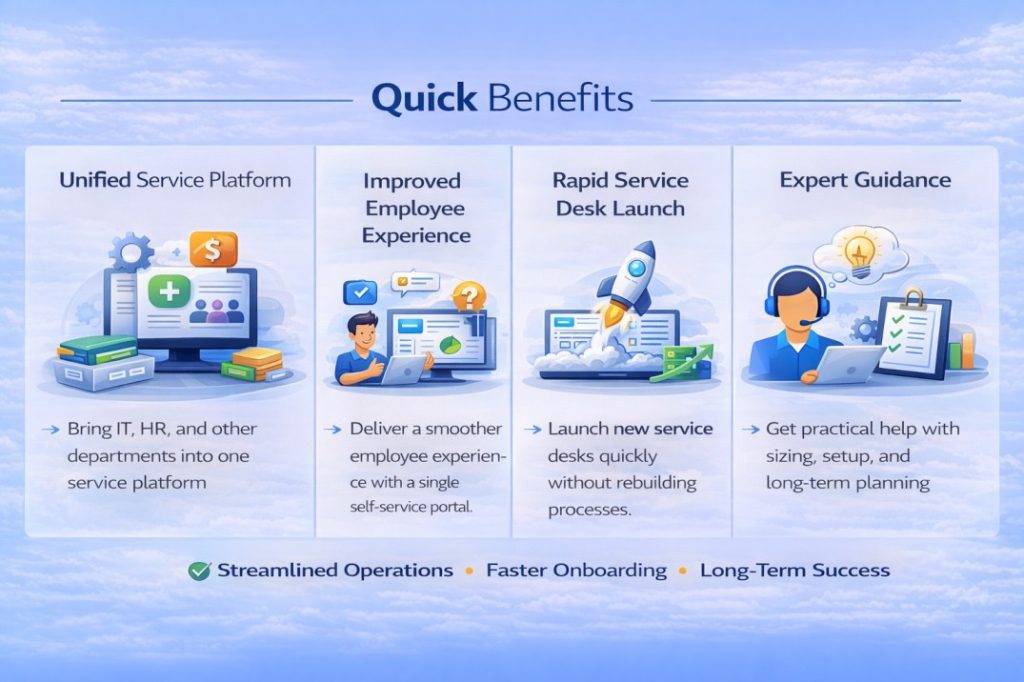
Quick Benefits
- Bring IT, HR, and other departments into one service platform
- Deliver a smoother employee experience with a single self-service portal
- Launch new service desks quickly without rebuilding processes
- Get practical help with sizing, setup, and long-term planning
ManageEngine Enterprise Service Management At a Glance
- What it does : Runs multiple service desks across different departments while keeping workflows and user experience consistent.
- Who needs it : Organizations that want to standardize how internal services are delivered across IT and non-IT teams.
- License Type : Subscription or perpetual (depending on how you deploy and purchase).
- Typical Terms : Usually annual (1 year), with multi-year options available in some cases.
- Activation : Depends on deployment, cloud subscriptions stay active through renewal, while on-prem setups are licensed directly within the product.
License Overview
The ManageEngine Enterprise Service Management license is what allows you to extend structured service delivery beyond IT and into the rest of the business. It defines how you can deploy and scale service desks across departments while keeping everything centrally managed.
In real-world use, this means you can run separate service environments for teams like HR, facilities, or finance, each with its own workflows, while still maintaining control from a single platform. This is especially useful for organizations that want consistency without forcing every department into the same exact process.
ManageEngine offers flexibility in how licensing works. Subscription models give you access for a defined period and need to be renewed to continue using the system. Perpetual licensing, where available, lets you keep using the software long-term, with support and updates handled separately.
Because ESM usually involves multiple teams, the most important step is sizing things correctly. That includes deciding how many service desks you need, which edition fits each team, and how complex your workflows will be. Getting this right early helps avoid limitations later and keeps everything running smoothly as your organization grows.
Options & Tiers
Most organizations structure ESM around multiple service desks, each with its own edition depending on the team’s needs.
|
Plan / Approach |
Best For |
Key Inclusions |
What Affects Price |
|
Standard |
Basic service desks |
Core ticketing and workflows |
Number of technicians, instances |
|
Professional |
IT + asset-focused teams |
Adds asset management capabilities |
Edition and scale |
|
Enterprise |
Mature service operations |
Includes change, project, and advanced workflows |
Scope and complexity |
|
Multi-instance ESM |
Multi-department setups |
Separate service desks managed centrally |
Number of instances, editions |
Features & Benefits
ManageEngine ESM is designed to make service delivery feel consistent across the organization, even when different teams have very different needs.
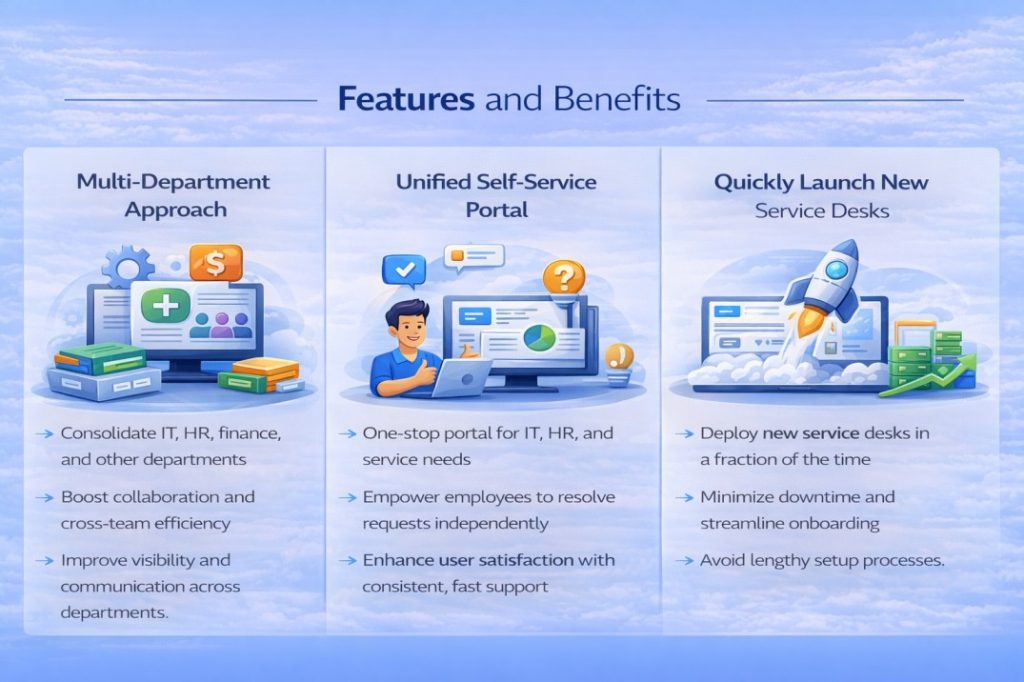
- With a multi-department approach, you can move away from siloed tools and bring everything into one system. This makes it easier to manage requests, track performance, and maintain visibility across teams.
- The unified self-service portal improves the employee experience by giving users a single place to request help, without needing to know which department handles what. Requests are automatically routed based on roles and categories, reducing confusion and delays.
- You can also quickly launch new service desks for different departments. Instead of building processes from scratch each time, teams can reuse and adapt existing workflows while still maintaining independence.
As your needs grow, the platform supports more advanced ITSM capabilities like change management and project workflows, helping you standardize operations without adding unnecessary complexity.
Compatibility & Requirements
- Organizations with multiple internal service teams (IT, HR, facilities, finance)
- Companies looking to standardize service delivery across departments
- Businesses aiming to improve internal service experience
How Activation Works
- Identify departments and service needs
- Create service desks for each team
- Configure the unified portal and access rules
- Apply the appropriate licenses per instance
- Launch and monitor usage, workflows, and SLAs
Pricing Factors & Quote Process
Pricing for ManageEngine ESM depends mostly on how your organization is structured. The number of service desks you need, the edition chosen for each one, and your licensing model all play a role in the final cost.
For example, a company running separate service desks for IT, HR, and facilities will have a different pricing structure than one using a single shared environment. On top of that, more advanced editions with deeper workflow capabilities will naturally cost more than basic setups.
Subscription vs perpetual licensing also affects how costs are distributed over time. Subscription models are predictable and easier to scale, while perpetual licensing may suit organizations looking for long-term ownership.
The most accurate way to price ESM is to align it with your actual structure, not just the product itself.
The Quote Process
- We map your departments to service desk instances
- Help you choose the right edition for each team
- Confirm licensing model and term
- Provide official pricing and rollout guidance
- Share clear activation and deployment steps