

Tenable Just-in-Time (JIT) helps organizations reduce standing privileges by providing temporary and controlled access to cloud and infrastructure resources only when needed.
Quick benefits
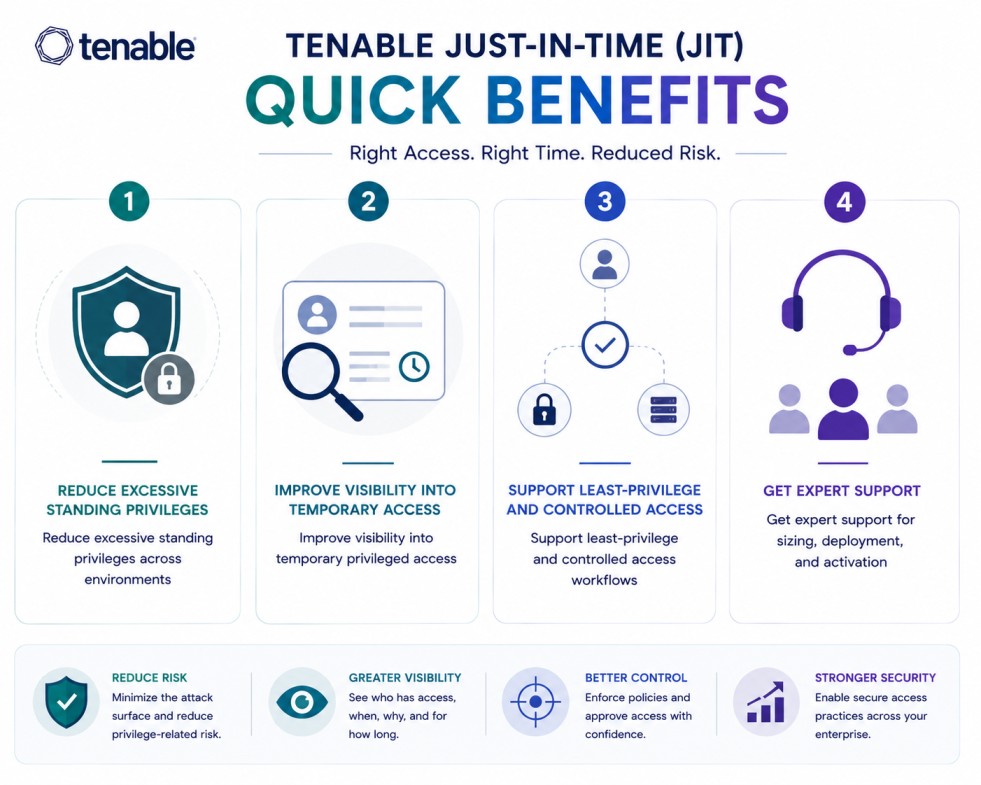
- Reduce excessive standing privileges across environments
- Improve visibility into temporary privileged access
- Support least-privilege and controlled access workflows
- Get expert support for sizing, deployment, and activation
Tenable Just-in-Time (JIT) access At a glance
What it does : Tenable JIT provides temporary privileged access workflows designed to reduce long-term privilege exposure across infrastructure and cloud environments.
License type : Subscription-based (identity/access-based)
Typical term : 1 year · 3 years · 5 years
Activation method : Cloud-managed or hybrid activation via Tenable platform
Who needs it : Organizations that want stronger control over privileged access and temporary entitlement workflows across cloud and enterprise environments

License Overview
Organizations implementing just-in-time access models often require a licensing approach that aligns with identity visibility, privileged workflows, and operational governance requirements rather than simple user counts alone. The Tenable Just-in-Time (JIT) license is generally aligned with the number of identities, privileged access workflows, and managed infrastructure environments included within the deployment scope.
Because many environments contain excessive standing privileges that evolve over time, licensing and deployment planning typically focus on improving access control visibility while reducing unnecessary long-term permissions. A properly aligned license helps organizations manage temporary privileged access more consistently across cloud and enterprise infrastructure while supporting operational and compliance objectives.
Product Overview
Standing privileges and persistent administrative access can gradually increase exposure risk across modern infrastructure environments, especially as cloud services and distributed identities continue to expand.
Over time, excessive permissions, inactive privileged accounts, and unmanaged administrative access paths may create opportunities for lateral movement or privilege escalation.
Tenable Just-in-Time (JIT) is designed to help organizations reduce these risks by limiting privileged access to controlled, temporary access windows instead of maintaining permanent elevated permissions.
In practice, the platform helps manage privileged access workflows by granting temporary access only when operationally required and removing elevated permissions once the approved access period ends.
For organizations operating cloud-native or hybrid infrastructures, this approach supports stronger least-privilege enforcement and more controlled administrative access management.
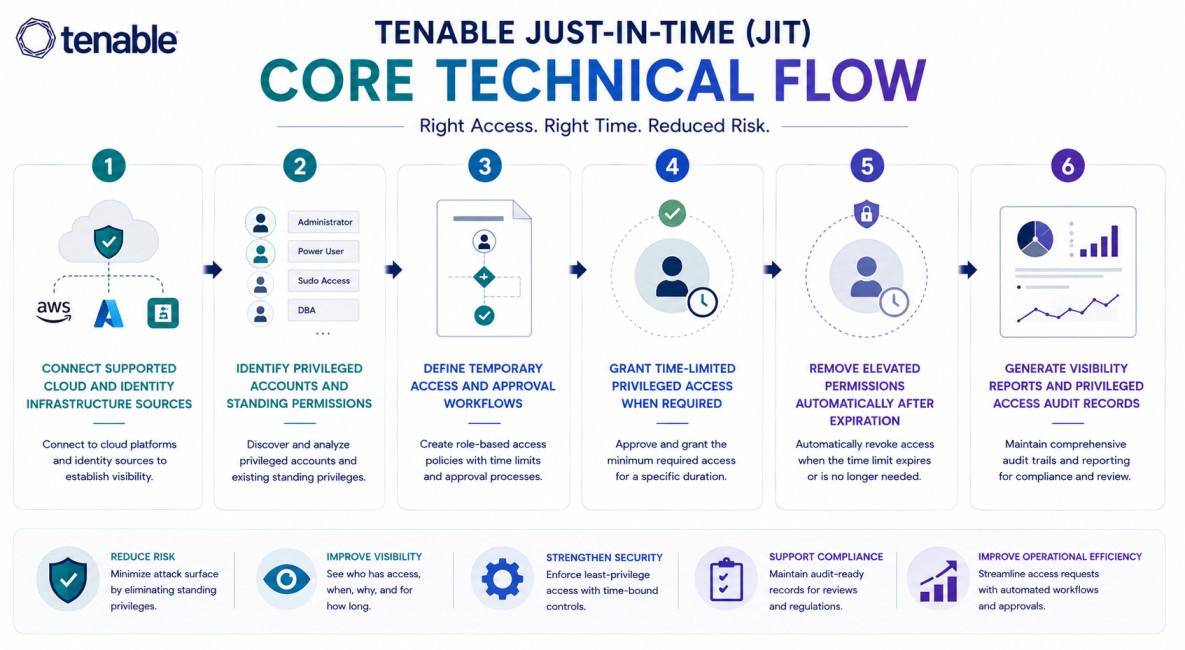
Core technical flow
- Connect supported cloud and identity infrastructure sources
- Identify privileged accounts and standing permissions
- Define temporary access and approval workflows
- Grant time-limited privileged access when required
- Remove elevated permissions automatically after expiration
- Generate visibility reports and privileged access audit records
Options & Tiers
| Plan / Model | Best for | Key inclusions | What affects price |
|---|---|---|---|
| Standard JIT visibility | Most organizations | Temporary privileged access workflows | Identity count, term |
| Hybrid deployment | Mixed cloud and enterprise environments | Cross-environment access visibility | Integration scope |
| Enterprise deployment | Large infrastructures | Scalable privileged workflow management | Operational complexity |
| Advanced governance visibility | Security-focused teams | Audit and privileged access analysis | Infrastructure scale |
Features & Benefits
Many organizations struggle to maintain consistent control over privileged accounts as administrative access expands across cloud and enterprise environments. Tenable Just-in-Time (JIT) helps reduce long-term privilege exposure by replacing persistent elevated access with temporary and controlled access workflows.
One of the key advantages is reduced standing privilege risk. Security teams can limit how long privileged permissions remain active while maintaining operational flexibility for administrators and support teams. The platform also supports stronger governance initiatives by improving visibility into privileged access requests, approval workflows, and temporary entitlement activity. Over time, this leads to more controlled access management practices and reduced exposure from unnecessary privileged access across the environment.
System Requirements
Common environments
- Hybrid cloud infrastructures
- Enterprise identity environments
- Privileged access management ecosystems
- Distributed administrative environments
Technical requirements
- Access to identity and privilege infrastructure
- Connectivity to supported cloud or enterprise platforms
- Visibility into privileged account workflows
How activation works
Activating Tenable Just-in-Time (JIT) typically starts with provisioning the Tenable environment and applying the appropriate subscription license. Once the platform is active, administrators configure integrations with supported identity providers, cloud environments, and privileged access infrastructure. Depending on the deployment architecture, this may involve configuring identity synchronization, approval workflows, and temporary entitlement policies.
The platform then begins analyzing privileged access relationships and enforcing temporary access workflows across connected environments. Because just-in-time access models rely heavily on identity visibility and operational policy alignment, activation usually includes validating approval paths, privilege expiration rules, and audit visibility requirements before broader rollout. After activation, organizations should review privileged access coverage and workflow policies regularly to ensure that temporary access controls remain aligned with operational and security objectives.
Pricing factors + quote process
Privileged access environments can vary significantly depending on identity architecture, approval workflows, and the number of managed administrative access paths across the organization. Because of this, licensing scope is usually aligned with privileged identity visibility and workflow complexity rather than simple user volume alone.
Organizations operating hybrid infrastructures or distributed cloud environments may require broader integration coverage and more advanced privileged access governance capabilities. Additional considerations, such as identity provider integrations, audit requirements, operational governance policies, and subscription term, can also influence licensing scope.
During the quote process, identity infrastructure structure, privileged workflow requirements, and operational governance objectives are typically reviewed first so the licensing and deployment model can align more accurately with the organization’s access control strategy.
After you request a quote
- We review your identity and privileged access environment
- Recommend the most suitable deployment approach
- Provide official pricing and delivery details
- Share activation and workflow guidance
Tenable Pricing depends on your license edition, quantity, term, and deployment needs.