

Tenable Enclave Security helps organizations secure isolated and highly controlled environments by improving visibility into vulnerabilities, assets, and exposure risks across enclave infrastructure.
Quick benefits
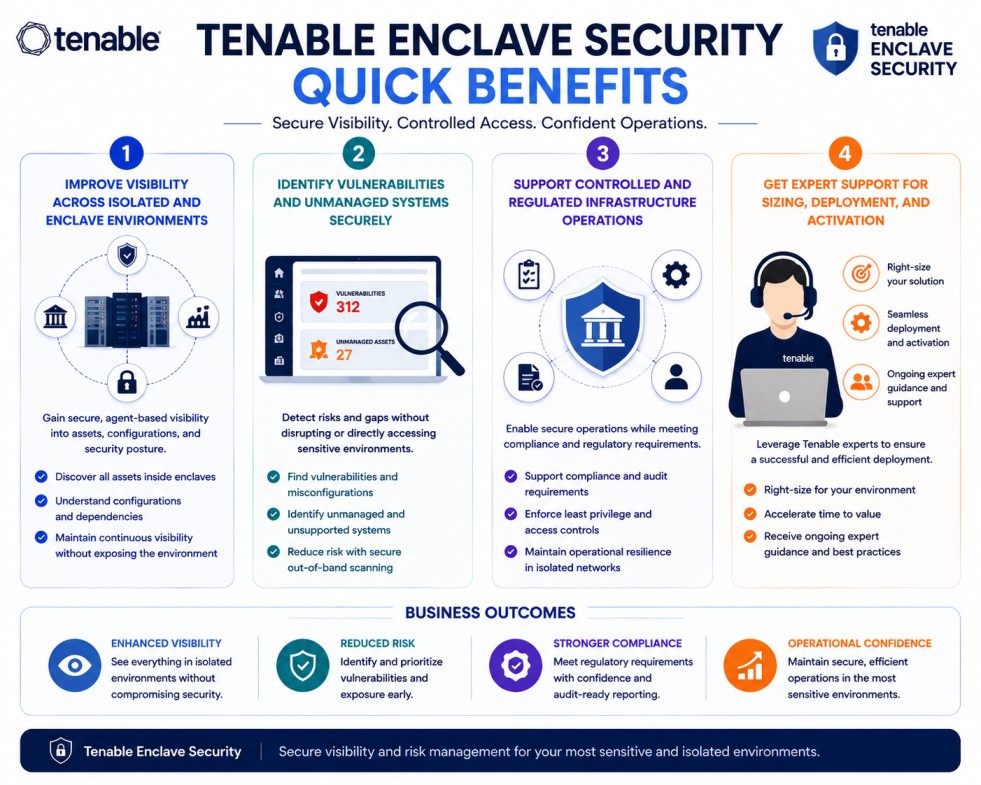
- Improve visibility across isolated and enclave environments
- Identify vulnerabilities and unmanaged systems securely
- Support controlled and regulated infrastructure operations
- Get expert support for sizing, deployment, and activation
Tenable Enclave Security At a glance
What it does : Tenable Enclave Security provides vulnerability visibility and exposure analysis for isolated, air-gapped, and highly regulated environments.
License type : Subscription-based (asset/environment-based)
Typical term : 1 year · 3 years · 5 years
Activation method : Controlled or offline activation for isolated environments
Who needs it : Organizations operating enclave, air-gapped, regulated, or restricted infrastructure environments

License Overview
Organizations operating enclave or isolated environments often require a different licensing approach compared to standard cloud-connected infrastructures. Visibility, compliance controls, and operational restrictions usually play a larger role in determining deployment scope. The Tenable Enclave Security license is generally aligned with the number of monitored assets and the operational scale of the isolated environment. This can include servers, endpoints, infrastructure systems, and regulated network segments operating within controlled environments.
Because enclave infrastructures are commonly designed to limit connectivity and external communication, licensing and deployment planning typically focus on maintaining visibility without disrupting operational or compliance requirements. A properly aligned license helps organizations maintain consistent vulnerability visibility across restricted environments while supporting secure operational controls and regulated infrastructure management.
Product Overview
Isolated and enclave environments often face unique security challenges because visibility and operational control must be maintained without relying on standard cloud-connected security workflows.
Over time, unmanaged assets, delayed visibility updates, and restricted communication paths may create exposure risks that are difficult to identify consistently across regulated environments.
Tenable Enclave Security is designed to help organizations reduce these visibility gaps by providing controlled vulnerability analysis and asset visibility inside restricted infrastructure environments.
In practice, the platform supports vulnerability visibility across enclave networks, air-gapped systems, and operationally restricted environments while maintaining tighter deployment and communication controls.
For organizations operating highly regulated or sensitive infrastructure, this visibility helps improve security posture awareness without compromising enclave operational requirements.
Core technical flow
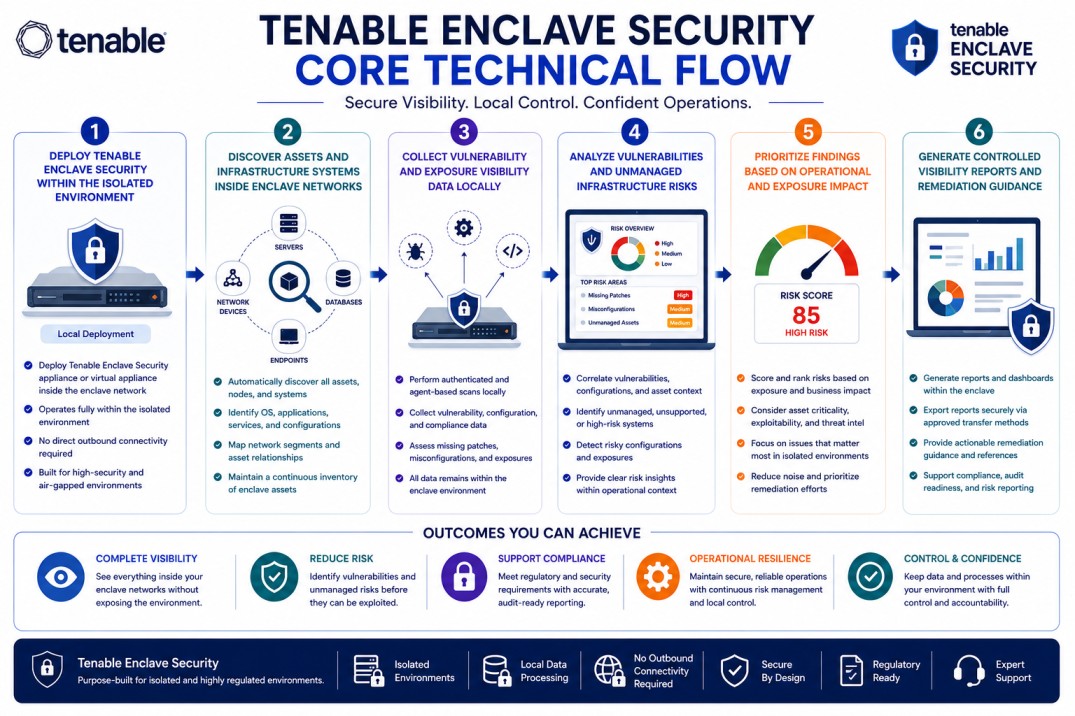
- Deploy Tenable Enclave Security within the isolated environment
- Discover assets and infrastructure systems inside enclave networks
- Collect vulnerability and exposure visibility data locally
- Analyze vulnerabilities and unmanaged infrastructure risks
- Prioritize findings based on operational and exposure impact
- Generate controlled visibility reports and remediation guidance
Options & Tiers
| Plan / Model | Best for | Key inclusions | What affects price |
|---|---|---|---|
| Standard enclave visibility | Most regulated environments | Local vulnerability visibility | Asset count, term |
| Air-gapped deployment | Isolated infrastructures | Offline operational support | Environment scope |
| Multi-site enclave deployment | Distributed restricted environments | Centralized visibility workflows | Infrastructure complexity |
| Enterprise deployment | Large regulated organizations | Scalable enclave security visibility | Operational scale |
Features & Benefits
Restricted and enclave environments often operate with limited external connectivity, which can make vulnerability visibility and asset tracking more difficult over time. Tenable Enclave Security helps organizations maintain controlled visibility into vulnerabilities and infrastructure exposure without relying on fully cloud-connected operational models. One of the key advantages is improved visibility across isolated infrastructure segments. Security teams can identify unmanaged systems, exposure risks, and vulnerable assets while maintaining operational restrictions required by regulated environments.
The platform also supports more consistent security operations across enclave infrastructure by helping organizations centralize visibility and remediation workflows inside controlled operational boundaries. Over time, this leads to stronger awareness of exposure risks across restricted infrastructure environments while supporting compliance and operational resilience objectives.
System Requirements
Common environments
- Air-gapped infrastructures
- Regulated enterprise environments
- Restricted operational networks
- Enclave and classified infrastructure segments
Technical requirements
- Local deployment infrastructure
- Controlled connectivity or offline operational support
- Visibility into enclave network assets and systems
How activation works
Activating Tenable Enclave Security usually begins with deploying the platform within the isolated or regulated environment and applying the appropriate subscription license through controlled operational workflows. Because enclave infrastructures often restrict internet communication and external connectivity, activation procedures are commonly designed around offline or tightly controlled deployment models. Depending on the environment architecture, activation may involve secure license transfer procedures, local deployment validation, and controlled configuration of visibility components within enclave infrastructure boundaries.
Once operational, the platform begins collecting vulnerability and asset visibility data locally while maintaining restricted communication policies required by the environment. After activation, organizations should review monitored infrastructure scope and visibility coverage to ensure that enclave systems remain fully included within the licensed operational environment.
Pricing factors + quote process
Enclave and isolated infrastructures often vary significantly depending on operational restrictions, deployment segmentation, and regulatory visibility requirements. Because of this, licensing scope is usually aligned with the operational complexity and visibility depth required across controlled environments rather than standard infrastructure volume alone.
Organizations operating air-gapped networks, classified systems, or highly segmented infrastructures may require broader deployment planning and more specialized visibility workflows.
Additional considerations, such as reporting requirements, enclave segmentation, operational restrictions, and subscription term, can also influence licensing scope.
During the quote process, infrastructure isolation requirements, visibility objectives, and operational controls are typically reviewed first so the deployment and licensing model can align more accurately with the organization’s regulated environment strategy.
After you request a quote
- We review your enclave environment and operational requirements
- Recommend the most suitable deployment model
- Provide official pricing and delivery details
- Share activation and controlled deployment guidance
Tenable Pricing depends on your license edition, quantity, term, and deployment needs.