

Palo Alto Cortex XSIAM is an AI-driven security operations platform designed to help organizations transform traditional SOC workflows into a more automated and proactive security model. By combining extended detection, analytics, automation, and incident response capabilities, Cortex XSIAM helps security teams investigate threats faster and manage complex security environments more efficiently.
Quick Benefits
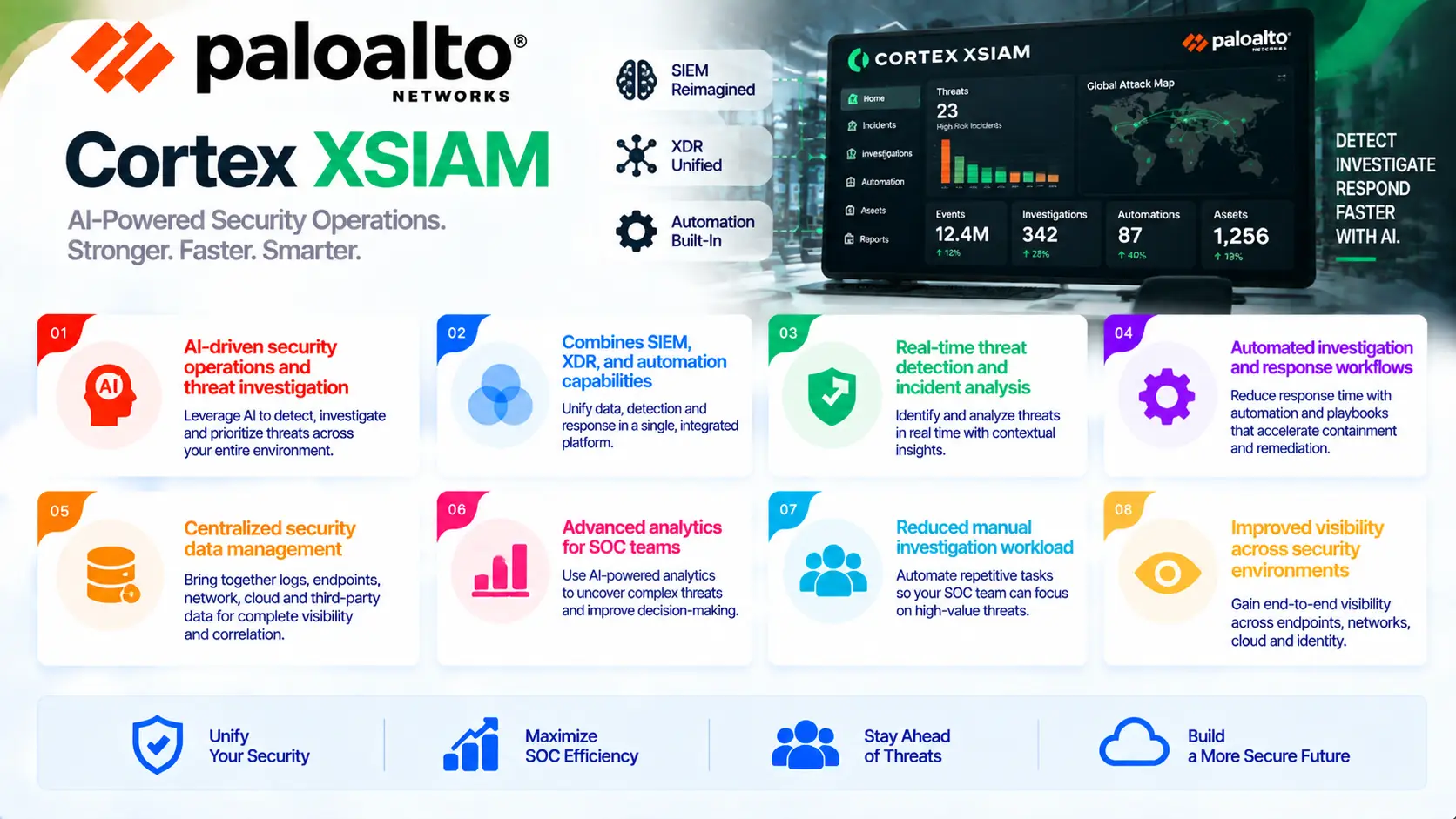
- AI-driven security operations and threat investigation
- Combines SIEM, XDR, and automation capabilities
- Real-time threat detection and incident analysis
- Automated investigation and response workflows
- Centralized security data management
- Advanced analytics for SOC teams
- Reduced manual investigation workload
- Improved visibility across security environments
Palo Alto Cortex XSIAM At a Glance
What it is: AI-powered Security Operations Platform
Product name: Cortex XSIAM
Parent category: Palo Alto License
Primary role: Automate threat detection, investigation, and response across enterprise security environments
Solution category: Extended Security Intelligence and Automation Management (XSIAM)
Management platform: Cortex Security Platform
Deployment model: Cloud-delivered security operations platform
Security data sources: Endpoint, network, cloud, identity, and third-party security sources
License Overview
A Palo Alto Cortex XSIAM License provides access to an advanced security operations platform designed to collect, analyze, and correlate security data from multiple sources. Unlike traditional SIEM solutions that often require extensive manual configuration and investigation, Cortex XSIAM focuses on automation and AI-assisted analysis to reduce the operational burden on security teams.
The licensing model is based on the scale of the security environment, including factors such as protected endpoints, data ingestion volume, connected sources, required retention periods, and enabled capabilities.
Organizations evaluating Cortex XSIAM should first understand their current SOC requirements. A company replacing multiple security tools may require broader data integration and automation capabilities, while an organization improving an existing SOC may focus on specific detection and response workflows.
When selecting a Palo Alto Cortex XSIAM License, businesses should consider the number of security data sources, investigation requirements, compliance obligations, and the level of automation needed. Because XSIAM operates as a centralized security operations platform, proper planning around data sources and integrations is essential to achieving maximum value from the deployment.
Product Overview
AI-Powered Security Operations
Security operations teams increasingly face a challenge of managing large volumes of alerts from multiple security products.
Traditional SOC models often require analysts to manually investigate alerts, correlate information from different tools, and determine whether activity represents a real threat.
Cortex XSIAM changes this approach by using AI-driven analytics and automation to analyze security data continuously and prioritize meaningful incidents.
The platform is designed to reduce alert fatigue and help analysts focus on high-value investigations.
Combining SIEM and XDR Capabilities
Many organizations operate separate platforms for log management, endpoint detection, analytics, and response workflows.
Cortex XSIAM brings these capabilities together by combining SIEM-like data analysis with XDR detection and automated response functions.
This unified approach helps security teams investigate incidents using broader context instead of reviewing isolated alerts from individual systems.
Automated Threat Detection and Investigation
Modern attacks often involve multiple stages across endpoints, identities, networks, and cloud environments.
Cortex XSIAM analyzes relationships between security events to identify suspicious activity and provide investigation context.
The platform can automatically correlate related events, highlight attack patterns, and support analysts during incident response processes.
Options and Licensing Models
| Licensing Option | Description | Suitable For |
|---|---|---|
| Endpoint-Based Licensing | Licensing based on protected endpoint coverage and collected endpoint telemetry | Organizations using endpoint-driven security operations |
| Data Ingestion Licensing | Based on the amount of security data analyzed by the platform | Large environments with multiple security sources |
| XDR Data Sources | Adds visibility from additional security domains | Organizations requiring broader threat detection |
| Third-Party Integration Licensing | Connects external security tools and data sources | Enterprises with complex security ecosystems |
| Extended Data Retention | Provides longer storage for investigation and compliance requirements | Organizations needing historical analysis |
| SOC Automation Capabilities | Enables advanced investigation and response workflows | Security teams improving operational efficiency |
| Multi-Year Subscription | Longer-term platform access and planning flexibility | Enterprise deployments |
The final licensing structure depends on security architecture, data volume, required integrations, and SOC operational goals.
Features and Benefits
Palo Alto Cortex XSIAM helps organizations modernize security operations by reducing the complexity created by disconnected security tools. Instead of forcing analysts to manually combine information from multiple systems, the platform creates a unified security view where incidents can be analyzed with broader context.
One of the main advantages of XSIAM is automation. Security teams can spend less time investigating repetitive alerts and more time focusing on complex threats that require human decision-making.
The platform also improves detection accuracy by correlating security signals across multiple environments. A suspicious endpoint event, identity anomaly, or network behavior can be analyzed together rather than as separate incidents.
For organizations building advanced SOC capabilities, Cortex XSIAM provides a foundation for moving toward more automated, intelligence-driven security operations.
Compatibility and Requirements
Before deploying Palo Alto Cortex XSIAM, organizations should evaluate their security environment and operational requirements.
Important considerations include:
- Existing security tools and integrations
- Number of endpoints and users
- Security data volume
- Required retention period
- SOC workflow requirements
- Cloud and network environments
- Compliance requirements
Cortex XSIAM is typically deployed in enterprise environments where organizations need centralized security analytics and automation.
A successful deployment requires planning around data sources, integrations, and operational processes.
Activation and Deployment
Deployment begins after selecting the appropriate Palo Alto Cortex XSIAM License and configuring the required security environment.
Typical deployment steps include:
- Activating the Cortex XSIAM subscription
- Connecting security data sources
- Deploying required agents or integrations
- Configuring analytics and detection policies
- Creating response workflows
- Validating incident investigation processes
Organizations usually begin with core data sources before expanding integrations across additional security platforms.
Pricing and Quote Process
Pricing for Palo Alto Cortex XSIAM depends on multiple factors, including the number of endpoints, data volume, connected sources, retention requirements, and selected capabilities.
Before requesting a quote, organizations should define:
- Number of protected endpoints
- Security data sources
- Required integrations
- SOC requirements
- Data retention needs
- Automation requirements
- Subscription duration
Because Cortex XSIAM operates as a comprehensive security operations platform, accurate sizing is important to ensure the platform matches operational needs. Organizations should also consider future expansion because additional data sources and security integrations may affect licensing requirements.
Palo Alto pricing depends on your security solution, firewall model, license edition, deployment model, license term, and support requirements.