

Juniper NAC is Juniper’s cloud-based network access control solution, currently delivered through Juniper Mist Access Assurance. It provides identity-based access control for wired and wireless networks, allowing organizations to decide who and what can connect based on user identity, device identity, authentication method, policy, and network context.
Quick Benefits
- Cloud-native network access control
- Identity-based wired and wireless access
- Zero Trust policy enforcement
- 802.1X authentication support
- MAC Authentication Bypass for non-802.1X devices
- Guest, BYOD, corporate, and IoT onboarding
- Dynamic VLAN and role assignment
- Integration with identity providers
- IoT Assurance included with Access Assurance subscriptions
- Centralized policy management through Juniper Mist
- Support for Juniper and third-party network infrastructure
- Standard and Advanced subscription options
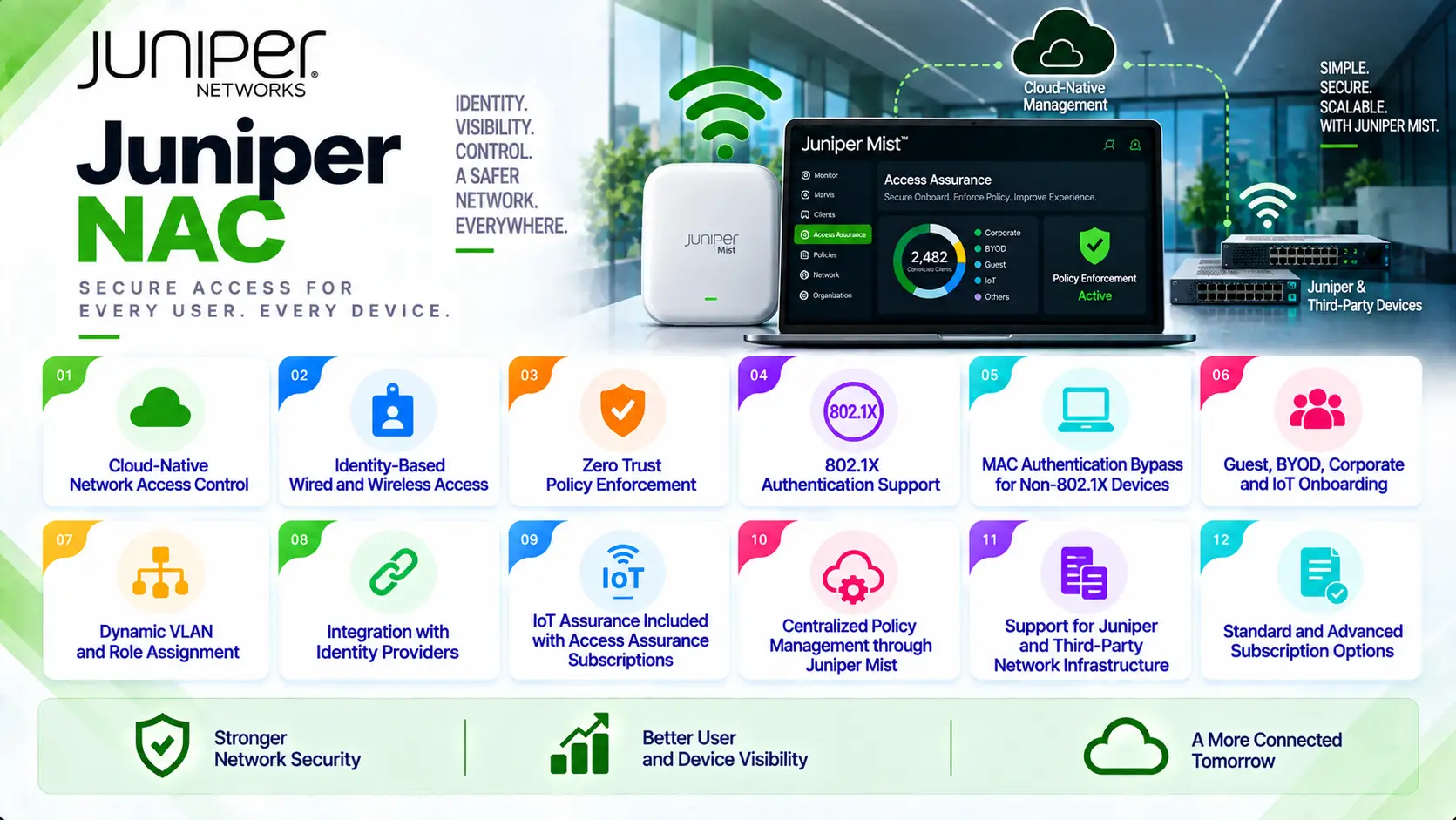
Juniper NAC At a Glance
What it is: Cloud-based Network Access Control service
Current product name: Juniper Mist Access Assurance
Parent category: Juniper License
Primary role: Authenticate users and devices and enforce network-access policies
Security model: Identity-based and Zero Trust network access
Network coverage: Wired and wireless environments
Authentication methods: 802.1X, MAB, PSK/MPSK, and supported certificate-based methods
Supported device groups: Corporate devices, guests, BYOD, IoT, and unmanaged endpoints
Management platform: Juniper Mist Cloud
Policy capabilities: Allow/deny access, VLAN assignment, role assignment, segmentation, and identity-based policy
Licensing model: Subscription based on concurrently active NAC clients

License Overview
A Juniper NAC License is currently purchased as a Juniper Mist Access Assurance subscription. The service is licensed according to the average number of concurrently active client devices observed over a seven-day period. This is an important distinction from infrastructure licensing because the commercial metric follows actual NAC client usage rather than the number of network devices.
Juniper currently offers Standard and Advanced Access Assurance subscriptions. Standard provides the core NAC capabilities needed for authentication, authorization, guest and IoT access, 802.1X, MAB, and policy enforcement. Advanced extends this with capabilities such as client posture checking and integrations with UEM, EMM, MDM, and firewall platforms.
Subscriptions are available in common 1-, 3-, and 5-year terms. Current SKU examples include S-CLIENT-S-1, S-CLIENT-S-3, and S-CLIENT-S-5 for Standard, along with corresponding Advanced SKUs such as S-CLIENT-A-1, S-CLIENT-A-3, and S-CLIENT-A-5.
Juniper also includes IoT Assurance functionality with Access Assurance subscriptions, which is useful where headless, BYOD, or devices that cannot perform traditional enterprise authentication need to be onboarded securely.
Product Overview
Cloud-Native Network Access Control
Traditional NAC platforms often require dedicated policy servers, complex high-availability designs, and significant operational maintenance.
Juniper Mist Access Assurance uses a cloud-native, microservices-based architecture instead. Juniper positions the service as a way to provide identity-based network access without deploying the traditional on-premises NAC server infrastructure associated with older solutions.
Policies and client information are centrally managed through the Mist environment, allowing network teams to apply a common access strategy across multiple locations.
Identity-Based Access
Juniper NAC determines access using both user and device identity.
Policies can decide whether a client should receive network access and what access should be provided after authentication. Organizations can use the same framework for employees, guests, corporate devices, BYOD endpoints, and IoT systems.
This makes NAC useful for Zero Trust designs where connecting to a physical switch port or wireless SSID should not automatically grant broad network access.
Support for Third-Party Networks
Juniper NAC is not limited exclusively to Juniper switches and wireless infrastructure.
Third-party wired and wireless environments can connect to Access Assurance using standard RADIUS through a Mist Edge Auth Proxy. Juniper currently requires an appropriate Mist Edge deployment when Access Assurance is used with supported third-party network infrastructure.
This can be useful during phased migrations where an organization operates both Juniper and non-Juniper networking equipment.
Options and Licensing Models
| Licensing Option | Description | Suitable For |
|---|---|---|
| Access Assurance Standard | Core cloud NAC functionality including authentication, policy enforcement, IoT Assurance, MAB, and supported EAP methods | Most enterprise wired and wireless NAC deployments |
| Access Assurance Advanced | Adds advanced posture and integrations such as UEM/EMM/MDM and firewall integration | Organizations requiring device posture and deeper security integration |
| 1-Year Subscription | Shorter-term licensing based on active clients | Trials, phased deployments, or shorter procurement cycles |
| 3-Year Subscription | Multi-year NAC coverage | Standard enterprise deployments |
| 5-Year Subscription | Longer-term subscription with predictable licensing duration | Long-term campus and enterprise deployments |
| Mist Edge Auth Proxy | Enables supported third-party infrastructure to communicate with Access Assurance through RADIUS | Mixed-vendor network environments |
| Marvis Client NAC Onboarding | Advanced onboarding workflow using SSO, certificates, and client provisioning | BYOD and passwordless onboarding scenarios |
The correct option depends primarily on the expected number of concurrently active users and devices and whether advanced posture or third-party integration capabilities are required.
Features and Benefits
One of the main benefits of Juniper NAC is reduced infrastructure complexity. Because Access Assurance is delivered through the Mist cloud, organizations do not need to build the same type of dedicated NAC server cluster commonly associated with traditional deployments.
The identity-driven policy model also improves segmentation. Rather than creating access rules solely around ports and SSIDs, policies can follow the type of user or endpoint attempting to connect.
For IoT-heavy environments, MAB, MPSK, endpoint registration, and client labels provide practical ways to control devices that cannot use standard employee authentication workflows.
Juniper continues to expand Access Assurance as well. As of July 2026, the service supports OpenRoaming as a native identity provider, allowing participating users to authenticate on compatible wireless networks without organizations having to maintain a separate RadSec proxy for that workflow.
Compatibility and Requirements
Before purchasing Juniper NAC, review the network and identity architecture carefully.
Important considerations include:
- Average number of concurrently active clients
- Wired and wireless client counts
- Juniper EX switch models and Junos versions
- Existing RADIUS architecture
- Identity provider and SSO requirements
- PKI and certificate requirements
- UEM, MDM, or EMM platforms
- Firewall integration needs
- Guest and BYOD onboarding requirements
For Juniper Mist wired and wireless infrastructure, Juniper states that no additional hardware is normally required to deploy Access Assurance. Third-party network environments may require Mist Edge with the Auth Proxy capability.
Activation and Deployment
Deployment begins after the Access Assurance subscription has been added to the Juniper Mist organization.
Typical steps include:
- Activate the required Access Assurance subscription
- Configure identity providers
- Define authentication methods
- Create NAC authentication policies
- Register or classify endpoints where required
- Configure VLAN and role assignments
- Enable MAB or IoT onboarding
- Configure Mist Edge for third-party infrastructure if needed
- Test client authentication
- Monitor NAC usage and subscription consumption
A staged rollout is recommended so authentication and segmentation policies can be validated against employee, guest, IoT, and BYOD use cases before broad enforcement.
Pricing and Quote Process
Pricing for Juniper NAC is driven primarily by the number of active clients and the selected Access Assurance tier.
Before requesting a quote, define:
- Average number of concurrently active clients
- Peak client count
- Standard or Advanced subscription requirement
- Number of sites
- Wired and wireless infrastructure
- Third-party network equipment
- Need for Mist Edge Auth Proxy
- BYOD and guest requirements
- Device posture requirements
- Subscription duration
Juniper calculates Access Assurance consumption from the average concurrently active client population over a seven-day period. This makes realistic client sizing important: purchasing based solely on total registered devices may not reflect actual license consumption.
Juniper pricing depends on your product family, license edition, router, switch or SRX model, Mist Cloud requirements, deployment model, license term, and support needs.