

Juniper PTX is a high-performance packet transport routing family built for core, peering, metro aggregation, data-center interconnect, and large-scale cloud networks. Current PTX platforms combine 400GbE and 800GbE connectivity, high routing scale, EVPN, MPLS, Segment Routing, SRv6, and MACsec with a Juniper Flex licensing model designed around the actual WAN or data-center role of the router.
Quick Benefits
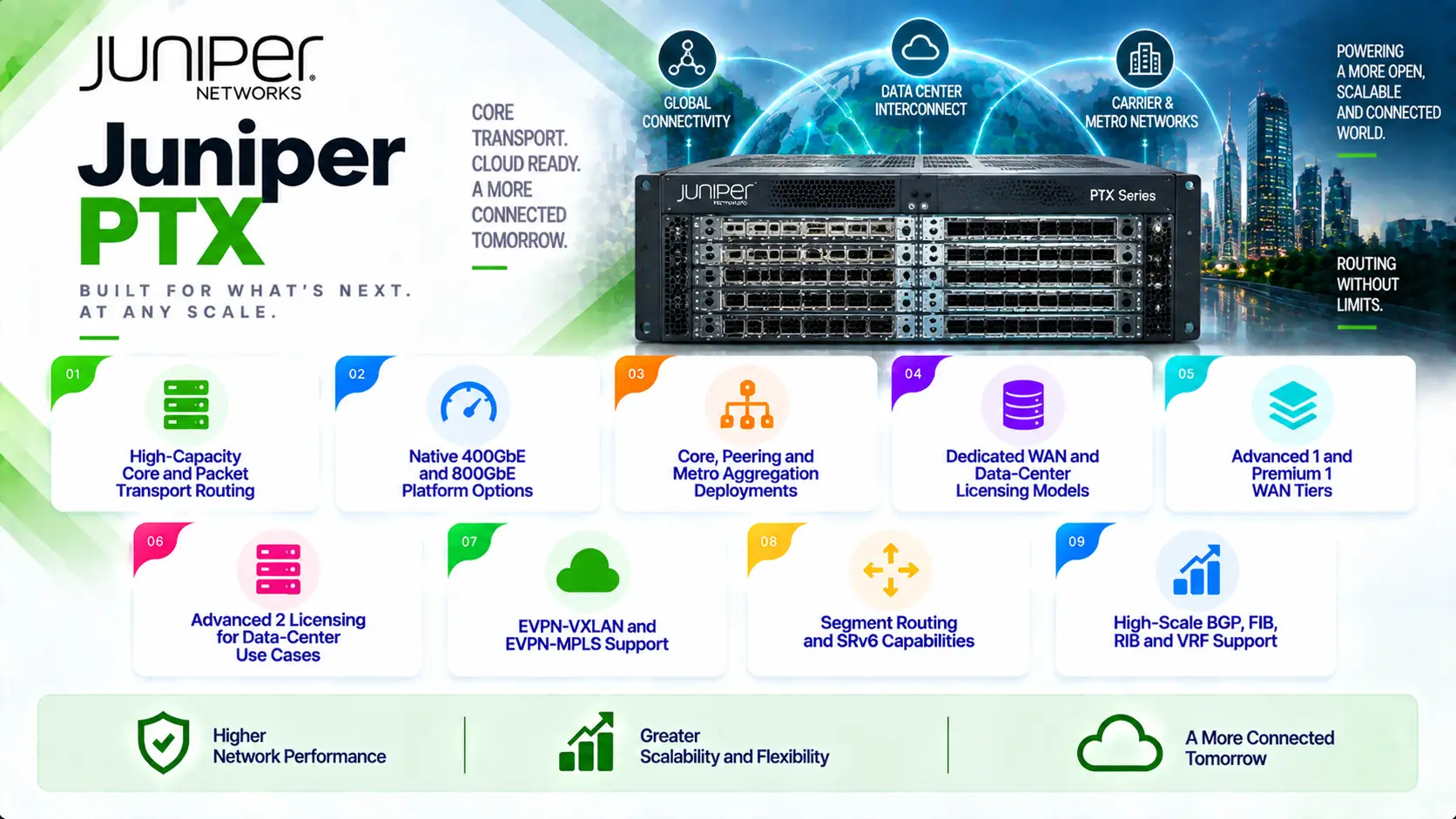
- High-capacity core and packet transport routing
- Native 400GbE and 800GbE platform options
- Core, peering, and metro aggregation deployments
- Dedicated WAN and data-center licensing models
- Advanced 1 and Premium 1 WAN tiers
- Advanced 2 licensing for data-center use cases
- EVPN-VXLAN and EVPN-MPLS support
- Segment Routing and SRv6 capabilities
- High-scale BGP, FIB, RIB, and VRF support
Juniper PTX At a Glance
What it is: High-capacity packet transport router family
Vendor: Juniper Networks
Product family: PTX Series Routers
Parent category: Juniper License
Primary role: Core routing, peering, metro aggregation, DCI, and data-center spine/overlay routing
Current licensing structure: Separate WAN and Data Center use-case licenses
WAN tiers: Advanced 1 (A1) and Premium 1 (P1)
Data Center tier: Advanced 2 (A2)
Current bandwidth unit: 800 Gbps per license entitlement
License types: Subscription and perpetual
Subscription terms: 1, 3, and 5 years

License Overview
A Juniper PTX License determines the software features, bandwidth, and scale available across the licensed chassis. Under Juniper’s current model, buyers first identify whether the PTX platform will operate in a WAN or Data Center role.
For WAN deployments, Juniper provides Advanced 1 (A1) and Premium 1 (P1) tiers. Both currently license up to 800 Gbps per entitlement, but the scale limits differ significantly. A1 is aimed at core, peering, and metro aggregation, while P1 supports higher-scale versions of those use cases.
For example, the current WAN Flex specification provides up to 2 million FIB entries and 6 million RIB entries with A1, compared with up to 4 million FIB entries and 80 million RIB entries with P1. P1 also increases VRF, LSP, firewall filter, tunnel, and BGP scale.
Data-center deployments use Advanced 2 (A2) licensing. Juniper positions this tier for IP spine and overlay use cases and includes features such as BGP, EVPN-VXLAN, VXLAN, SRv6, OSPF, IS-IS, PIM, and ESI-LAG.
Current licenses can be purchased as perpetual entitlements or 1-, 3-, and 5-year subscriptions. Subscription SKUs include customer support, while Juniper lists current perpetual WAN and data-center licenses without customer service included.
Product Overview
High-Capacity Core Routing
PTX is Juniper’s packet transport family for networks where very high throughput must be combined with large routing tables and predictable forwarding performance.
Typical deployments include internet cores, large peering locations, content-provider networks, metro aggregation, DCI, and cloud-provider fabrics.
The newer PTX10002-36QDD, for example, is a 2U fixed platform providing 28.8 Tbps of capacity with 36x800GbE or 72x400GbE connectivity and inline MACsec support.
Core and Internet Peering
PTX platforms are particularly suited to large BGP environments.
Current WAN A1 and P1 licenses both include BGP, but P1 provides higher routing and service scale. Juniper currently specifies up to 2,000 BGP peers under A1 and up to 4,000 with P1 for the current 800G WAN licensing model.
This distinction becomes important for hyperscale peering, large carrier cores, or networks maintaining very large routing tables.
MPLS and Segment Routing
Juniper PTX supports modern transport technologies including MPLS, EVPN-MPLS, LDP, RSVP, Segment Routing, SRv6, PCEP, and Layer 2 circuit services under the current WAN licensing structure.
These capabilities allow PTX to operate as a high-capacity label-switching router while supporting traffic engineering and automated path selection across large transport networks.
Options and Licensing Models
| Licensing Option | Description | Suitable For |
|---|---|---|
| WAN Advanced 1 (A1) | 800G WAN license with core, peering, metro aggregation, and standard routing scale | Standard core and aggregation deployments |
| WAN Premium 1 (P1) | 800G WAN license with significantly higher routing, VRF, LSP, and policy scale | Large carrier, cloud, and high-scale peering environments |
| Data Center Advanced 2 (A2) | 800G license optimized for IP spine and EVPN/VXLAN overlay environments | High-capacity data centers and AI/cloud fabrics |
| FIB Scale Top-Up | Expands supported FIB scale beyond 4 million entries on eligible hardware | Very large internet and hyperscale routing tables |
| 100G MACsec License | Enables licensed MACsec capacity for 100G-class encrypted connectivity | Secure transport links |
| 400G MACsec License | Adds 400G encrypted bandwidth on supported platforms | High-capacity DCI and WAN connections |
| 800G MACsec License | Enables up to 800G of MACsec bandwidth | 800G core, DCI, and cloud infrastructure |
| Subscription License | 1-, 3-, or 5-year entitlement with customer service | Term-based infrastructure procurement |
| Perpetual License | Permanent right-to-use entitlement; support is handled separately | Long-life routing deployments |
Features and Benefits
The current PTX licensing model is more use-case-oriented than the legacy structure. Instead of selecting from numerous generic capacity and feature combinations, new deployments can start by identifying whether the router belongs in the WAN or data center.
The A1/P1 distinction then allows WAN operators to choose scale according to the network. A regional aggregation point may not need tens of millions of routes or 25,000 VRFs, while a large carrier or cloud backbone might.
PTX also provides a pay-as-needed approach to encryption and extreme routing scale. MACsec bandwidth and FIB expansion can be added where required rather than automatically attaching those costs to every deployment.
For newer Express 5 platforms, the combination of 800GbE connectivity, high density, routing scale, and relatively compact form factors makes PTX relevant not only to national or global cores but also to metro aggregation and AI-focused data-center networks.
Compatibility and Requirements
Before ordering a Juniper PTX license, verify:
- Exact PTX hardware model and line card
- WAN or Data Center use case
- Required licensed bandwidth
- A1, P1, or A2 tier
- Expected FIB and RIB size
- Number of BGP peers
- VRF and LSP scale
- MPLS and Segment Routing requirements
- EVPN/VXLAN requirements
Activation and Deployment
PTX licensing is managed through the Juniper Agile Licensing lifecycle.
A typical deployment includes:
- Confirm the chassis and supported line cards
- Define WAN or data-center deployment role
- Select the required Flex tier
- Calculate licensed 800G capacity
- Add FIB or MACsec top-ups where required
- Choose subscription or perpetual entitlement
- Activate the license through the JAL Portal
Pricing and Quote Process
Pricing for Juniper PTX depends on considerably more than the router model.
Before requesting a quote, prepare:
- Exact PTX chassis or fixed platform
- Required number of routers
- WAN or Data Center use case
- Required bandwidth
- A1, P1, or A2 license
- Expected FIB/RIB scale
- MACsec requirements
- Required subscription term
Juniper pricing depends on your product family, license edition, router, switch or SRX model, Mist Cloud requirements, deployment model, license term, and support needs.