

Juniper ACX is a family of high-performance access, aggregation, and Cloud Metro routers built for service-provider, enterprise, mobile transport, edge, and data-center networks. The portfolio combines IP/MPLS routing, Segment Routing, EVPN, precise timing, automation, and high-capacity Ethernet connectivity, while Juniper Flex licensing enables organizations to match software capabilities and bandwidth to the role of each router.
Quick Benefits
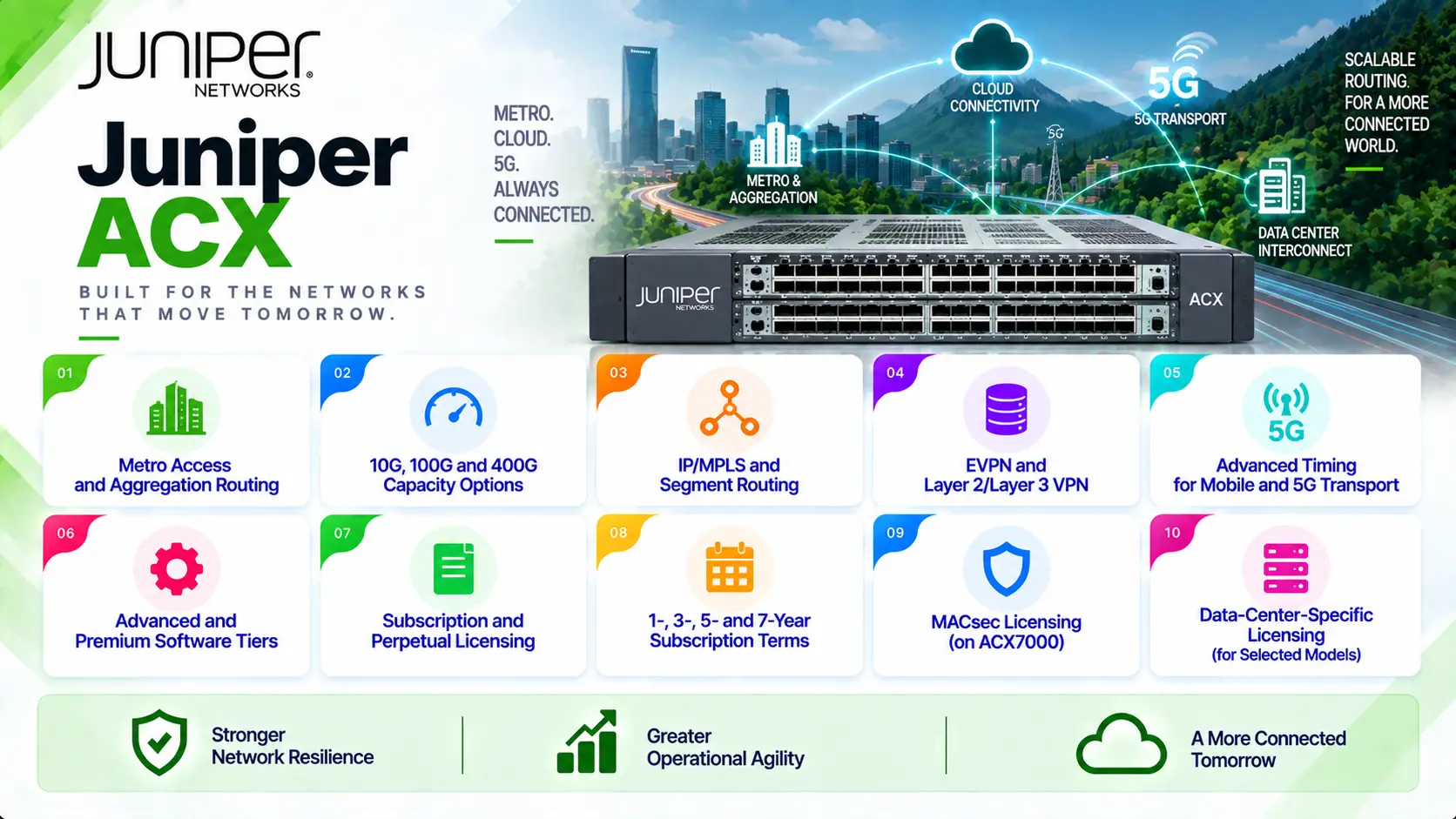
- Metro access and aggregation routing
- High-capacity 10G, 100G, and 400G licensing options
- Advanced IP/MPLS and Segment Routing capabilities
- EVPN and Layer 2/Layer 3 VPN support
- Advanced timing for mobile and 5G transport
- Advanced and Premium software tiers
- Subscription and perpetual licensing options
- 1-, 3-, and 5-year subscription terms
- 7-year terms on selected newer ACX licenses
- MACsec licensing on supported ACX7000 platforms
- Data-center-specific licensing for selected models
Juniper ACX At a Glance
What it is: Metro access, aggregation, and edge router family
Vendor: Juniper Networks
Product family: ACX Series Routers
Parent category: Juniper License
Primary role: Metro Ethernet, IP/MPLS access, aggregation, mobile transport, edge routing, and data-center connectivity
Current flagship family: ACX7000 Series
Key current platforms: ACX7020, ACX7024/7024X, ACX7100, ACX7332, ACX7348, and ACX7509
Operating environment: Service provider, enterprise, wholesale, mobile, edge, and data-center networks
Core technologies: IP/MPLS, EVPN, Segment Routing, SRv6, Layer 2/Layer 3 VPN, QoS, timing, and telemetry
Licensing framework: Juniper Flex
Common license levels: Advanced / Advanced 1 and Premium / Premium 1, depending on platform
Additional license types: Data Center Advanced tiers and MACsec licenses on supported models
License Overview
A Juniper ACX License determines the software entitlement and scale available for supported ACX routers. Juniper currently supports both subscription and perpetual licensing for the ACX family, with Advanced and Premium tiers forming the main Flex licensing structure.
Licensing varies significantly between models. Current ACX SKUs can encode the product family, licensed bandwidth, software tier, and subscription duration. For example, Juniper documentation lists 10G, 100G, and 400G bandwidth-based license variants alongside Advanced/Advanced 1 and Premium/Premium 1 levels. Newer EACX subscription SKUs can use 1-, 3-, 5-, or 7-year terms, while perpetual versions are also available for supported platforms.
Selected ACX7000 platforms have additional licensing requirements. ACX7100-32C and ACX7100-48L, for example, have dedicated Cloud Data Center Advanced 1 and Advanced 2 licenses. MACsec is also separately licensed on supported models through 100G or 400G ACX Junos Evolved MACsec entitlements.
One unusual aspect of current ACX licensing is enforcement. Juniper states that ACX devices can operate without installing a license key and do not generate non-compliance alerts, but customers are still required to hold the appropriate entitlement under Juniper’s purchase and license terms. In other words, technical operation without a key does not remove the commercial licensing requirement.
Product Overview
Metro Access and Aggregation
Juniper ACX routers are designed for networks where large numbers of access connections need to be aggregated into high-capacity IP/MPLS or Ethernet infrastructure.
Typical deployments include carrier Ethernet, mobile backhaul, broadband transport, enterprise WAN aggregation, wholesale services, and distributed edge networks.
The current ACX7000 generation extends this role into Juniper’s Cloud Metro architecture with support for access, pre-aggregation, aggregation, and lean-edge deployment models.
IP/MPLS and Segment Routing
Advanced metro networks require more than basic IP forwarding.
The ACX7000 family supports technologies such as MPLS, L2VPN, L3VPN, EVPN, Segment Routing for IPv4 and IPv6, SR-TE, Flex-Algo, BGP, OSPF, IS-IS, and multiple traffic-engineering mechanisms.
These capabilities allow service providers and enterprises to build scalable transport networks while supporting differentiated customer and application services.
EVPN and Data-Center Connectivity
Selected ACX platforms can also operate in data-center and DCI architectures.
Juniper ACX7000 supports EVPN services over MPLS or VXLAN, including Layer 2 and Layer 3 VPN use cases. ACX7100 platforms are particularly relevant where high-capacity metro aggregation intersects with data-center connectivity.
Juniper provides dedicated data-center license tiers for selected ACX7100 models, so buyers should identify whether the router will be deployed primarily for metro services or data-center functions before choosing a SKU.
Options and Licensing Models
| Licensing Option | Description | Suitable For |
|---|---|---|
| Advanced / Advanced 1 | Enables the Advanced software tier at the licensed bandwidth level | Metro access and aggregation environments requiring advanced IP/MPLS services |
| Premium / Premium 1 | Provides the higher Flex feature/scale tier on supported ACX platforms | Larger metro, service-edge, and high-scale deployments |
| 100G License | Entitlement aligned with 100G licensed capacity on supported models | Lower or medium-capacity ACX deployments |
| 400G License | Entitlement aligned with higher 400G capacity on supported platforms | High-capacity aggregation and Cloud Metro |
| Data Center Advanced 1 | Data-center-focused entitlement for selected ACX7100 models | Leaf/spine and data-center deployments |
| Data Center Advanced 2 | Higher data-center software tier on supported ACX7100 models | More advanced data-center requirements |
| MACsec License | Enables licensed MACsec bandwidth on supported ACX7000 hardware | Encrypted metro and DCI links |
| Subscription License | Term-based entitlement, commonly 1, 3, or 5 years and up to 7 years on selected SKUs | Organizations preferring renewable software rights |
| Perpetual License | Long-term software entitlement on supported ACX products | Long-life routing infrastructure |
Exact license availability is model-dependent. ACX710, ACX5448 variants, ACX7100, ACX7024, and ACX7348, for example, do not all use identical SKU combinations.
Features and Benefits
The main advantage of Juniper ACX is its ability to cover several metro roles within one product family. Smaller platforms can sit close to customer or mobile access, while higher-capacity ACX7000 systems can aggregate those connections and extend them toward a service edge or data center.
The licensing structure follows this architecture. Organizations can select the software tier and bandwidth aligned with each router rather than applying one universal entitlement across every ACX deployment.
Modern routing capabilities are another important advantage. Segment Routing, EVPN, MPLS, advanced QoS, telemetry, and automation provide a foundation for highly programmable transport networks without requiring completely separate platforms for access and aggregation.
For newer ACX7000 deployments, Junos OS Evolved and Juniper Routing Director also provide a more automation-oriented operational model.
Compatibility and Requirements
Before ordering a Juniper ACX license, confirm:
- Exact ACX router model
- Installed or planned Junos/Junos OS Evolved release
- Metro, edge, or data-center use case
- Required forwarding capacity
- 10G, 100G, or 400G licensing requirement
- Advanced or Premium feature tier
- MPLS and Segment Routing requirements
- EVPN requirements
- Number and scale of VPN services
- MACsec requirements
- Timing and synchronization requirements
- Subscription or perpetual licensing preference
- Required subscription duration
- Automation and management platform
Hardware capabilities still matter. Purchasing a license does not add physical interfaces or features unsupported by the selected ACX model.
Activation and Deployment
After determining the correct Juniper ACX License, the entitlement should be associated with the appropriate customer account and platform.
A typical deployment includes:
- Confirm the exact ACX model
- Define required bandwidth
- Select Advanced or Premium tier
- Determine subscription or perpetual term
- Add MACsec or data-center licenses where needed
- Verify software release compatibility
- Activate the entitlement
- Configure routing and services
- Connect the router to management and automation platforms
- Verify entitlement records and renewal dates
Because ACX licensing is not always technically enforced through an installed license key, maintaining accurate entitlement records is especially important for commercial compliance.
Pricing and Quote Process
Pricing for Juniper ACX depends on the hardware model, licensed bandwidth, software tier, deployment type, subscription duration, and any additional capabilities such as MACsec.
Before requesting a quote, prepare:
- Exact ACX model
- Number of routers
- Required 100G or 400G capacity
- Advanced or Premium tier
- Metro or data-center use case
- MACsec requirements
- Required Junos version
- Subscription duration
- Perpetual licensing preference, if applicable
- Support requirements
Juniper pricing depends on your product family, license edition, router, switch or SRX model, Mist Cloud requirements, deployment model, license term, and support needs.