

Proofpoint Security Posture is a security assessment and risk visibility solution designed to help organizations understand their exposure to email-based threats, user-related risks, and security weaknesses. By analyzing security conditions and providing actionable insights, it helps businesses improve their protection strategy before attackers exploit existing gaps.
Quick Benefits
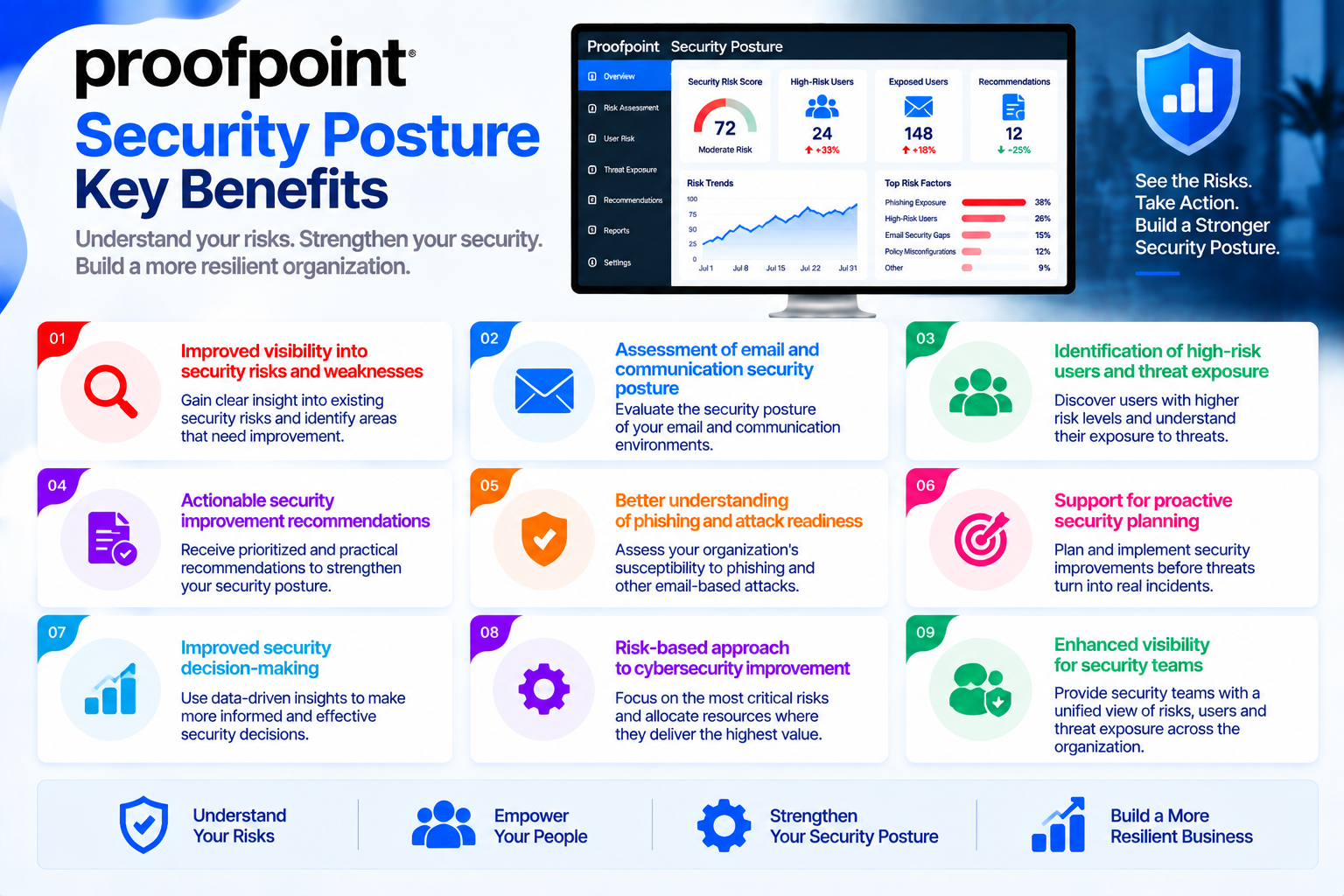
- Improved visibility into security risks and weaknesses
- Assessment of email and communication security posture
- Identification of high-risk users and threat exposure
- Actionable security improvement recommendations
- Better understanding of phishing and attack readiness
- Support for proactive security planning
- Improved security decision-making
- Risk-based approach to cybersecurity improvement
- Enhanced visibility for security teams
Proofpoint Security Posture At a Glance
What it is: Security posture assessment and risk visibility solution
Product name: Proofpoint Security Posture
Parent category: Proofpoint License
Primary role: Assess security readiness and identify areas requiring improvement
Solution category: Cybersecurity Assessment and Risk Management
Management platform: Proofpoint Security Platform
Protected assets: Users, email environments, security controls, and communication workflows
Supported environments: Enterprise email environments, cloud communication platforms, and security operations workflows

License Overview
A Proofpoint Security Posture License enables organizations to evaluate their current security condition and identify areas where improvements can reduce cyber risk. Unlike prevention-focused solutions that primarily block threats, security posture solutions provide visibility into weaknesses, exposure levels, and opportunities for improvement.
The licensing model depends on the scope of assessment, number of users or environments evaluated, available security data sources, and required reporting capabilities. Organizations should determine whether they need a focused assessment of email security risks or broader visibility across multiple security areas.
Security posture management is particularly valuable for businesses that already have security controls in place but need better understanding of their effectiveness. A company may have email filtering, user training, and threat protection technologies deployed but still lack visibility into remaining risks.
When selecting a Proofpoint Security Posture License, organizations should consider their existing Proofpoint deployment, security maturity level, compliance requirements, and the level of reporting required by security teams. A proper assessment helps organizations prioritize security improvements based on actual risk instead of applying security changes without clear visibility.
Product Overview
Understanding Cybersecurity Risk Exposure
Modern organizations often operate with multiple security technologies, but having security tools does not automatically mean that risk is fully controlled. Attackers continuously adapt their techniques, especially around email-based attacks, credential theft, and social engineering. Proofpoint Security Posture helps organizations understand their current security position by evaluating risk factors and providing visibility into areas that may require additional protection.
Security Assessment and Risk Visibility
Security teams need accurate information to decide where improvements will have the highest impact. Proofpoint Security Posture provides insights into security conditions and helps organizations identify weaknesses related to users, communication environments, and existing protection strategies. Instead of relying only on assumptions, security teams can use measurable information to guide security planning.
Identifying User and Communication Risks
Employees remain one of the most targeted elements in modern cyberattacks. Weak security awareness, exposed accounts, and risky communication behaviors can increase the likelihood of successful attacks. Proofpoint Security Posture helps organizations understand user-related risks and identify areas where additional controls, training, or policy improvements may be needed.
Options and Licensing Models
| Licensing Option | Description | Suitable For |
|---|---|---|
| User-Based Assessment | Security visibility based on protected users and communication environments | Organizations evaluating user-related risks |
| Email Security Assessment | Focused evaluation of email-related security exposure | Businesses prioritizing email threats |
| Security Risk Analysis | Broader assessment of security conditions and weaknesses | Enterprises improving cybersecurity maturity |
| Reporting and Analytics Package | Enhanced visibility and security improvement reporting | Security teams requiring detailed analysis |
| Enterprise Subscription | Broader posture management capabilities | Large organizations with complex environments |
| Multi-Year Subscription | Longer security assessment coverage | Organizations planning continuous improvement programs |
Features and Benefits
Proofpoint Security Posture helps organizations shift from reactive security management toward proactive risk reduction. Instead of waiting for incidents to reveal weaknesses, businesses can identify areas that require attention and improve their security strategy before problems occur. A key benefit is improved decision-making. Security teams can use risk visibility to prioritize investments, adjust policies, and focus on areas with the highest potential impact.
The solution also supports better alignment between security operations and business objectives. By understanding current security conditions, organizations can create realistic improvement plans instead of implementing controls without clear priorities. For enterprises managing complex communication environments, Proofpoint Security Posture provides a structured approach to measuring and improving cybersecurity readiness.
Compatibility and Requirements
Before deploying Proofpoint Security Posture, organizations should evaluate their security environment and assessment objectives.
Important considerations include:
- Existing Proofpoint solutions
- Email security architecture
- Number of users and environments
- Required assessment scope
- Reporting requirements
- Compliance objectives
- Security team workflows
Organizations should identify which security areas require evaluation before deployment to ensure that assessment results provide meaningful guidance. Integration requirements may vary depending on the existing Proofpoint platform and selected capabilities.
Activation and Deployment
Deployment begins after selecting the appropriate Proofpoint Security Posture License and activating the required assessment capabilities.
Typical deployment steps include:
- Activating the Proofpoint subscription
- Connecting required security data sources
- Defining assessment scope
- Running security evaluations
- Reviewing findings and recommendations
Organizations often begin with critical communication environments before expanding assessment coverage across additional security areas.
Pricing and Quote Process
Pricing for Proofpoint Security Posture depends mainly on assessment scope, number of users, required integrations, reporting capabilities, and subscription duration.
Before requesting a quote, organizations should define:
- Number of users or environments evaluated
- Required security assessment areas
- Existing Proofpoint products
- Reporting requirements
- Compliance objectives
- Subscription term
A detailed evaluation helps organizations select the appropriate assessment capabilities without unnecessary licensing costs. Organizations should also consider future requirements because expanding infrastructure, additional users, or new security objectives may increase assessment needs.
Proofpoint pricing depends on your security solution, email protection features, data security requirements, deployment model, license term, and support needs.