

Proofpoint Prime Threat Protection is an advanced email security solution designed to protect organizations against phishing, business email compromise (BEC), malware, and targeted email-based attacks. It combines threat detection, email analysis, and security intelligence to help businesses reduce email risks while maintaining visibility into modern communication threats.
Quick Benefits
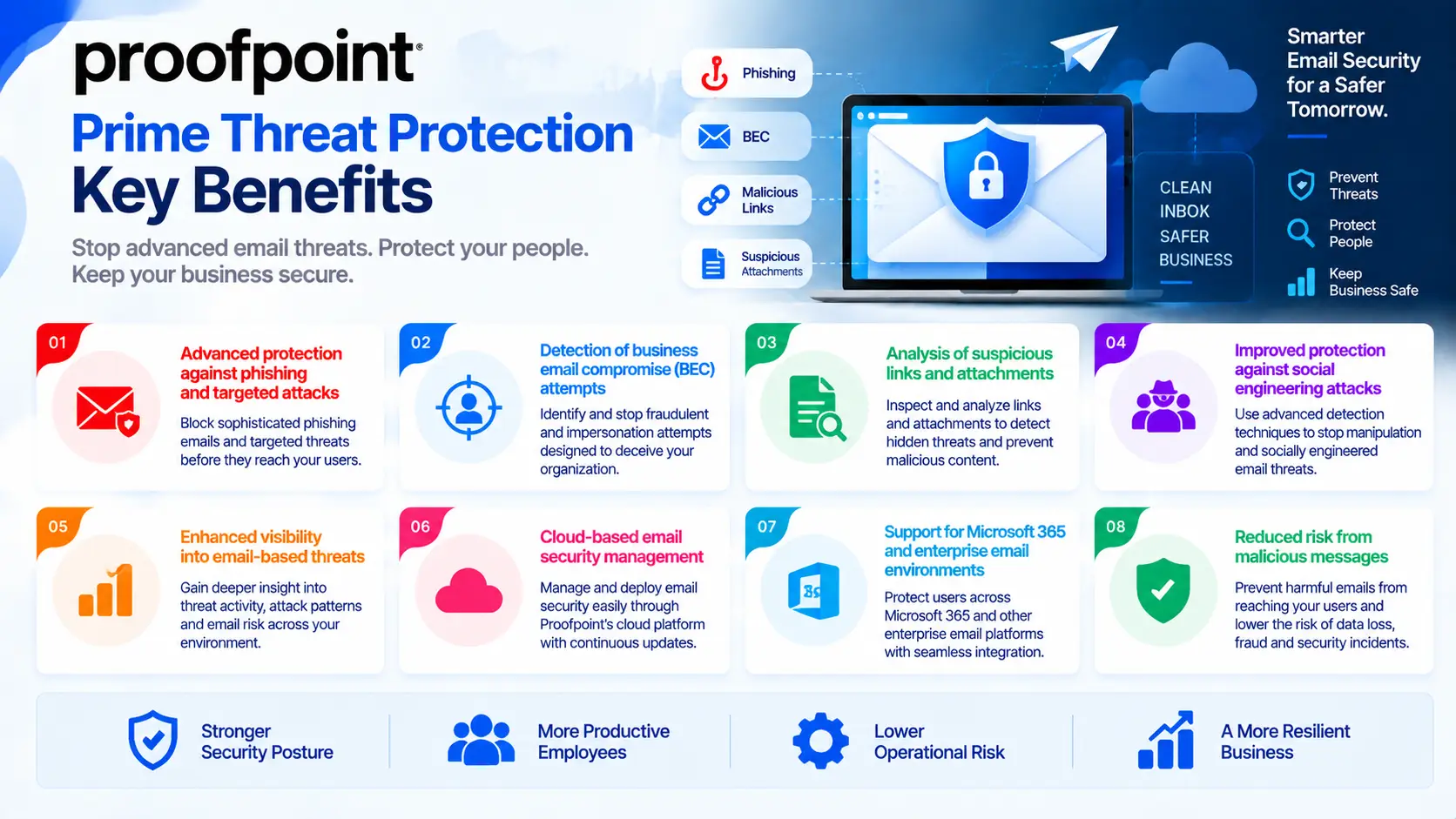
- Advanced protection against phishing and targeted email attacks
- Detection of business email compromise (BEC) attempts
- Analysis of suspicious links and attachments
- Improved protection against social engineering attacks
- Enhanced visibility into email-based threats
- Cloud-based email security management
- Support for Microsoft 365 and enterprise email environments
- Reduced risk from malicious messages
Proofpoint Prime Threat Protection At a Glance
What it is: Advanced email threat protection solution
Product name: Proofpoint Prime Threat Protection
Parent category: Proofpoint License
Primary role: Detect and prevent advanced email-based threats including phishing, malware, and targeted attacks
Solution category: Email Security and Advanced Threat Protection
Management platform: Proofpoint Enterprise Security Platform
Protected assets: Corporate email users, mailboxes, domains, and communication environments
Supported environments: Microsoft 365, enterprise email systems, and cloud-based email infrastructures
License model: Subscription-based licensing based on protected users, mailboxes, and selected capabilities

License Overview
A Proofpoint Prime Threat Protection License is designed around protecting organizational email communication against advanced threats that traditional spam filtering solutions may not detect. The licensing model is generally based on the number of protected users or mailboxes, along with the selected security capabilities and subscription duration.
Unlike basic email filtering solutions that mainly focus on known spam and malware patterns, Prime Threat Protection is designed to analyze more sophisticated attack techniques such as credential phishing, impersonation attempts, malicious URLs, and socially engineered messages.
Organizations should evaluate their email environment, number of users, threat exposure, and existing security controls before selecting the appropriate license configuration. Companies with high-value users, external communication requirements, or increased phishing risk may require broader protection capabilities.
When selecting a Proofpoint Prime Threat Protection License, businesses should also consider integration requirements, security policies, compliance obligations, and future growth because email threats continue to evolve and often target users rather than infrastructure alone.
Product Overview
Advanced Email Threat Protection
Email remains one of the most common attack channels used by cybercriminals because it directly targets employees and business communication workflows. Proofpoint Prime Threat Protection helps organizations identify and block advanced email threats by analyzing messages, attachments, links, sender behavior, and communication patterns. The solution focuses on preventing attacks before they reach users while providing security teams with better visibility into attempted threats.
Protection Against Phishing and Business Email Compromise
Modern phishing attacks are increasingly personalized and designed to bypass traditional security controls. Business Email Compromise (BEC) attacks often rely on impersonation, trusted communication patterns, or urgent requests rather than obvious malicious content.
Proofpoint Prime Threat Protection helps detect suspicious communication behavior and identify messages that may represent fraudulent activity. This is especially important for organizations where attackers target executives, finance teams, or employees with access to sensitive information.
URL and Attachment Analysis
Malicious links and attachments remain two of the most common methods used to deliver malware and steal credentials. Prime Threat Protection analyzes email content and identifies potentially dangerous elements before users interact with them. By examining suspicious URLs and files, organizations can reduce exposure to phishing pages, malware delivery mechanisms, and credential harvesting attempts.
Core Technical Flow
Incoming Email Message
→ Proofpoint Email Security Analysis
→ Sender Reputation and Threat Intelligence Evaluation
→ URL and Attachment Inspection
→ Policy Enforcement and Threat Decision
→ Delivery, Quarantine, or Blocking
→ Security Monitoring and Reporting
The platform evaluates email content, sender behavior, and threat indicators before allowing communication to reach users.
Options and Licensing Models
| Licensing Option | Description | Suitable For |
|---|---|---|
| User-Based Subscription | Licensing based on the number of protected email users | Organizations with defined user populations |
| Mailbox Protection | Coverage based on protected business mailboxes | Microsoft 365 and enterprise email environments |
| Advanced Threat Protection Modules | Additional security capabilities for enhanced email analysis | Organizations facing targeted attacks |
| Enterprise Email Security Package | Broader protection combining multiple Proofpoint capabilities | Large organizations requiring layered protection |
| Multi-Year Subscription | Longer licensing commitment with predictable planning | Enterprises requiring stable security investment |
| Additional Security Services | Optional capabilities such as awareness, DLP, or threat intelligence extensions | Organizations building broader security programs |
The correct licensing model depends on the number of protected users, email architecture, security requirements, and selected Proofpoint capabilities.
Features and Benefits
Proofpoint Prime Threat Protection helps organizations move beyond traditional email filtering by focusing on the techniques attackers use in modern campaigns. Instead of only identifying known malicious messages, the solution provides deeper analysis of communication patterns, suspicious content, and targeted attack methods. One of the strongest benefits is improved protection against phishing and BEC attacks. These threats often depend on convincing users rather than exploiting technical vulnerabilities, making advanced email analysis an important security layer.
The solution also improves security operations by reducing the number of suspicious messages that require manual investigation and providing security teams with additional context when reviewing incidents. For organizations handling sensitive communication, Prime Threat Protection provides a stronger foundation for protecting users, reducing email-based risks, and improving overall security awareness.
Compatibility and Requirements
Before deploying Proofpoint Prime Threat Protection, organizations should evaluate their email infrastructure and security requirements.
Important considerations include:
- Current email platform
- Number of users and mailboxes
- Email domains requiring protection
- Existing security controls
- Compliance requirements
- Security policy requirements
- Required integrations
Proofpoint Prime Threat Protection is commonly used with enterprise email environments, including Microsoft 365 deployments. Organizations should review email routing, domain configuration, and security policies before deployment to ensure proper protection coverage.
Activation and Deployment
Deployment begins after selecting the appropriate Proofpoint Prime Threat Protection License and activating the required services.
Typical deployment steps include:
- Activating the Proofpoint subscription
- Configuring protected domains
- Connecting email routing environments
- Defining security policies
- Testing message inspection and protection workflows
Organizations often begin by protecting primary business domains before expanding coverage to additional users, departments, or subsidiaries.
Pricing and Quote Process
Pricing for Proofpoint Prime Threat Protection depends mainly on the number of protected users or mailboxes, selected security capabilities, subscription duration, and deployment requirements.
Before requesting a quote, organizations should define:
- Number of email users
- Protected domains
- Current email platform
- Required threat protection capabilities
- Compliance requirements
- Additional Proofpoint modules
- Subscription term
A proper assessment helps organizations select the right protection level without purchasing unnecessary capacity. Organizations should also consider future growth because increasing user numbers, additional domains, and evolving threat requirements may affect licensing needs.
Proofpoint pricing depends on your security solution, email protection features, data security requirements, deployment model, license term, and support needs.