

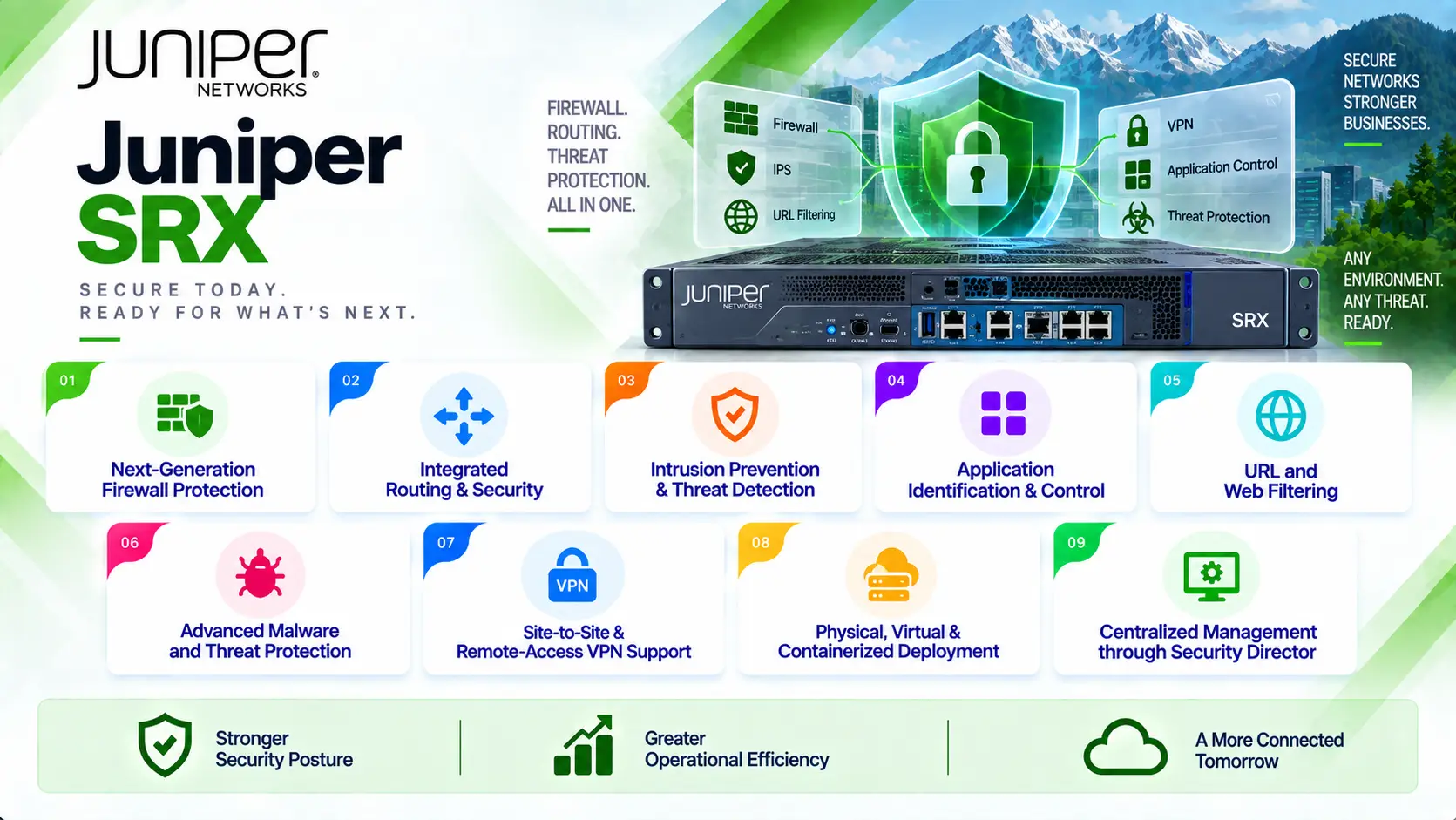
Juniper SRX is a family of next-generation firewalls designed to protect branch networks, enterprise campuses, data centers, service-provider environments, and cloud deployments. Running Junos OS and supported by Juniper’s security services, SRX platforms combine stateful firewalling, routing, VPN, intrusion prevention, application control, web filtering, malware protection, and threat intelligence within a common security architecture.
Quick Benefits
- Next-generation firewall protection
- Integrated routing and security
- Intrusion prevention and threat detection
- Application identification and control
- URL and web filtering capabilities
- Advanced malware and threat protection
- Site-to-site and remote-access VPN support
- Physical, virtual, and containerized deployment options
- Centralized management through Security Director
Juniper SRX At a Glance
What it is: Next-generation firewall product family
Vendor: Juniper Networks
Product family: SRX Series Firewalls
Parent category: Juniper License
Primary role: Network firewalling, threat prevention, secure routing, and segmentation
Operating system: Junos OS
Deployment models: Physical SRX appliances, vSRX virtual firewall, and cSRX container firewall
Typical environments: Branch, campus, data center, service provider, cloud, and hybrid networks
Core capabilities: Stateful firewall, IPS, AppID, VPN, web filtering, antivirus, threat intelligence, and advanced threat prevention
Management platform: Juniper Security Director / Security Director Cloud
Licensing framework: Juniper Flex
License Overview
A Juniper SRX License determines which advanced security services can be enabled on an SRX firewall beyond its base Junos firewall and routing capabilities.
Under Juniper Flex, supported SRX appliances can use subscription or perpetual software licenses. Exact tier availability depends on the hardware model. For example, SRX300 and SRX320 support Advanced 1, Advanced 2, and Premium 1, while platforms such as SRX340, SRX345, and SRX380 can also support Premium 2. Higher-end models may provide additional A3 or P3 tiers depending on the generation and licensing structure.
The most important point is that the tier name alone does not describe every feature. Juniper builds different security capabilities into individual tiers. IDP signatures, application identification, web filtering, antivirus, anti-spam, and ATP Cloud may appear in different combinations depending on both the SRX model and selected Flex tier.
For example, current Juniper documentation shows IDP signatures in multiple Advanced and Premium tiers, while ATP Cloud is associated with Premium tiers on several SRX platforms. Web filtering and antivirus are commonly included in higher feature bundles. Selecting the correct Juniper SRX License therefore requires matching the exact firewall model with the security functions that will actually be used.
Product Overview
Firewall and Secure Routing in One Platform
One of the core strengths of Juniper SRX is that firewalling and routing operate within Junos OS rather than being treated as completely separate functions.
This makes SRX suitable for branch and edge designs where one platform may provide routing, NAT, VPN, segmentation, security policy enforcement, and threat prevention.
For larger environments, the same architecture extends into data-center and service-provider platforms with significantly higher scale and policy capacity.
Intrusion Prevention
Intrusion Prevention System capabilities help SRX identify known exploits and suspicious network activity.
Juniper Flex licensing includes IDP signature capabilities across several Advanced and Premium tiers. The exact feature combination varies by firewall generation and license.
IPS is particularly important where the firewall is positioned at an internet edge, between network zones, or in front of applications that may be exposed to exploit attempts.
Application Identification and Control
Modern firewall policy increasingly depends on application context rather than port numbers alone.
Juniper AppID allows SRX platforms to recognize application traffic and enforce more granular policies. Current next-generation SRX Flex bundles include AppID signatures across supported Advanced and Premium tiers on newer platforms.
This gives administrators more control over SaaS, web applications, collaboration platforms, and other application traffic.
Physical, Virtual, and Containerized Firewalls
The SRX security architecture is not limited to hardware appliances.
Juniper also provides vSRX for virtual and public-cloud environments and cSRX for containerized and microservices-based environments. Juniper currently positions the SRX family as covering physical, virtual, and containerized firewall deployments under centralized Security Director management.
cSRX has its own Flex licensing structure. Current Juniper documentation lists Standard, Advanced 1, and Advanced 2 subscription tiers, with Advanced levels adding capabilities such as IDP, AppID, antivirus, and web filtering.
Options and Licensing Models
| Licensing Option | Description | Suitable For |
|---|---|---|
| Standard / Base Software | Core firewall and Junos capabilities supplied with supported hardware | Basic firewall, routing, VPN, and segmentation requirements |
| Advanced 1 | Adds security capabilities such as IDP and, on newer platforms, AppID | Organizations requiring NGFW and intrusion-prevention functions |
| Advanced 2 | Extends Advanced functionality with services such as web filtering, antivirus, or anti-spam depending on model | Enterprise edge and internet-facing firewall deployments |
| Premium 1 | Adds advanced threat capabilities such as ATP Cloud on supported platforms | Organizations requiring malware and advanced-threat protection |
| Premium 2 | Combines broader content-security and premium threat-protection capabilities where supported | Higher-security enterprise environments |
| Perpetual License | Provides long-term software rights on supported SRX products, with support purchased separately | Long-lived infrastructure deployments |
| Subscription License | Provides advanced or premium features for a defined term with software support included | Organizations preferring term-based security licensing |
Features and Benefits
Juniper SRX provides a practical combination of networking and security. In branch environments, this can reduce the need for separate routing and firewall appliances. In data centers, SRX can enforce segmentation and high-capacity security policies while integrating with broader Juniper network designs.
The Flex licensing structure is also useful because security services can be selected according to operational requirements. A location that only requires routing, firewalling, and VPN does not necessarily need the same license as an internet-facing edge that requires IPS, application visibility, web filtering, malware inspection, and ATP.
Centralized management is another advantage. Juniper positions physical SRX, vSRX, and cSRX firewalls around Security Director Cloud for unified management and consistent policy enforcement.
For larger organizations, this makes it possible to standardize policies while using different SRX form factors across branch, campus, data center, and cloud environments.
Compatibility and Requirements
Before purchasing or renewing an SRX license, verify:
- Exact SRX hardware model
- Installed or planned Junos OS release
- Required firewall throughput
- IPS and threat-prevention throughput requirements
- Application-control requirements
- Web filtering requirements
- Antivirus or anti-spam requirements
- ATP Cloud requirements
- VPN requirements
- High-availability architecture
- Security Director compatibility
- Subscription or perpetual preference
- Required license duration
Feature availability must be checked against the exact model. Juniper explicitly notes that inclusion of a feature within a license tier does not guarantee that every SRX hardware platform supports that feature.
Activation and Deployment
After selecting the correct SKU, licensing is normally associated with the customer entitlement and relevant SRX platform.
A typical deployment includes:
- Confirm the SRX model and Junos version
- Select the required Flex tier
- Activate the software entitlement
- Configure firewall and security policies
- Enable licensed threat services
- Update signatures and security intelligence
- Connect the firewall to Security Director where required
- Validate licenses and policy enforcement
Security services should be tested against expected traffic before full production enforcement, especially when enabling IPS, web filtering, antivirus, or application-control policies.
Pricing and Quote Process
Pricing for Juniper SRX depends on both the firewall platform and the security subscription required.
Before requesting a quote, prepare:
- Exact SRX model
- Number of firewalls
- Required Advanced or Premium tier
- Security services required
- Subscription duration
- Perpetual licensing requirements, if applicable
- High-availability design
- Support requirements
- Planned Junos version
- Existing Juniper entitlements
Juniper pricing depends on your product family, license edition, router, switch or SRX model, Mist Cloud requirements, deployment model, license term, and support needs.