

Palo Alto PA-450R is a ruggedized next-generation firewall designed for organizations that require advanced network security in industrial, outdoor, and environmentally challenging environments. Built on Palo Alto Networks’ PA-400 Series architecture, it combines enterprise firewall capabilities with a hardened design suitable for locations where standard security appliances may not be practical.
Quick Benefits
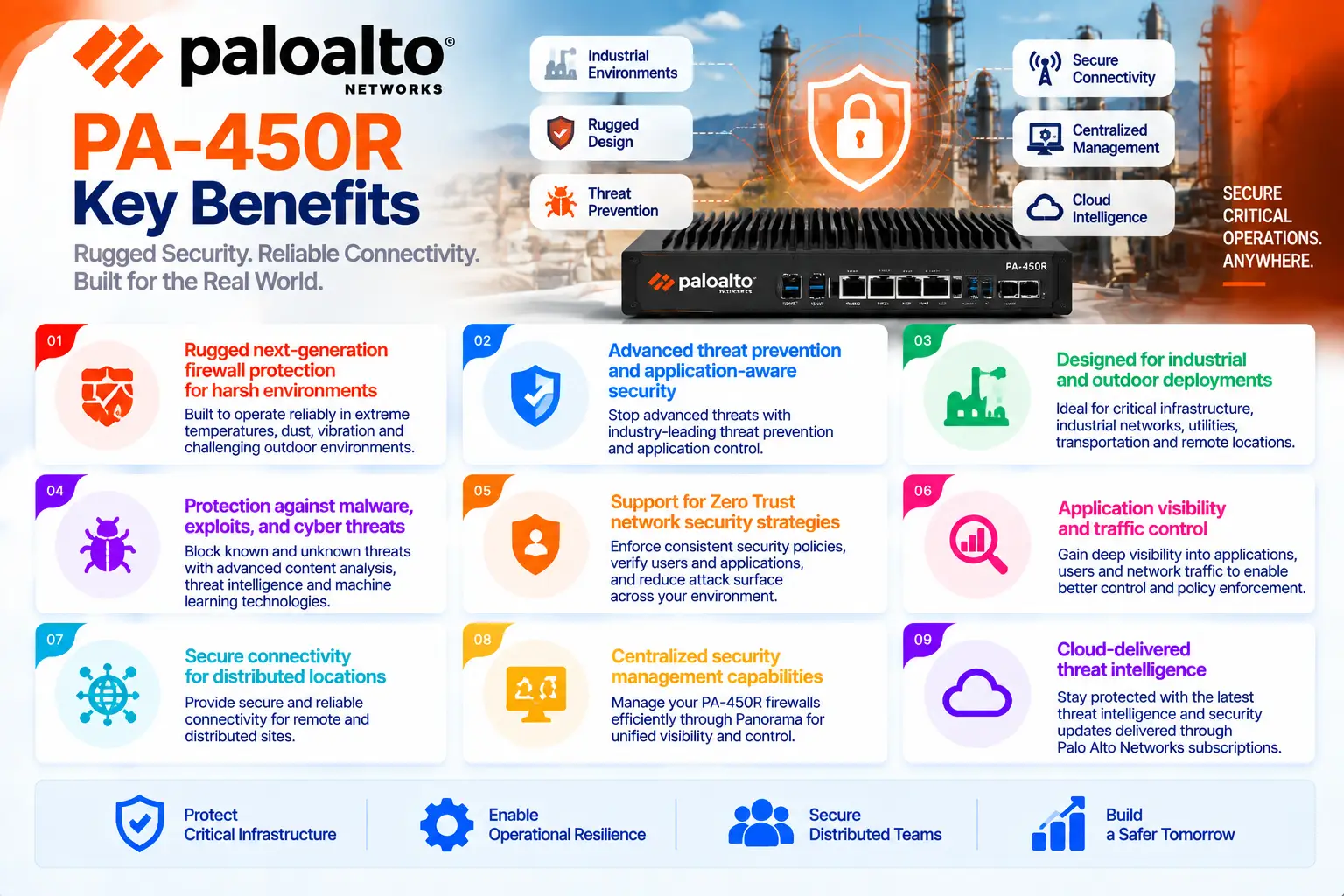
- Rugged next-generation firewall protection for harsh environments
- Advanced threat prevention and application-aware security
- Designed for industrial and outdoor deployments
- Protection against malware, exploits, and cyber threats
- Support for Zero Trust network security strategies
- Application visibility and traffic control
- Secure connectivity for distributed locations
- Centralized security management capabilities
- Cloud-delivered threat intelligence through subscriptions
Palo Alto PA-450R At a Glance
What it is: Ruggedized Next-Generation Firewall appliance
Product name: Palo Alto PA-450R
Product family: PA-400R Series
Parent category: Palo Alto License
Primary role: Secure network connectivity and threat protection for industrial and rugged environments
Solution category: Network Security and Next-Generation Firewall
Management platform: PAN-OS, Panorama, and Palo Alto cloud management options
Deployment model: Physical ruggedized appliance
Security capabilities: Application control, threat prevention, URL filtering, DNS security, malware analysis, and advanced traffic inspection

License Overview
A Palo Alto PA-450R License extends the capabilities of the PA-450R firewall by enabling additional security services required for modern network protection. Similar to other Palo Alto Networks firewall platforms, the appliance provides the core security framework, while subscription services add advanced detection, prevention, and intelligence capabilities.
The licensing structure is designed around the organization’s operational environment and required security coverage. A standard deployment may use the firewall for application visibility and access control, while environments exposed to advanced threats may require additional subscriptions such as Threat Prevention, WildFire malware analysis, DNS Security, or URL Filtering.
Because PA-450R is targeted toward industrial and rugged locations, licensing decisions should consider not only security requirements but also operational continuity. Facilities such as manufacturing sites, utilities, and remote infrastructure often require reliable protection with minimal maintenance opportunities.
When selecting a Palo Alto PA-450R License, organizations should evaluate network traffic volume, connected devices, compliance requirements, remote management needs, and the level of threat prevention required. The correct subscription combination allows businesses to maintain strong security protection without deploying unnecessary services.
Product Overview
Rugged Security for Challenging Environments
Many organizations operate critical infrastructure outside traditional office environments. Industrial facilities, transportation systems, and remote locations often require networking equipment that can operate under demanding physical conditions.
The PA-450R addresses these requirements by combining Palo Alto’s next-generation firewall technology with a ruggedized design intended for environments where temperature, location, or physical conditions create additional deployment challenges.
This allows organizations to extend enterprise security capabilities beyond conventional data centers and branch offices.
Next-Generation Firewall Capabilities
At its core, the PA-450R provides the same security philosophy found across Palo Alto Networks firewall platforms: visibility, control, and threat prevention.
The appliance examines network traffic based on applications, users, and security policies rather than relying only on traditional port-based filtering.
This approach helps security teams create more accurate access controls and reduce unnecessary exposure across operational networks.
Protection for Industrial and Edge Networks
Industrial environments often include a combination of operational technology (OT), connected devices, and traditional IT systems.
Without proper segmentation and security controls, these environments can become attractive targets for attackers.
The PA-450R helps organizations apply security policies at network edges, protect connected systems, and improve visibility into traffic patterns between operational locations.
Options and Licensing Models
| Licensing Option | Description | Suitable For |
|---|---|---|
| Base PA-450R Appliance License | Provides the ruggedized firewall platform and core PAN-OS functionality | Organizations requiring secure edge deployment |
| Threat Prevention Subscription | Adds protection against exploits, vulnerabilities, and malicious activity | Industrial and enterprise environments requiring advanced defense |
| WildFire Subscription | Provides cloud-based malware analysis and unknown threat detection | Organizations handling advanced malware risks |
| Advanced URL Filtering | Protects users and networks from malicious web destinations | Environments requiring web threat protection |
| DNS Security Subscription | Adds protection against DNS-based attacks and malicious domains | Organizations requiring additional threat intelligence |
| GlobalProtect Licensing | Enables secure remote access capabilities | Distributed organizations and remote users |
| Support and Maintenance Subscription | Provides technical support and software lifecycle assistance | Production deployments |
The correct licensing combination depends on the deployment environment, security objectives, and required level of threat protection.
Features and Benefits
Palo Alto PA-450R provides organizations with a way to extend enterprise-grade cybersecurity into locations where traditional firewall appliances may not be suitable. Its ruggedized design makes it valuable for environments that require reliable operation while maintaining advanced security capabilities.
One of the main advantages of the platform is combining physical durability with Palo Alto’s security technology. Organizations can apply application-aware policies, inspect traffic, and protect critical network segments without relying on separate security architectures.
For industrial and edge deployments, visibility is particularly important. The PA-450R helps security teams understand network activity and enforce security controls between connected systems.
The available subscription services further strengthen protection by adding threat intelligence, malware analysis, and advanced prevention capabilities.
Compatibility and Requirements
Before deploying Palo Alto PA-450R, organizations should evaluate their network architecture and environmental requirements.
Important considerations include:
- Deployment location and environmental conditions
- Expected network throughput
- Connected systems and devices
- Required security subscriptions
- Management requirements
- Compliance obligations
- Remote administration needs
Because the PA-450R is designed for specialized environments, organizations should ensure that the appliance configuration matches both operational and security requirements. Proper sizing is important because enabling advanced inspection services may affect performance expectations.
Activation and Deployment
Deployment begins after selecting the appropriate Palo Alto PA-450R License and registering the firewall appliance.
Typical deployment steps include:
- Registering the PA-450R device
- Activating required subscriptions
- Configuring PAN-OS settings
- Defining security policies
- Connecting centralized management
- Testing traffic inspection and protection features
Organizations usually establish basic connectivity first and then enable additional security services based on operational requirements.
Pricing and Quote Process
Pricing for Palo Alto PA-450R depends on the appliance configuration, selected security subscriptions, support services, and licensing duration.
Before requesting a quote, organizations should define:
- Deployment environment
- Expected traffic volume
- Required security capabilities
- Number of locations
- Remote management requirements
- Support term
The total investment is influenced by both the firewall appliance and selected security subscriptions. A detailed assessment helps organizations choose a configuration that provides sufficient protection while avoiding unnecessary licensing expenses.
Palo Alto pricing depends on your security solution, firewall model, license edition, deployment model, license term, and support requirements.