

Palo Alto Prisma AIRS is an AI security platform designed to help organizations securely develop, deploy, and operate artificial intelligence applications. It provides protection for AI models, large language models (LLMs), AI agents, and applications by identifying security risks, controlling AI interactions, and protecting sensitive data throughout the AI lifecycle.
Quick Benefits
- Security protection for AI applications and LLM environments
- Detection of AI-specific security risks
- Protection against prompt injection attacks
- Sensitive data protection in AI interactions
- AI application visibility and governance
- Security controls for AI development workflows
- Risk assessment for AI models and applications
- Protection against unsafe AI outputs
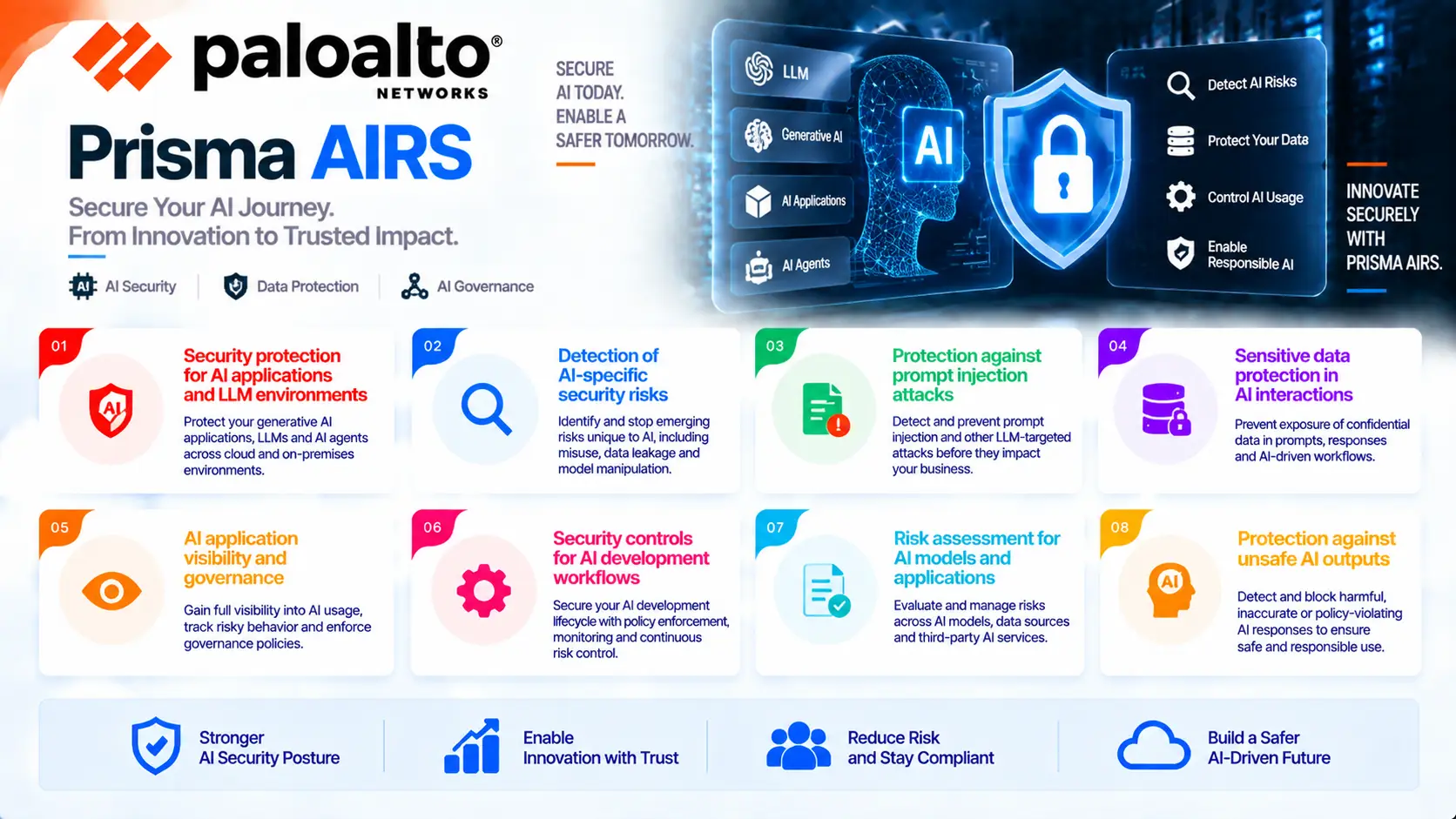
Palo Alto Prisma AIRS At a Glance
What it is: AI Runtime Security platform
Vendor: Palo Alto Networks
Product name: Prisma AIRS
Parent category: Palo Alto License
Primary role: Secure AI applications, models, agents, and AI-powered workflows
Solution category: AI Security and Application Protection
Management platform: Palo Alto Prisma Security Platform
Deployment model: Cloud-based AI security platform

License Overview
A Palo Alto Prisma AIRS License enables organizations to secure artificial intelligence applications and protect AI-driven workflows from emerging security risks. As AI adoption increases, organizations face new challenges that traditional cybersecurity solutions may not fully address, including prompt injection, sensitive data exposure, insecure AI behavior, and unauthorized AI usage.
The licensing model is based on the organization’s AI environment, including the number of AI applications, protected workloads, usage requirements, integrations, and required security capabilities.
Unlike traditional security products that focus mainly on networks, endpoints, or applications, Prisma AIRS is designed specifically around the unique security requirements of AI systems. Organizations need to evaluate how AI is being developed, where models are hosted, what data is processed, and how users interact with AI services.
When selecting a Palo Alto Prisma AIRS License, businesses should consider their AI adoption level, regulatory requirements, application architecture, and the level of runtime protection required. For organizations moving AI projects from development into production, proper licensing helps maintain security controls without limiting innovation.
Product Overview
Security for the AI Application Lifecycle
Artificial intelligence introduces new security challenges across development, deployment, and daily usage.
AI models can process sensitive information, generate unpredictable outputs, and interact with external systems. These characteristics create risks that require specialized security controls.
Prisma AIRS helps organizations protect AI applications throughout their lifecycle by providing visibility, assessment, and runtime security capabilities.
AI Runtime Security
Traditional application security approaches may not fully address risks introduced by AI models and AI-powered applications.
Prisma AIRS focuses on runtime protection by monitoring AI interactions and identifying suspicious behavior while applications are actively being used.
This helps organizations detect unsafe requests, malicious inputs, and potential data exposure scenarios before they impact business operations.
Protection Against AI-Specific Threats
AI systems introduce attack techniques that differ from traditional cybersecurity threats.
Examples include prompt injection, model manipulation, unsafe output generation, and attempts to extract confidential information through AI interactions.
Prisma AIRS helps organizations identify these risks and apply security controls designed specifically for AI environments.
Options and Licensing Models
| Licensing Option | Description | Suitable For |
|---|---|---|
| AI Application Protection License | Protects enterprise AI applications and workflows | Organizations deploying AI applications |
| LLM Security Licensing | Provides security controls for large language model usage | Businesses using generative AI platforms |
| Runtime Security Protection | Monitors AI interactions during operation | Production AI environments |
| AI Governance Capabilities | Provides visibility and control over AI usage | Organizations managing AI compliance |
| Data Protection Features | Helps protect sensitive information processed by AI systems | Businesses handling confidential data |
| Enterprise Subscription | Broader AI security coverage and platform access | Large organizations adopting AI at scale |
| Multi-Year Subscription | Long-term licensing coverage | Enterprises planning continuous AI security programs |
The appropriate licensing model depends on AI workload size, application architecture, security requirements, and governance objectives.
Features and Benefits
Palo Alto Prisma AIRS helps organizations adopt artificial intelligence without sacrificing security and control. As AI becomes part of business processes, organizations need protection mechanisms that understand the specific risks created by AI models and applications.
One of the main benefits of Prisma AIRS is improved visibility into AI usage. Security teams can better understand which AI applications exist, how they operate, and where potential risks may appear.
The platform also helps reduce exposure to AI-specific attacks such as prompt injection and sensitive data leakage. By applying security controls at the AI interaction level, organizations can maintain safer AI workflows.
For businesses developing internal AI applications or integrating generative AI into customer-facing services, Prisma AIRS provides a structured approach to managing AI security risks.
Compatibility and Requirements
Before deploying Palo Alto Prisma AIRS, organizations should evaluate their AI environment and security requirements.
Important considerations include:
- Number of AI applications
- AI models and platforms in use
- Data processed by AI systems
- Application architecture
- API integrations
- Compliance requirements
- AI governance policies
Prisma AIRS is designed for organizations using AI workloads across development, testing, and production environments. Proper planning ensures security controls align with business AI objectives.
Activation and Deployment
Deployment begins after selecting the appropriate Palo Alto Prisma AIRS License and preparing the AI environment.
Typical deployment steps include:
- Activating the Prisma AIRS subscription
- Connecting AI applications and workloads
- Defining security policies
- Configuring AI monitoring controls
- Testing AI workflows
- Reviewing security insights
Organizations usually begin with critical AI applications before expanding protection across additional AI services.
Pricing and Quote Process
Pricing for Palo Alto Prisma AIRS depends on AI application scope, usage requirements, security capabilities, integrations, and subscription duration.
Before requesting a quote, organizations should define:
- Number of AI applications
- AI platforms and models in use
- Required security controls
- Data protection requirements
- Compliance needs
- Subscription term
Because AI environments vary significantly between organizations, accurate assessment is important for selecting the right licensing scope. Organizations should also consider future AI expansion because additional applications and workloads may increase security requirements.
Palo Alto pricing depends on your security solution, firewall model, license edition, deployment model, license term, and support requirements.