

Trellix DLP (Data Loss Prevention) is a data security solution designed to help organizations discover, monitor, and protect sensitive information across endpoints, networks, and business environments. By applying security policies to data movement and user activities, Trellix DLP helps prevent unauthorized sharing, leakage, and misuse of confidential information.
Quick Benefits
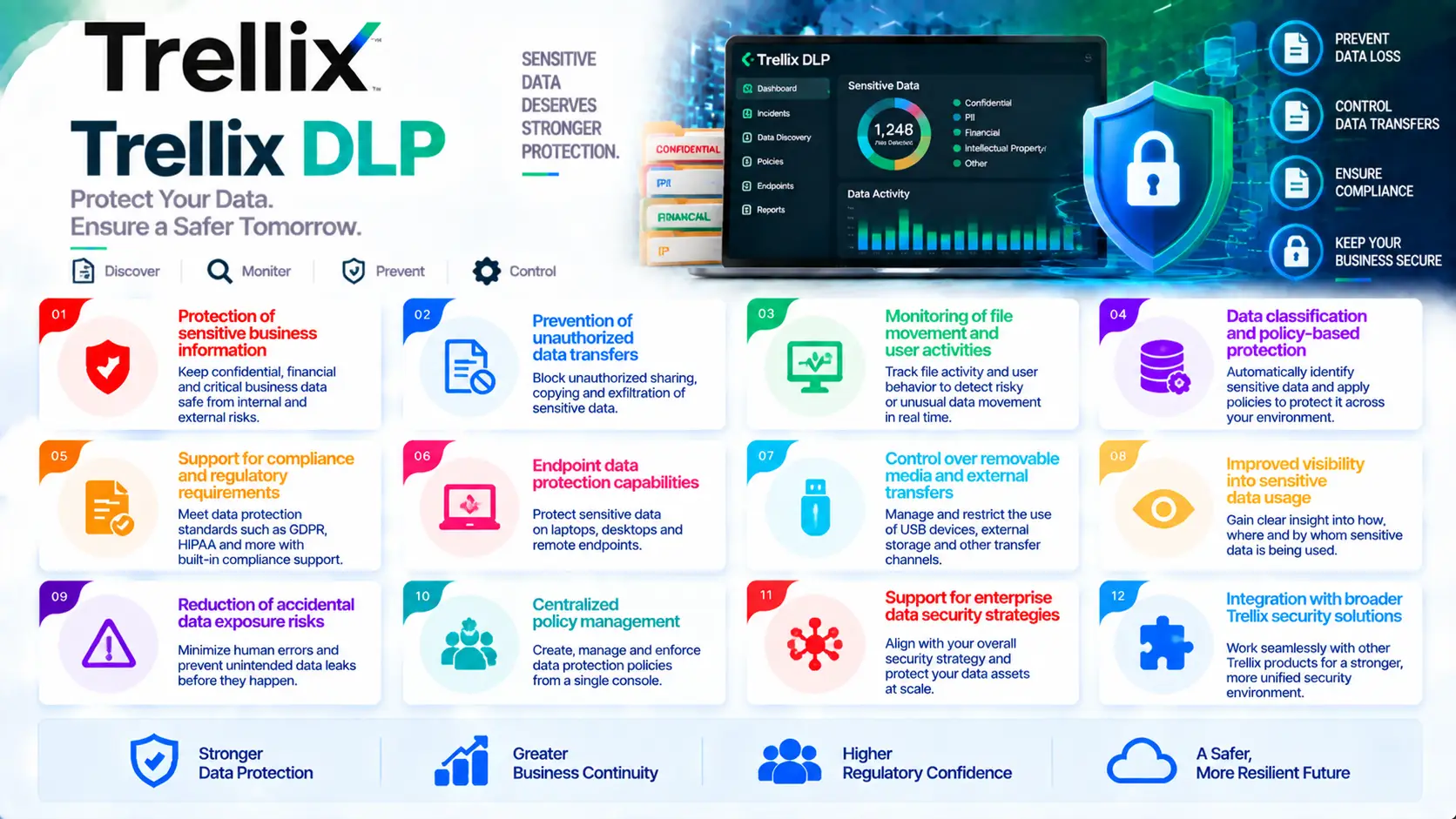
- Protection of sensitive business information
- Prevention of unauthorized data transfers
- Monitoring of file movement and user activities
- Data classification and policy-based protection
- Support for compliance and regulatory requirements
- Endpoint data protection capabilities
- Control over removable media and external transfers
- Improved visibility into sensitive data usage
Trellix DLP At a Glance
What it is: Data Loss Prevention Platform
Product name: Trellix Data Loss Prevention (DLP)
Parent category: Trellix License
Primary role: Discover, monitor, and protect sensitive data from unauthorized access or transfer
Solution category: Data Security and Data Loss Prevention
Management platform: Trellix security management ecosystem
Protected assets: Endpoints, files, documents, sensitive business information, and data transfer channels
Deployment model: On-premises, cloud, and hybrid environments
Core capabilities: Data discovery, classification, monitoring, policy enforcement, and loss prevention
License Overview
A Trellix DLP License provides organizations with the capabilities required to identify sensitive information, monitor how data is used, and prevent unauthorized movement of confidential files. Data loss can occur through many everyday activities, including email sharing, cloud uploads, removable devices, file transfers, or accidental user actions. DLP solutions focus on controlling these activities while allowing legitimate business operations to continue.
The licensing model is generally based on factors such as the number of protected endpoints, users, monitored data sources, required policies, and deployment scope. When evaluating a Trellix DLP License, organizations should first identify what types of information require protection. This may include customer records, intellectual property, financial documents, credentials, research data, or regulated information.
Unlike endpoint security solutions that focus on malware and threats, DLP focuses on protecting the information itself. This makes it a complementary security layer alongside solutions such as Trellix ENS, EDR, and XDR. Proper licensing planning helps organizations apply effective data protection controls without creating unnecessary restrictions for users.
Product Overview
Protecting Sensitive Data Across the Organization
Organizations generate and exchange large amounts of sensitive information every day. Employees may access confidential files, collaborate through cloud platforms, or transfer documents between different systems.
Without visibility and control, sensitive data can leave the organization unintentionally or through unauthorized actions.
Trellix DLP helps security teams understand where sensitive information exists, how it is being used, and where potential data exposure risks may occur.
Data Discovery and Classification
Effective data protection starts with knowing what information requires protection.
Trellix DLP helps organizations identify sensitive data and apply classification policies based on business requirements.
This allows security teams to differentiate between ordinary business files and information requiring additional controls.
Examples may include financial documents, customer information, intellectual property, and regulated data.
Policy-Based Data Protection
Every organization has different requirements for handling sensitive information.
Trellix DLP allows security teams to define policies that determine how data should be monitored, restricted, or protected.
Policies can help control actions such as copying files, transferring information externally, uploading documents, or using removable storage devices.
This approach provides protection while maintaining business productivity.
Options and Licensing Models
| Licensing Option | Description | Suitable For |
|---|---|---|
| Endpoint DLP Licensing | Protects sensitive data usage on user devices and workstations | Organizations requiring endpoint data controls |
| User-Based Licensing | Licensing based on employees requiring data protection | User-focused security deployments |
| Data Discovery Capability | Identifies sensitive information across environments | Organizations needing visibility into stored data |
| Policy Enforcement Module | Applies controls for preventing unauthorized data movement | Businesses requiring active data protection |
| Removable Media Control | Manages data transfer through external devices | Organizations controlling USB and external storage risks |
| Cloud Data Protection | Extends DLP policies to cloud-based data usage | Hybrid and cloud-focused organizations |
| Multi-Year Subscription | Provides long-term data security coverage | Enterprise security programs |
The correct Trellix DLP licensing model depends on protected data types, users, endpoints, compliance requirements, and security objectives.
Features and Benefits
Trellix DLP helps organizations protect valuable information by focusing on how data is accessed, transferred, and used across the business environment. Instead of only responding after data exposure occurs, DLP provides preventive controls that reduce the chance of unauthorized disclosure. One of the main advantages of Trellix DLP is improved visibility. Security teams can understand where sensitive information exists and identify risky data movement activities.
The platform also supports stronger governance by allowing organizations to create policies based on business requirements, regulatory obligations, and information sensitivity. For enterprises managing confidential information, DLP provides an additional security layer that works alongside endpoint protection and threat detection solutions.
Compatibility and Requirements
Before deploying Trellix DLP, organizations should evaluate their data environment and protection requirements.
Important considerations include:
- Types of sensitive data requiring protection
- Number of users and endpoints
- Existing security platforms
- Data storage locations
- Cloud applications in use
- Compliance requirements
- Data transfer channels
- Policy management requirements
Organizations should define their data protection objectives before deployment to ensure policies match business operations. Testing policies before full enforcement is recommended to avoid unnecessary disruption to users.
Activation and Deployment
Deployment begins after selecting the appropriate Trellix DLP License and preparing data protection policies.
Typical deployment steps include:
- Activating the Trellix DLP subscription
- Defining sensitive data categories
- Configuring protection policies
- Deploying required endpoint components
- Testing monitoring rules
- Applying enforcement policies
Organizations commonly begin with monitoring mode before enabling stricter controls. This allows security teams to understand user behavior and adjust policies before full enforcement.
Pricing and Quote Process
Pricing for Trellix DLP depends on the number of users, endpoints, protected data sources, required capabilities, deployment model, and subscription duration.
Before requesting a quote, organizations should define:
- Number of protected users
- Endpoint coverage requirements
- Sensitive data categories
- Required policies
- Cloud and storage environments
- Compliance requirements
- Subscription term
Accurate planning helps organizations select the right level of protection while avoiding unnecessary licensing costs. Future growth should also be considered because additional users, devices, or data sources may affect licensing requirements.
Trellix pricing depends on your security solution, endpoint coverage, threat protection modules, deployment model, license term, and support requirements.