

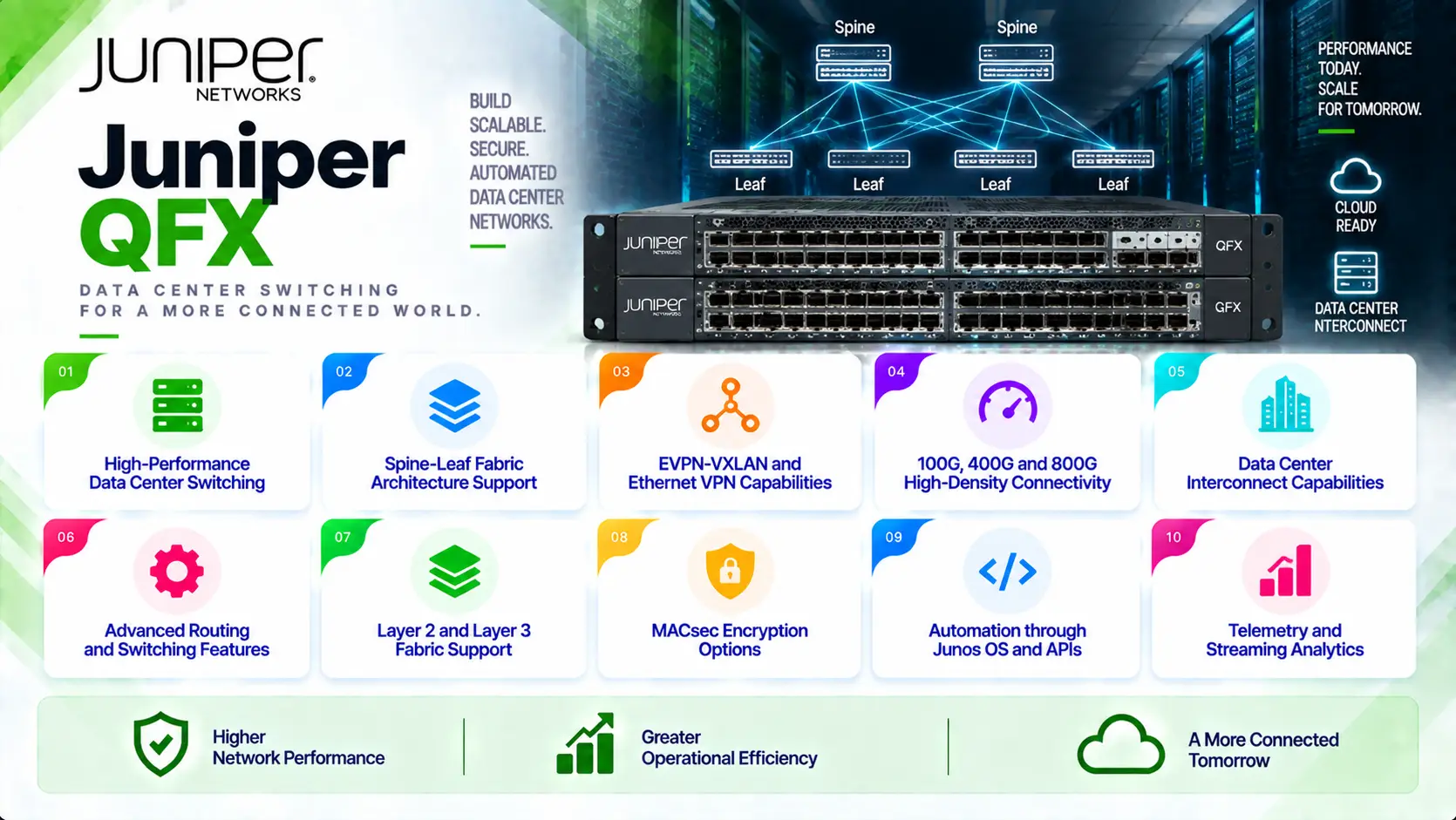
Juniper QFX is a family of high-performance data center switches designed for spine, leaf, data center interconnect (DCI), and enterprise network fabric deployments. Built on Junos OS and Juniper’s switching ASIC technology, QFX platforms provide high-density Ethernet connectivity, EVPN-VXLAN networking, automation, telemetry, and cloud-scale data center capabilities. Through Juniper Flex licensing, organizations can select software features and capacity options according to their architecture and operational requirements.
Quick Benefits
- High-performance data center switching
- Spine-leaf fabric architecture support
- EVPN-VXLAN and Ethernet VPN capabilities
- High-density 100G, 400G, and 800G connectivity on supported platforms
- Data center interconnect capabilities
- Advanced routing and switching features
- Layer 2 and Layer 3 fabric support
- MACsec encryption options on supported models
- Automation through Junos OS and APIs
- Telemetry and streaming analytics
Juniper QFX At a Glance
What it is: Data center switching platform family
Vendor: Juniper Networks
Product family: QFX Series Switches
Parent category: Juniper License
Primary role: Spine, leaf, data center fabric, aggregation, and DCI switching
Operating system: Junos OS
Management platforms: Juniper Apstra, Juniper Mist, Junos Space, CLI, and automation APIs
Key technologies: EVPN-VXLAN, MC-LAG, BGP, MPLS, VXLAN, telemetry, automation, and MACsec
Current product families: QFX5120, QFX5130, QFX5220, QFX5230, QFX5700, QFX5700E, and QFX10000 series
Licensing framework: Juniper Flex
Common license tiers: Advanced 1 (A1), Advanced 2 (A2), Premium 1 (P1), and Premium 2 (P2) depending on model
License Overview
A Juniper QFX License determines the software capabilities, scale limits, and advanced features available on supported QFX switching platforms.
QFX licensing follows the Juniper Flex model, where different software tiers unlock different feature levels. The exact license structure depends on the QFX model generation and deployment purpose.
Current QFX platforms commonly use Advanced and Premium tiers. Earlier QFX licensing models included options such as Advanced 1 (A1), Advanced 2 (A2), and Premium 1 (P1), while newer platforms may use updated Flex SKU structures based on bandwidth and use case.
For data center deployments, licensing decisions are usually based on:
- Required switching role
- Spine or leaf architecture
- EVPN-VXLAN requirements
- Routing scale
- MACsec requirements
- Interface bandwidth
- Automation requirements
For example, a QFX switch operating as a simple Layer 2 leaf may require a different software tier compared with a spine device handling BGP routing, EVPN control plane functions, and large-scale VXLAN deployments.
Juniper also provides model-specific licensing. A license designed for one QFX platform cannot automatically be assumed to provide identical capabilities on another model.
Product Overview
Data Center Spine and Leaf Networking
The primary use case for Juniper QFX is modern data center fabric architecture.
QFX switches are commonly deployed in spine-leaf designs where:
- Leaf switches connect servers and workloads
- Spine switches provide high-speed fabric connectivity
- EVPN-VXLAN provides segmentation and workload mobility
This architecture is widely used in enterprise data centers, cloud environments, and AI infrastructure.
EVPN-VXLAN Fabric Support
One of the key capabilities of QFX platforms is support for EVPN-VXLAN.
EVPN-VXLAN separates the physical network infrastructure from logical network segmentation by creating scalable overlays.
This allows organizations to support:
- Multi-tenant environments
- Application segmentation
- Virtual machine mobility
- Cloud-style network architectures
- Large Layer 2 and Layer 3 domains
Selected QFX platforms support VXLAN routing, EVPN control plane functions, and BGP-based fabric architectures.
High-Speed Data Center Connectivity
Modern applications require increasing bandwidth.
Current QFX platforms support a wide range of Ethernet speeds, including:
- 10GbE
- 25GbE
- 40GbE
- 100GbE
- 400GbE
- 800GbE on selected newer platforms
The exact interface options depend on the QFX model.
For example, QFX5700 platforms are designed for high-density data center environments requiring large numbers of high-speed connections.
Options and Licensing Models
| Licensing Option | Description | Suitable For |
|---|---|---|
| Standard Feature Set | Base switching functionality included with supported QFX platforms | Basic Layer 2 and Layer 3 switching |
| Advanced 1 (A1) | Advanced feature tier for supported QFX platforms | Enterprise data center deployments requiring additional routing and fabric features |
| Advanced 2 (A2) | Higher advanced feature level on supported models | Larger EVPN-VXLAN and routing environments |
| Premium 1 (P1) | Premium feature tier providing increased scale and capabilities | Large-scale data centers and service-provider environments |
| Premium 2 (P2) | Higher premium tier for selected QFX platforms | Complex fabric and high-scale deployments |
| MACsec License | Enables encrypted Ethernet connectivity where supported | Secure DCI and high-security environments |
| Subscription License | Term-based software entitlement | Organizations preferring operational subscription models |
| Perpetual License | Long-term software entitlement | Traditional infrastructure deployments |
| Multi-Year Subscription | 3- or 5-year software coverage | Long-term data center projects |
Features and Benefits
Juniper QFX provides organizations with a switching platform designed around modern data center requirements rather than traditional hierarchical networks.
The combination of high-density Ethernet, EVPN-VXLAN, automation, and Junos OS allows QFX to support both traditional enterprise environments and cloud-style architectures.
One major advantage is architectural consistency. Organizations can use the same switching family across leaf, spine, and DCI roles while managing different capabilities through software licensing.
The licensing model also provides flexibility. A customer deploying a smaller enterprise fabric may not require the same scale as a cloud provider operating thousands of workloads. Juniper Flex allows software capabilities to align with the actual deployment requirements.
For AI and high-performance computing environments, QFX platforms provide the bandwidth and fabric capabilities required for large east-west traffic patterns.
Compatibility and Requirements
Before purchasing a Juniper QFX License, verify:
- Exact QFX switch model
- Spine or leaf deployment role
- Required Ethernet speeds
- EVPN-VXLAN requirements
- BGP routing requirements
- Number of VLANs and VRFs
- MACsec requirements
- Data center automation requirements
- Junos OS version
- Apstra integration requirements
Activation and Deployment
A typical Juniper QFX licensing workflow includes:
- Select the required QFX hardware
- Define fabric architecture
- Identify required software tier
- Select subscription or perpetual licensing
- Activate entitlement through Juniper Agile Licensing Portal
- Apply required software configuration
- Configure EVPN/VXLAN or routing features
Pricing and Quote Process
Pricing for Juniper QFX depends on:
- Exact QFX model
- Port speed requirements
- Number of switches
- Spine or leaf role
- Required Flex tier
- EVPN-VXLAN requirements
- MACsec requirements
- Automation requirements
- Subscription duration
- Support services
Juniper pricing depends on your product family, license edition, router, switch or SRX model, Mist Cloud requirements, deployment model, license term, and support needs.