

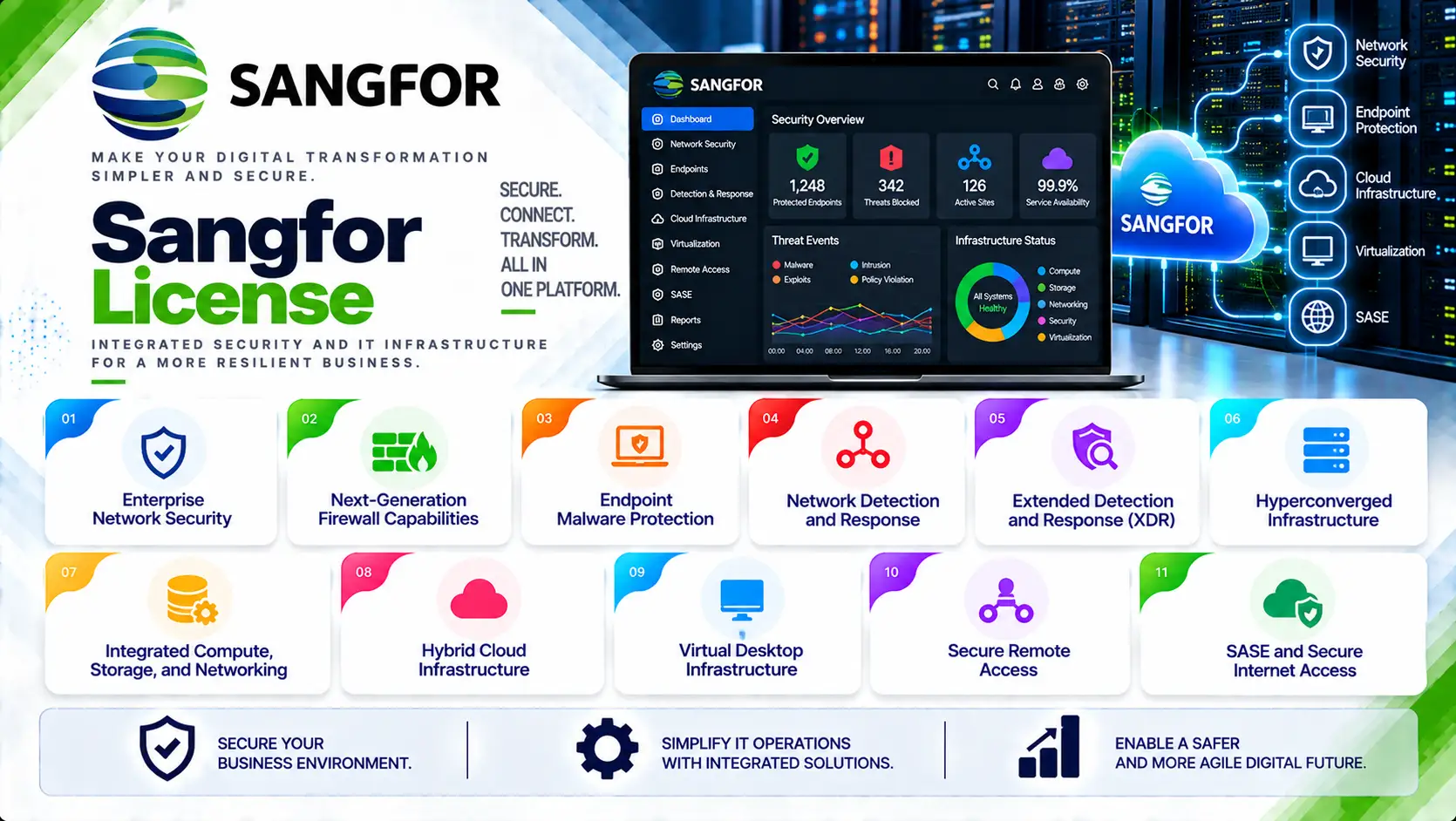
Sangfor License provides access to enterprise solutions for cybersecurity, hyperconverged infrastructure, cloud computing, endpoint protection, network security, and secure access. Sangfor’s portfolio is designed for organizations that need to consolidate infrastructure, protect network and endpoint environments, and operate hybrid or distributed IT environments through centrally managed platforms.
Quick Benefits
- Enterprise network security
- Next-Generation Firewall capabilities
- Endpoint malware protection
- Network Detection and Response
- Extended Detection and Response
- Hyperconverged infrastructure
- Integrated compute, storage, and networking
- Hybrid cloud infrastructure
- Virtual desktop infrastructure
- Secure remote access
- SASE and secure internet access
Sangfor License At a Glance
What it is: Enterprise cybersecurity, cloud, and IT infrastructure licensing portfolio
Vendor: Sangfor Technologies
Primary product families: Network Secure, Cyber Command, Endpoint Secure, HCI, Cloud Platform, aDesk VDI, and SASE solutions
Primary role: Network protection, endpoint security, infrastructure consolidation, cloud management, and secure access
Security areas: NGFW, NDR, XDR, endpoint protection, threat intelligence, IPS, web security, and secure access
Infrastructure areas: HCI, virtualization, cloud computing, VDI, storage, and database management
Deployment models: Physical appliance, virtual, cloud, hybrid, and distributed environments
Management: Product-specific management platforms and centralized Sangfor management capabilities

License Overview
A Sangfor License determines the software capabilities, security services, infrastructure functions, and support entitlements available for a particular Sangfor deployment.
Because Sangfor operates across both cybersecurity and infrastructure markets, there is no single licensing metric applicable to every product.
For example, Sangfor Network Secure, formerly known as NGAF, uses security subscription bundles and optional modules. Current Sangfor documentation identifies Network Secure as a next-generation firewall platform, while older NGAF documentation shows subscription bundles offered in 1-, 2-, 3-, and 5-year increments. For Sangfor HCI, licensing and activation are tied to the HCI/aSV platform and its deployment environment. Sangfor’s current documentation also shows license activation procedures for HCI installations.
Depending on the product, licensing may therefore consider:
- Hardware model
- Network throughput
- Number of protected endpoints
- Number of users
- Virtual machines
- Compute resources
- Storage capacity
- Security modules
- Cloud resources
- Deployment architecture
- Support services
- Subscription duration
How Sangfor Licensing Works
Sangfor licensing starts by identifying the technology problem being addressed.
A typical enterprise deployment may follow this structure:
Infrastructure Assessment
→ Identify servers, endpoints, network traffic, applications, and users
Product Selection
→ Select the appropriate Sangfor security, infrastructure, or cloud platform
Capacity Planning
→ Determine throughput, endpoint count, compute resources, storage, or other applicable metrics
License Selection
→ Select the required base subscription, modules, and support services
Deployment
→ Install or activate the Sangfor platform
Management and Updates
→ Maintain software versions, security services, subscriptions, and support
This approach is particularly important because Sangfor products can combine software subscriptions with physical appliances or infrastructure resources.
Sangfor Product Portfolio Overview
| Sangfor Solution | Primary Purpose |
|---|---|
| Sangfor Network Secure | Next-Generation Firewall and network security protection |
| Sangfor Cyber Command | Intelligent threat detection, investigation, and response |
| Sangfor Endpoint Secure | Endpoint malware prevention, detection, and response |
| Sangfor HCI | Hyperconverged compute, storage, networking, and security |
| Sangfor Cloud Platform (SCP) | Enterprise cloud computing and infrastructure management |
| Sangfor Kubernetes Engine (SKE) | Kubernetes-based container management |
| Sangfor aDesk VDI | Virtual desktop infrastructure and desktop virtualization |
| Sangfor aStor | Enterprise storage infrastructure |
| Sangfor Athena SASE | Secure access for branch offices and remote users |
| Sangfor Athena XDR | Extended Detection and Response |
| Sangfor Athena NDR | Network Detection and Response |
| Sangfor Athena EPP | Modern endpoint protection |
| Sangfor Athena SWG | Secure Web Gateway |
Sangfor’s current product portfolio spans both cybersecurity and cloud/infrastructure technologies, including HCI, SCP, SKE, DMP, VDI, and aStor on the infrastructure side.
Licensing Options and Models
| Licensing Option | Description | Suitable For |
|---|---|---|
| Network Secure Subscription | Security subscription for firewall, IPS, application control, URL filtering, and related capabilities | Enterprise and branch network protection |
| Network Secure Premium | Adds advanced security capabilities such as Engine Zero and Neural-X to the base security functions | Organizations requiring advanced threat protection |
| Network Secure Ultimate | Expanded security and management capabilities with additional platform services | Organizations requiring broader security operations |
| Neural-X License | Threat intelligence, analytics, and advanced threat defense capabilities | Advanced network security deployments |
| Engine Zero License | AI-powered malware detection and anti-malware capabilities | Network and endpoint threat protection |
| Endpoint Secure Subscription | Endpoint protection for supported workstations and servers | Enterprise endpoint security |
| Cyber Command Licensing | Threat detection, investigation, correlation, and response capabilities | SOC and security operations environments |
| HCI Licensing | Licensing for Sangfor hyperconverged infrastructure and associated software | Data center and private-cloud environments |
| Cloud Platform Licensing | Licensing for Sangfor Cloud Platform capabilities | Enterprise cloud infrastructure |
| VDI Licensing | Licensing for virtual desktop infrastructure deployments | Desktop virtualization projects |
| SASE Subscription | Secure access and internet-security services for remote users and branches | Distributed and hybrid organizations |
| Hardware Support Services | Software upgrades, technical support, and hardware service coverage | Appliance-based Sangfor deployments |
Sangfor’s Network Secure documentation specifically identifies Essential, Premium, and Ultimate security bundles, together with a-la-carte Neural-X, Engine Zero, and Web Application Firewall options.
Features and Benefits
Network Security
Sangfor Network Secure, previously known as NGAF, provides next-generation firewall capabilities for enterprise networks.
Its security functions can include:
- Stateful firewall
- IPS
- Application control
- URL filtering
- Bandwidth management
- Email security
- Botnet prevention
- Threat intelligence
- Advanced malware detection
- Web application firewall capabilities
The exact functions depend on the selected subscription bundle.
Advanced Threat Defense
Sangfor integrates advanced security technologies such as Engine Zero and Neural-X into selected security subscriptions.
Engine Zero provides AI-powered malware detection and anti-malware capabilities, while Neural-X provides threat intelligence and analytics for identifying unknown and advanced threats.
This architecture allows organizations to extend traditional firewall controls with additional threat-analysis capabilities.
Endpoint Security
Sangfor Endpoint Secure provides protection for PCs and servers against malware and other endpoint threats.
When integrated with Cyber Command, Endpoint Secure can provide endpoint security events and digital evidence that contribute to broader investigation and response workflows.
This makes endpoint licensing relevant for organizations that want security controls beyond the network perimeter.
Compatibility and Requirements
Before selecting a Sangfor License, organizations should evaluate:
- Required Sangfor product
- Hardware model
- Network throughput
- Peak traffic
- Number of endpoints
- Number of users
- Number of servers
- Virtual machine requirements
- CPU and memory requirements
- Storage capacity
- Cloud resources
- Branch locations
- Remote users
For Network Secure deployments, traffic throughput and required security services are particularly important. For HCI deployments, compute, storage, cluster architecture, and virtualization requirements should be established first. For endpoint or SASE deployments, user and endpoint counts become more important licensing inputs.
Activation and Deployment
A typical Sangfor deployment includes:
- Identify the required product family
- Determine hardware or virtual deployment
- Calculate capacity requirements
- Select the appropriate license or subscription
- Activate the software
- Configure management components
- Deploy required agents or infrastructure nodes
- Enable selected security services
- Configure policies
For appliance-based security deployments, software subscriptions and hardware-support services may be purchased together. Sangfor documentation for Network Secure shows security bundles offered in 1-, 2-, 3-, and 5-year increments, with separate hardware-support services.
Pricing and Quote Process
Pricing for Sangfor License depends on the selected product, hardware or software architecture, capacity, enabled features, and subscription term.
Before requesting a quote, prepare:
- Sangfor product name
- Hardware model, if applicable
- Network throughput
- Number of protected endpoints
- Number of users
- Number of servers
- Required security modules
- HCI cluster requirements
- Compute and storage requirements
- VDI user count
For Sangfor Network Secure, for example, the required security bundle and optional services can materially change the licensing scope. Sangfor’s published ordering guides show 1-, 2-, 3-, and 5-year subscription terms and separate a-la-carte modules. For HCI, the licensing calculation should instead begin with cluster and infrastructure requirements. The two scenarios should not be treated as the same licensing model.
Sangfor pricing depends on your product family, security solution, license edition, deployment model, license term, and support requirements.