

Proofpoint Security Awareness is a cybersecurity awareness and human risk management solution designed to help organizations reduce security incidents caused by phishing, social engineering, and employee-related risks. Through training, simulations, and behavioral insights, it helps businesses improve user awareness and build stronger security habits.
Quick Benefits
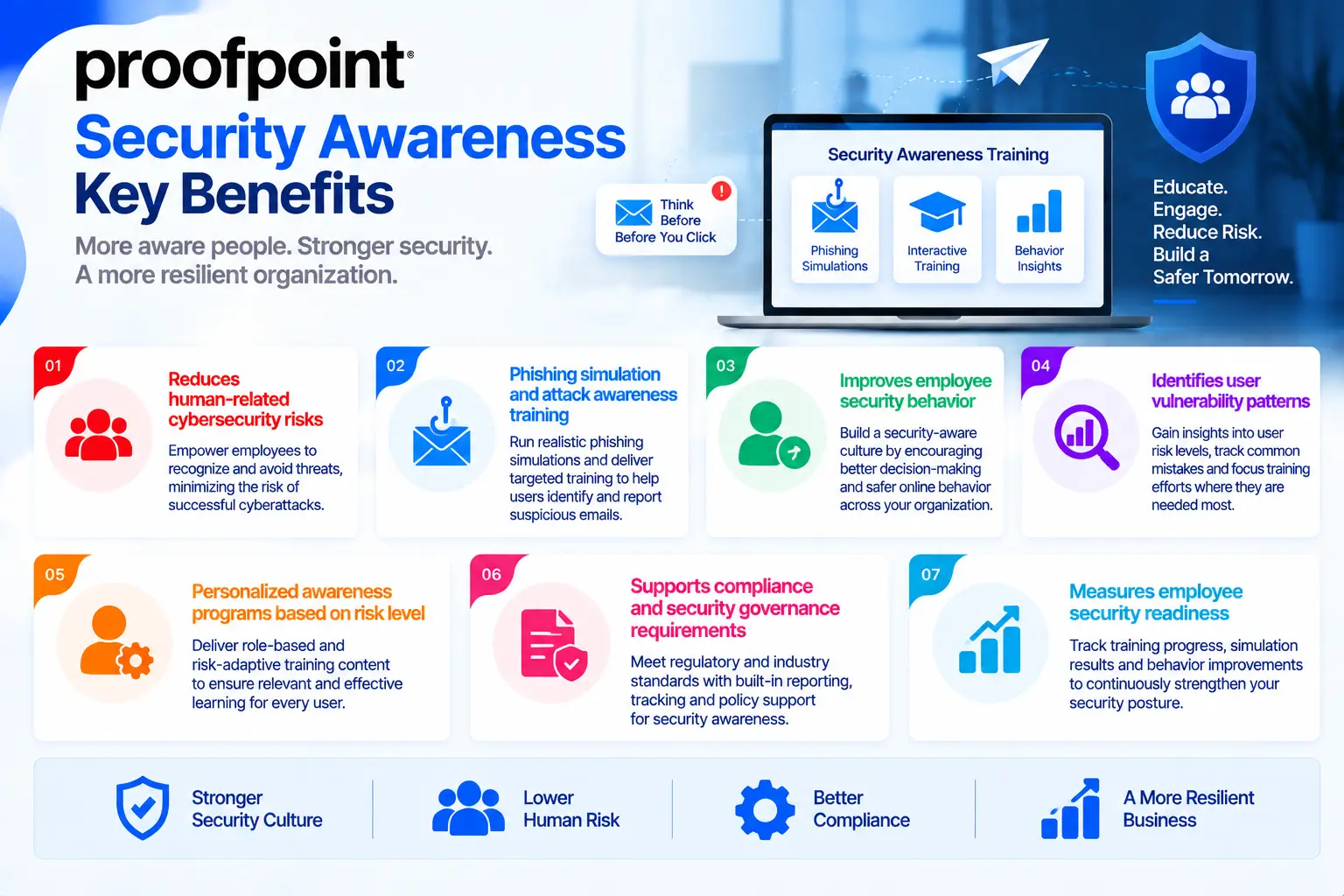
- Reduces human-related cybersecurity risks
- Phishing simulation and attack awareness training
- Improves employee security behavior
- Identifies user vulnerability patterns
- Personalized awareness programs based on risk level
- Supports compliance and security governance requirements
- Measures employee security readiness
Proofpoint Security Awareness At a Glance
What it is: Security awareness training and human risk management solution
Product name: Proofpoint Security Awareness
Parent category: Proofpoint License
Primary role: Reduce human cybersecurity risks through training, simulation, and behavioral analysis
Solution category: Security Awareness and Human Risk Management
Management platform: Proofpoint Security Awareness Platform
Protected assets: Employees, users, contractors, and business teams

License Overview
A Proofpoint Security Awareness License enables organizations to provide cybersecurity education, phishing simulations, and employee risk management capabilities. Unlike technical security products that focus on blocking threats, security awareness solutions address one of the most common attack vectors: human behavior.
The licensing model is typically based on the number of users included in training programs. Organizations should evaluate the number of employees requiring awareness training, frequency of simulations, required content packages, and reporting requirements before selecting the appropriate subscription. A company with a small workforce may only need basic phishing simulations and awareness courses, while larger enterprises may require continuous training programs, role-based education, executive-focused campaigns, and detailed risk analytics.
When selecting a Proofpoint Security Awareness License, organizations should consider their current security maturity, compliance obligations, employee risk level, and long-term awareness strategy. The goal is not only to train users once but to create continuous improvement in security behavior through measurement, feedback, and targeted education.
Product Overview
Human Risk Management and Security Culture
Technology alone cannot prevent every cyberattack. Many successful incidents begin with actions such as clicking malicious links, sharing credentials, or responding to fraudulent requests. Proofpoint Security Awareness helps organizations address this challenge by improving employee understanding of cybersecurity threats and creating stronger security habits. The platform focuses on changing user behavior rather than simply delivering technical information.
Phishing Simulation and Attack Readiness
Phishing remains one of the most common techniques used by attackers because it targets decision-making rather than software vulnerabilities. Proofpoint Security Awareness allows organizations to simulate phishing scenarios and measure how users respond to realistic attack attempts. These simulations help identify employees who may require additional guidance and provide security teams with measurable information about organizational risk.
Personalized Security Training
Different users face different levels of cyber risk depending on their role, access privileges, and daily activities. A finance employee handling payments may require different training compared to a general office user.
Proofpoint Security Awareness supports targeted education programs by helping organizations deliver relevant training based on user behavior and risk exposure. This creates more effective awareness programs compared to generic security courses.
Options and Licensing Models
| Licensing Option | Description | Suitable For |
|---|---|---|
| User-Based Awareness Subscription | Licensing based on employees included in awareness programs | Organizations training internal users |
| Phishing Simulation Package | Simulated attack campaigns to measure user response | Businesses improving phishing resilience |
| Training Content Access | Security education materials and awareness courses | Organizations building continuous training programs |
| Risk-Based Training | Personalized education based on user behavior and risk level | Enterprises requiring targeted awareness |
| Compliance Training Programs | Structured awareness programs supporting governance requirements | Regulated industries |
| Multi-Year Subscription | Longer-term awareness coverage and planning | Organizations running ongoing programs |
The correct licensing model depends on the number of users, training frequency, simulation requirements, and organizational security objectives.
Features and Benefits
Proofpoint Security Awareness helps organizations address the human side of cybersecurity by turning employees into a stronger security layer. Instead of assuming that users already understand modern threats, businesses can continuously educate employees and measure their ability to recognize suspicious activity.
One of the main advantages is reducing phishing-related risk. Through realistic simulations and targeted training, organizations can identify weak points and improve employee responses before real attackers exploit them.
The platform also provides security teams with measurable results. Rather than treating awareness as a one-time training requirement, businesses can track progress, identify risky behavior patterns, and improve their overall security culture.
For enterprises managing large or distributed workforces, Proofpoint Security Awareness provides a scalable approach to improving cybersecurity readiness across the organization.
Compatibility and Requirements
Before deploying Proofpoint Security Awareness, organizations should evaluate their workforce structure and awareness objectives.
Important considerations include:
- Number of employees requiring training
- Remote and distributed workforce requirements
- Compliance obligations
- Existing security awareness processes
- Required simulation frequency
- Reporting requirements
- User segmentation needs
Because the platform is cloud-based, deployment typically focuses on user management, campaign configuration, and integration with existing organizational processes. Organizations should define their awareness strategy before deployment to ensure training efforts align with actual security risks.
Activation and Deployment
Deployment begins after selecting the appropriate Proofpoint Security Awareness License and activating the awareness platform.
Typical deployment steps include:
- Activating the Proofpoint subscription
- Importing or defining user groups
- Configuring training campaigns
- Creating phishing simulation policies
- Monitoring user results and reports
Organizations usually begin with baseline assessments before launching continuous awareness campaigns.
Pricing and Quote Process
Pricing for Proofpoint Security Awareness depends mainly on the number of users, selected training capabilities, simulation requirements, reporting features, and subscription duration.
Before requesting a quote, organizations should define:
- Number of users to train
- Required awareness content
- Phishing simulation frequency
- Reporting requirements
- Compliance requirements
- Subscription period
Accurate planning helps organizations select an awareness program that matches their workforce size and security objectives. Organizations should also consider future expansion because additional employees, departments, or awareness requirements may increase licensing needs.
Proofpoint pricing depends on your security solution, email protection features, data security requirements, deployment model, license term, and support needs.