

Palo Alto PA-7500 is a high-performance next-generation firewall platform designed for large enterprises, service providers, and mission-critical environments that require extremely high throughput, advanced threat prevention, and scalable network security. Built for demanding data center architectures, the PA-7500 Series provides modular security performance combined with Palo Alto Networks’ advanced inspection and threat intelligence capabilities.
Quick Benefits
- Hyperscale next-generation firewall protection
- Designed for large enterprise and service provider networks
- Extremely high-performance traffic inspection
- Advanced threat prevention capabilities
- Modular architecture for future expansion
- Application-aware security control
- Support for Zero Trust network architectures
- Integration with broader Palo Alto security platforms
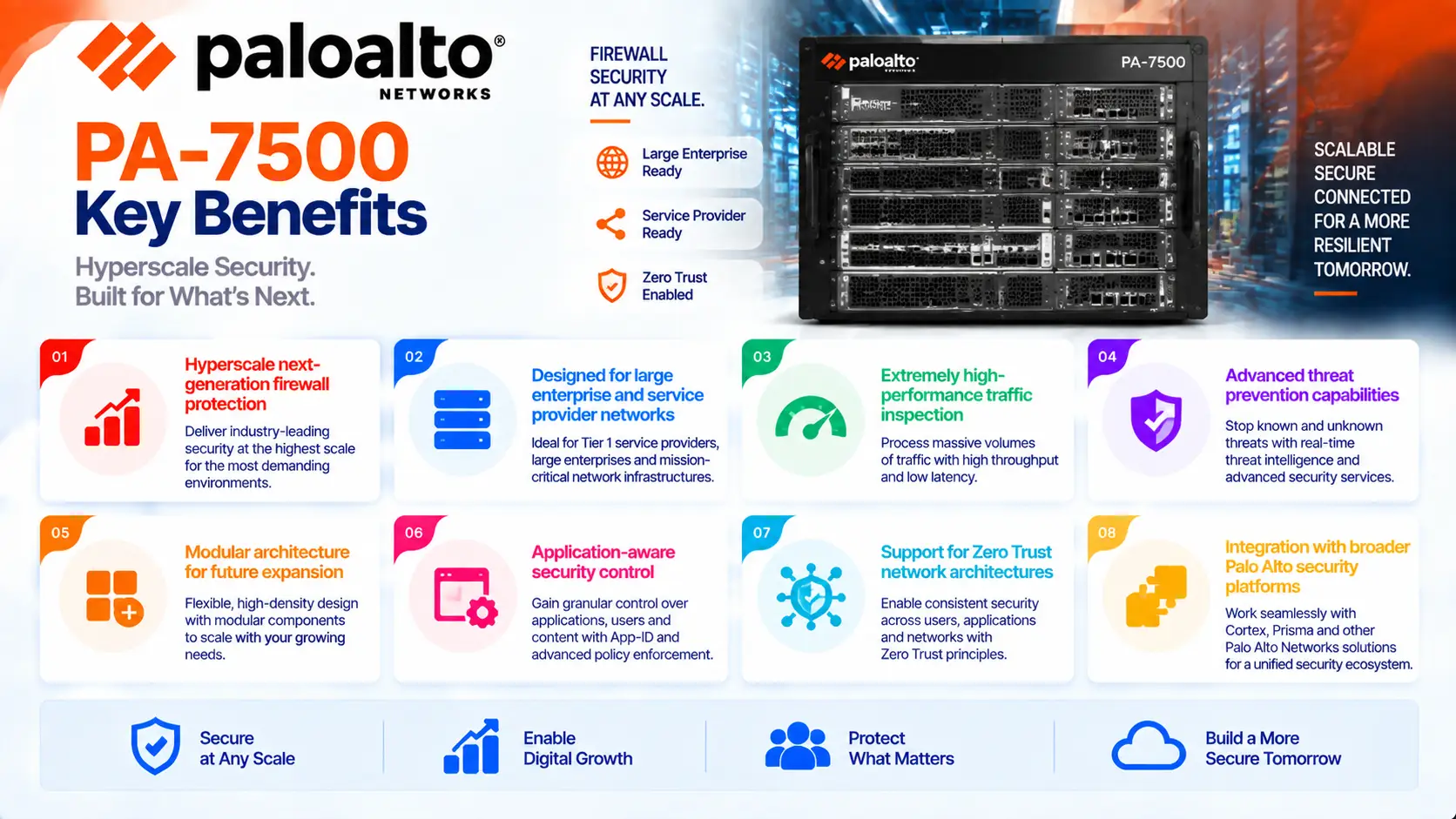
Palo Alto PA-7500 At a Glance
What it is: High-performance modular Next-Generation Firewall platform
Product name: Palo Alto PA-7500
Product family: PA-7500 Series
Parent category: Palo Alto License
Primary role: Large-scale network security, advanced traffic inspection, and enterprise threat prevention
Solution category: Data Center and Enterprise Next-Generation Firewall
Management platform: PAN-OS, Panorama, and Palo Alto cloud management solutions
Deployment model: Physical modular firewall platform
Security capabilities: Application control, threat prevention, intrusion prevention, malware detection, URL filtering, DNS security, and advanced security inspection

License Overview
A Palo Alto PA-7500 License enables organizations to extend the security capabilities of the PA-7500 firewall platform through advanced subscription services and security features. The appliance itself provides the foundation for high-performance network protection, while additional licenses activate capabilities required for modern threat defense.
The PA-7500 is designed for environments where security inspection must operate at very large scales. Because these deployments often support critical applications, internet-facing services, or large volumes of traffic, licensing decisions should be based on both performance requirements and security objectives.
Palo Alto Networks uses a modular subscription model where organizations can select additional services according to their threat landscape. These may include Threat Prevention, Advanced URL Filtering, WildFire malware analysis, DNS Security, and other security intelligence services.
When planning a Palo Alto PA-7500 License, organizations should evaluate expected traffic volume, security inspection requirements, high availability needs, compliance obligations, and future network expansion. Unlike smaller firewall deployments, enterprise-scale platforms require careful capacity planning because security features, encrypted traffic inspection, and advanced analytics can influence performance requirements.
Product Overview
Hyperscale Security for Enterprise Networks
Large organizations and service providers face security challenges that go beyond traditional firewall requirements. They need platforms capable of inspecting massive traffic volumes while maintaining consistent security policies.
The PA-7500 Series is designed for these environments by combining high-performance processing with Palo Alto Networks’ next-generation firewall technology.
It provides organizations with a security foundation capable of supporting large data centers, internet gateways, and complex enterprise networks.
Modular Architecture and Scalability
One of the defining characteristics of the PA-7500 platform is its modular architecture.
Large environments often grow over time, requiring additional capacity, interfaces, or security capabilities. A modular firewall design allows organizations to expand their security infrastructure without replacing the entire platform.
This approach is especially valuable for service providers and enterprises managing continuously growing network demands.
Advanced Application and User Visibility
Modern enterprise traffic includes cloud applications, SaaS platforms, remote access services, and business-critical systems.
The PA-7500 provides application-level visibility that allows security teams to understand how traffic is being used and create policies based on applications, users, and security context.
This improves control compared with traditional firewall approaches based only on IP addresses and ports.
Options and Licensing Models
| Licensing Option | Description | Suitable For |
|---|---|---|
| Base PA-7500 Platform License | Provides the modular firewall hardware platform and PAN-OS capabilities | Large enterprise and data center deployments |
| Threat Prevention Subscription | Adds advanced protection against exploits, malware, and network threats | Organizations requiring comprehensive threat defense |
| WildFire Subscription | Provides cloud-based malware analysis and unknown threat detection | Environments exposed to advanced malware risks |
| Advanced URL Filtering | Protects against malicious websites and web-based threats | Organizations requiring secure internet access |
| DNS Security Subscription | Adds protection against DNS-based attacks and malicious domains | Enterprises requiring additional threat intelligence |
| GlobalProtect Licensing | Enables secure remote access capabilities | Organizations supporting remote users |
| Support and Maintenance Subscription | Provides software updates, technical support, and lifecycle assistance | Mission-critical deployments |
The final licensing configuration depends on traffic requirements, security objectives, compliance needs, and the desired protection level.
Features and Benefits
Palo Alto PA-7500 provides organizations with a security platform built for environments where network performance and cybersecurity cannot be separated. Its high-performance architecture allows enterprises to apply advanced security inspection without compromising the scale required by modern applications.
A key benefit is the ability to maintain consistent security policies across extremely large network environments. Security teams can control applications, users, and traffic behavior while gaining better visibility into potential risks.
The platform also supports organizations moving toward Zero Trust architectures by enabling more detailed control over network access and application usage.
For service providers and large enterprises, the combination of scalability, centralized management, and advanced threat intelligence creates a security foundation suitable for long-term infrastructure growth.
Compatibility and Requirements
Before deploying Palo Alto PA-7500, organizations should evaluate their network architecture and operational requirements.
Important considerations include:
- Expected traffic volume
- Data center architecture
- Interface and connectivity requirements
- High availability design
- Security subscription requirements
- Encrypted traffic inspection needs
- Central management requirements
Because PA-7500 deployments are typically part of critical infrastructure, organizations should perform detailed capacity planning before implementation. The selected configuration should support both current traffic demands and future expansion.
Activation and Deployment
Deployment begins after selecting the appropriate Palo Alto PA-7500 License configuration and registering the firewall platform.
Typical deployment steps include:
- Registering the PA-7500 system
- Activating required subscriptions
- Configuring PAN-OS
- Integrating management platforms
- Creating security policies
- Testing traffic flows and protection capabilities
Large-scale deployments usually include architecture planning, policy validation, and staged implementation before full production use.
Pricing and Quote Process
Pricing for Palo Alto PA-7500 depends on the platform configuration, required capacity, security subscriptions, support services, and deployment requirements.
Before requesting a quote, organizations should define:
- Required firewall capacity
- Expected traffic throughput
- Interface requirements
- Security subscriptions
- High availability requirements
- Support duration
Because PA-7500 is designed for enterprise-scale environments, pricing depends heavily on the final hardware configuration and selected security services. A proper evaluation ensures organizations receive sufficient capacity and protection without unnecessary investment.
Palo Alto pricing depends on your security solution, firewall model, license edition, deployment model, license term, and support requirements.