

Palo Alto PA-445 is a next-generation firewall appliance designed for branch offices, distributed enterprises, and organizations requiring advanced network protection in a compact form factor. As part of the Palo Alto Networks PA-400 Series, it combines firewall capabilities with threat prevention, application visibility, secure connectivity, and subscription-based security services.
Quick Benefits
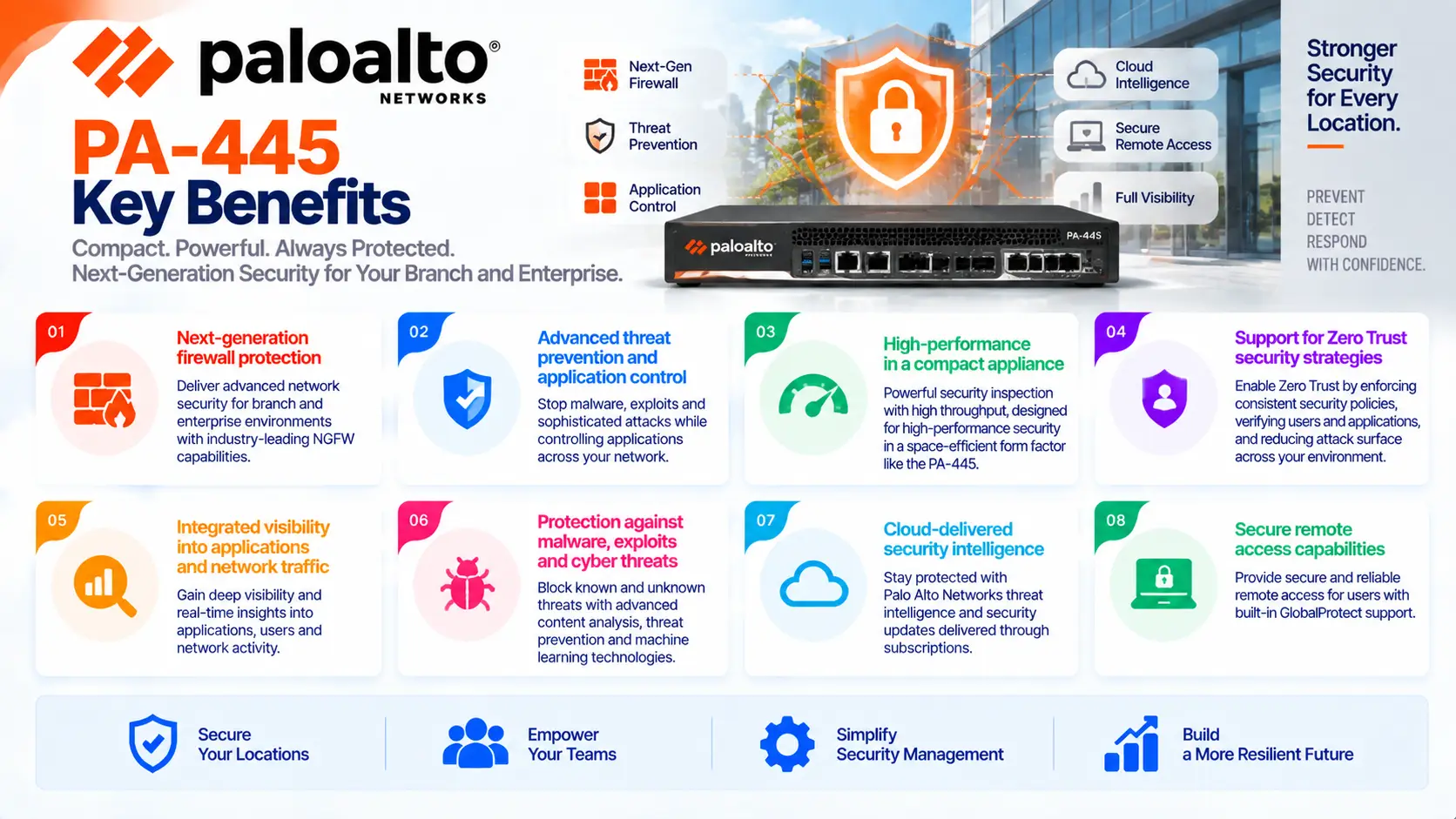
- Next-generation firewall protection for branch and enterprise environments
- Advanced threat prevention and application control
- High-performance security inspection in a compact appliance
- Support for Zero Trust security strategies
- Integrated visibility into applications and network traffic
- Protection against malware, exploits, and cyber threats
- Cloud-delivered security intelligence through subscriptions
- Secure remote access capabilities
Palo Alto PA-445 At a Glance
What it is: Next-Generation Firewall appliance
Product name: Palo Alto PA-445
Product family: PA-400 Series
Parent category: Palo Alto License
Primary role: Network security, threat prevention, and application-aware firewall protection
Deployment model: Physical appliance for branch offices, enterprise sites, and distributed environments
Firewall type: Next-Generation Firewall (NGFW)
Management platform: PAN-OS, Panorama, and cloud-based management options
Security capabilities: Application control, intrusion prevention, URL filtering, malware protection, DNS security, and advanced threat detection

License Overview
A Palo Alto PA-445 License enables organizations to extend the base firewall platform with additional security capabilities required for modern network protection. The appliance provides the foundation for security enforcement, while subscription services add advanced detection, prevention, and intelligence features.
Palo Alto Networks follows a modular licensing approach where organizations select the security services that match their threat environment. A basic firewall deployment may focus on application visibility and access control, while more advanced environments typically enable additional subscriptions for threat prevention, malware analysis, URL protection, and DNS security.
When planning a Palo Alto PA-445 License, organizations should consider more than the appliance itself. Factors such as expected traffic volume, security inspection requirements, user locations, internet connectivity, and compliance obligations directly affect the required subscription configuration.
The PA-445 is commonly deployed in environments where organizations need enterprise-grade firewall protection without moving to larger data center appliances. This makes proper licensing selection important to ensure the device provides the required level of security throughout its lifecycle.
Product Overview
Compact Next-Generation Firewall Protection
The PA-445 is part of Palo Alto Networks’ PA-400 Series, a firewall family designed to deliver enterprise security capabilities for distributed environments. Many organizations today operate across branch offices, remote locations, and hybrid infrastructures where traditional perimeter security is no longer sufficient. The PA-445 provides application-aware inspection, threat prevention, and policy-based control to help organizations secure network traffic while maintaining visibility into how applications and users consume network resources.
Application Visibility and Control
Modern networks carry a wide range of applications, including cloud services, collaboration platforms, and business-critical systems. Traditional firewalls often rely mainly on ports and protocols, which can limit visibility when applications use dynamic connections.
The PA-445 uses Palo Alto’s application identification capabilities to help administrators understand traffic behavior and create policies based on applications rather than only network addresses. This allows security teams to apply more accurate access controls and reduce unnecessary exposure.
Threat Prevention and Security Inspection
Cyber threats continue to evolve beyond simple malware delivery. Attackers increasingly combine multiple techniques, including exploits, credential theft, and malicious web activity. The PA-445 can be extended with Palo Alto security subscriptions that provide additional protection layers, including threat prevention, URL filtering, WildFire malware analysis, and DNS security. These services help organizations detect and block threats before they impact users or business operations.
Options and Licensing Models
| Licensing Option | Description | Suitable For |
|---|---|---|
| Base PA-445 Appliance License | Provides the physical firewall platform and core PAN-OS functionality | Organizations requiring NGFW deployment |
| Threat Prevention Subscription | Adds protection against exploits, vulnerabilities, and malicious activity | Businesses requiring advanced network defense |
| Advanced URL Filtering | Provides web security and malicious website detection | Organizations managing internet access risks |
| WildFire Subscription | Adds cloud-based malware analysis and unknown threat detection | Environments requiring advanced malware protection |
| DNS Security Subscription | Protects against DNS-based attacks and malicious domains | Organizations requiring additional threat intelligence |
| GlobalProtect Licensing | Enables secure remote access capabilities | Businesses supporting remote users |
| Support and Maintenance Subscription | Provides updates, technical support, and lifecycle assistance | Enterprise deployments |
Features and Benefits
Palo Alto PA-445 helps organizations strengthen network security by combining traditional firewall functions with advanced threat prevention capabilities. Its main advantage is the ability to inspect traffic based on applications, users, and security context rather than relying only on basic network rules.
For branch and distributed environments, the appliance provides a practical balance between performance and enterprise security features. Organizations can maintain consistent security policies across locations while reducing the complexity of managing separate security technologies.
The optional subscription services significantly extend the value of the platform. Features such as WildFire malware analysis, DNS Security, and Threat Prevention provide additional layers against modern attack techniques. The PA-445 is also valuable for organizations building Zero Trust architectures because it improves visibility into users, applications, and network behavior.
Compatibility and Requirements
Before deploying Palo Alto PA-445, organizations should evaluate their network architecture and security requirements.
Important considerations include:
- Expected firewall throughput
- Number of users and locations
- Internet bandwidth requirements
- Required security subscriptions
- Remote access requirements
- Existing Palo Alto management environment
- High availability requirements
The PA-445 should be sized according to traffic volume and enabled security features because advanced inspection capabilities can affect performance requirements. Organizations should also evaluate future growth to ensure the selected appliance and subscription package remain suitable over time.
Activation and Deployment
Deployment begins after selecting the appropriate Palo Alto PA-445 License and registering the appliance.
Typical deployment steps include:
- Registering the firewall device
- Activating required subscriptions
- Configuring PAN-OS settings
- Creating security policies
- Connecting management platforms
- Testing traffic inspection and protection features
Organizations typically begin with basic network policies before enabling additional security subscriptions and advanced inspection capabilities.
Pricing and Quote Process
Pricing for Palo Alto PA-445 depends on the appliance configuration, selected security subscriptions, support level, and subscription duration.
Before requesting a quote, organizations should define:
- Required firewall deployment scenario
- Expected traffic volume
- Number of protected users or locations
- Required security services
- Support requirements
- Subscription term
The final cost is influenced significantly by selected subscriptions because advanced security capabilities are licensed separately from the base appliance. A proper evaluation ensures organizations receive the required protection level without purchasing unnecessary services.
Palo Alto pricing depends on your security solution, firewall model, license edition, deployment model, license term, and support requirements.