

Juniper MX is a family of high-performance universal routing platforms designed for service-provider edge, broadband, peering, mobile, aggregation, enterprise WAN, and data-center connectivity. The MX portfolio combines Junos OS, programmable Trio silicon, high-capacity routing, subscriber services, MPLS, EVPN, Segment Routing, MACsec, and automation, with Juniper Flex licensing used to align software capabilities and bandwidth with each deployment.
Quick Benefits
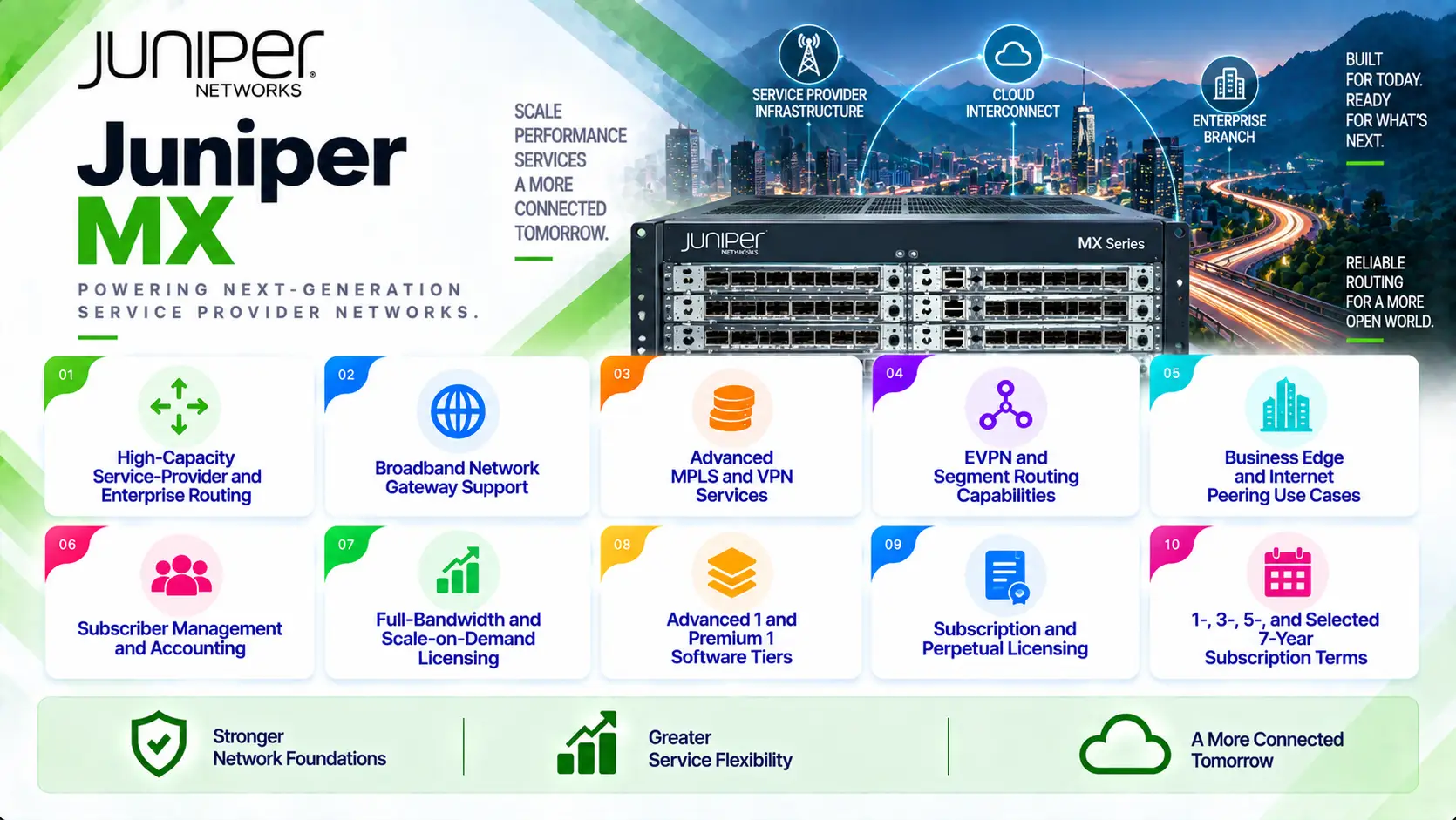
- High-capacity service-provider and enterprise routing
- Broadband Network Gateway support
- Advanced MPLS and VPN services
- EVPN and Segment Routing capabilities
- Business edge and internet peering use cases
- Subscriber management and accounting
- Full-bandwidth and Scale-on-Demand licensing
- Advanced 1 and Premium 1 software tiers
- Subscription and perpetual licensing
- 1-, 3-, 5-, and selected 7-year subscription terms
Juniper MX At a Glance
What it is: Universal routing platform family
Vendor: Juniper Networks
Product family: MX Series
Parent category: Juniper License
Primary role: Service-provider edge, broadband, aggregation, peering, WAN, data-center edge, and mobile transport
Operating system: Junos OS
Current compact platforms: MX204, MX301, MX301-M, MX304
Current modular platforms: MX240, MX480, MX960, MX2008, MX2010, MX2020, MX10004, MX10008, and related MX10000 systems
Core technologies: BGP, MPLS, L2/L3 VPN, EVPN, Segment Routing, subscriber services, QoS, telemetry, and MACsec
Licensing framework: Juniper Flex
Primary Flex tiers: Advanced 1 (A1) and Premium 1 (P1)

License Overview
A Juniper MX License defines the software tier, licensed bandwidth, scale, and optional services available on supported MX routers. Juniper currently supports both subscription and perpetual licensing for the MX Series. Enhanced capabilities are offered primarily through Advanced 1 (A1) and Premium 1 (P1) Flex tiers. Juniper also notes that many core features remain available through the standard software even when an A1 or P1 license has not been purchased.
Bandwidth is a central part of MX licensing. Modular Flex SKUs can represent different licensed capacities, while compact models also use bandwidth-specific entitlements. Current Juniper documentation defines modular A1/P1 licensing across capacities from tens of gigabits into multi-terabit levels, while compact MX platforms use their own class-based licensing structure.
Another important option is Scale on Demand (SoD). Instead of licensing the full physical capacity immediately, supported platforms such as MX240, MX480, MX960, MX2000, MX301, and MX304 can use incremental capacity licensing. This gives operators a way to expand software-enabled bandwidth as traffic grows.
For broadband deployments, separate subscriber-service licenses may also be required. Juniper currently offers wireline broadband entitlements in 1,000- and 10,000-subscriber increments with Advanced and Premium options.
Product Overview
Universal Routing for Multiple Edge Roles
Juniper MX is called a Universal Routing Platform because one architecture can cover several very different network roles.
The same product family can operate as a business edge router, Broadband Network Gateway, internet peering router, provider edge platform, mobile backhaul router, aggregation system, or data-center/cloud edge.
This allows service providers and large enterprises to standardize operational practices while choosing different MX hardware according to scale.
Broadband Network Gateway and Subscriber Services
One of the strongest MX use cases is broadband edge.
MX platforms can operate as Broadband Network Gateways and provide subscriber authentication, RADIUS accounting, address assignment, subscriber VLAN handling, service QoS, and other subscriber-management functions.
Juniper currently licenses integrated wireline broadband services in subscriber blocks of 1,000 or 10,000. Both Advanced and Premium tiers exist, while CUPS architectures can separately license user plane, control plane, or combined bundles.
This is especially important for ISPs because router capacity alone does not determine the required software entitlement—the subscriber scale must also be included in the design.
MPLS, VPN, and Segment Routing
MX routers are widely used as provider-edge platforms because they support large-scale MPLS and VPN architectures.
The platform supports Layer 2 and Layer 3 VPN services, MPLS transport, EVPN, traffic engineering, and modern Segment Routing designs. Premium licensing increases certain routing and VPN scale limits compared with Advanced licensing. For example, Juniper’s current Flex tables show substantial differences in licensed L3 VPN and multicast VPN scale between A1 and P1.
This makes the selected software tier relevant not only to feature availability but also to how large the routing environment can become.
Options and Licensing Models
| Licensing Option | Description | Suitable For |
|---|---|---|
| Advanced 1 (A1) | Advanced Juniper Flex tier with licensed bandwidth and service scale | Standard business edge, aggregation, and service-provider deployments |
| Premium 1 (P1) | Higher Flex tier with larger scale for supported routing and VPN functions | Large provider-edge, peering, and high-scale networks |
| Full Bandwidth License | Licenses the supported platform at its intended full software-enabled capacity | Networks requiring maximum capacity from deployment |
| Scale on Demand | Enables incremental licensed capacity rather than full bandwidth from day one | Networks expecting staged traffic growth |
| Wireline Broadband A1/P1 | Subscriber-service licensing in 1K or 10K increments | Broadband Network Gateway deployments |
| CUPS Subscriber Licensing | Separately licenses BNG user plane, control plane, or combined architectures | Distributed and cloud-oriented broadband networks |
| MACsec License | Enables licensed MACsec bandwidth on supported MX platforms | Secure WAN, metro, and DCI links |
| Perpetual License | Provides long-term software rights for supported MX functions | Long-life infrastructure deployments |
| Subscription License | Provides software entitlement for a defined term | Organizations preferring renewable licensing |
Juniper’s current Flex SKU definitions support 1-, 3-, 5-, and selected 7-year terms for MX platform licensing, while subscriber-service products may use slightly different term structures depending on the SKU.
Features and Benefits
The biggest advantage of Juniper MX is architectural flexibility. A service provider can use the same routing family for broadband edge, business services, peering, aggregation, and mobile transport rather than building every role around an unrelated platform.
Flex licensing supports that approach by separating hardware capability from software scale. A router can be selected for long-term physical capacity while software bandwidth is activated gradually through Scale on Demand.
Subscriber licensing provides similar flexibility for broadband environments. Operators can increase subscriber capacity in blocks as customer numbers grow rather than replacing the routing infrastructure.
MX also provides strong investment protection through the shared Junos environment and programmable Trio architecture. New routing technologies and telemetry capabilities can often be introduced through software rather than requiring an entirely new platform generation.
Compatibility and Requirements
Before ordering a Juniper MX license, confirm:
- Exact MX platform
- Modular or compact architecture
- Required forwarding bandwidth
- A1 or P1 software tier
- Full Bandwidth or Scale-on-Demand model
- Subscriber count
- BNG or CUPS requirements
- MPLS and VPN scale
- EVPN and Segment Routing requirements
- MACsec bandwidth
- IPsec requirements
- Installed Junos OS version
Activation and Deployment
Juniper software licenses are activated through the Juniper Agile Licensing Portal for supported products.
A typical workflow includes:
- Confirm the exact MX hardware
- Determine required licensed bandwidth
- Select Advanced or Premium tier
- Add broadband, MACsec, or security licenses where required
- Choose subscription or perpetual term
- Locate the entitlement in the JAL Portal
- Select the appropriate software version
- Activate the required quantity
- Verify licensing after deployment
Pricing and Quote Process
Pricing for Juniper MX depends heavily on architecture and scale.
Before requesting a quote, prepare:
- Exact router model
- Required forwarding capacity
- Full Bandwidth or Scale-on-Demand requirement
- A1 or P1 tier
- Number of broadband subscribers
- BNG or CUPS architecture
- MACsec requirements
- IPsec/security requirements
- Number of routers
- Subscription duration
- Perpetual-license requirements
- Junos OS version and support needs
Juniper pricing depends on your product family, license edition, router, switch or SRX model, Mist Cloud requirements, deployment model, license term, and support needs.