

Cisco Meraki is a cloud-managed networking and security platform designed to simplify the deployment, monitoring, and operation of enterprise infrastructure. The portfolio includes wireless access points, switches, security and SD-WAN appliances, cellular gateways, smart cameras, environmental sensors, and endpoint management, all administered through the Meraki cloud dashboard.
A Cisco Meraki License provides the software entitlement required to manage supported Meraki products and access the cloud-based features associated with each product family. Depending on the device and license tier, organizations can use capabilities such as centralized configuration, monitoring, security analytics, SD-WAN, application visibility, wireless optimization, firmware management, and cloud-based troubleshooting.
Because licensing is closely integrated with the Meraki operating model, organizations should select the correct license type, feature tier, device quantity, and term when deploying or expanding a Meraki environment.
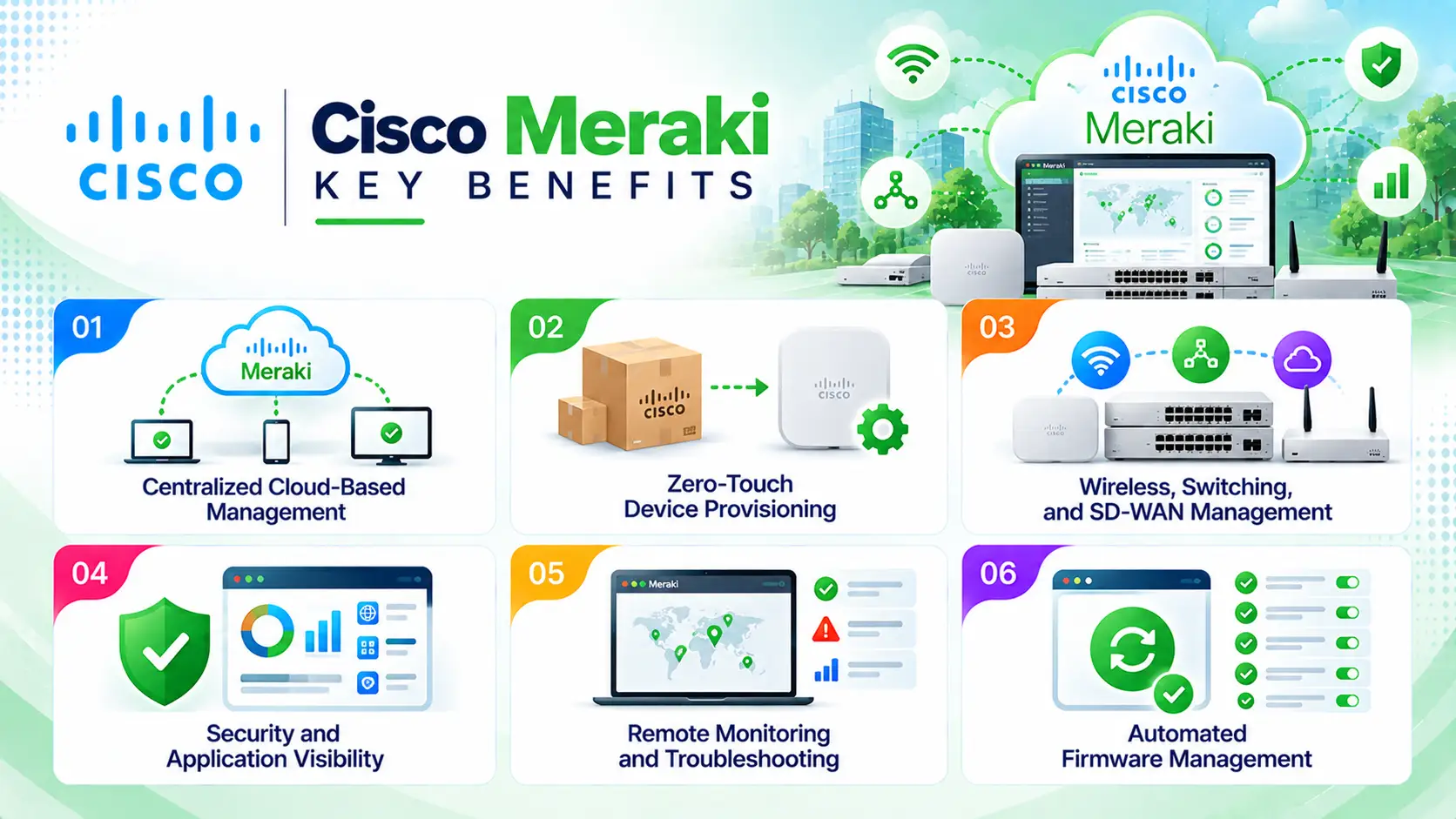
Quick Benefits
- Centralized cloud-based management
- Zero-touch device provisioning
- Wireless, switching, and SD-WAN management
- Security and application visibility
- Remote monitoring and troubleshooting
- Automated firmware management
- Role-based administration
- API-based automation
- Multi-site network visibility
- Scalable branch deployment
- Integrated network analytics
- Flexible licensing models
At a Glance
- Product Family: Cisco Meraki
- Category: Cloud-Managed Networking and Security
- Management: Meraki Dashboard
- Primary Use: Centralized network, security, and device management
- Main Products: MR, MS, MX, MG, MV, MT, and Systems Manager
- Current Licensing Models: Subscription and Co-Termination
- Legacy Model: Per-Device Licensing
- Subscription Model: Hardware-agnostic software subscription structure
- Co-Term Model: Organization-wide common expiration date
- Deployment: Cloud-managed
- Automation: Dashboard APIs and integrations
- Typical Environments: Branches, campuses, retail, distributed enterprises, and remote sites
Cisco Meraki License Overview
Cisco Meraki licensing is a fundamental part of the platform because Meraki devices rely on cloud-based software services for configuration, monitoring, management, and feature delivery.
Meraki currently supports Subscription Licensing and Co-Termination Licensing for customers. Per-Device Licensing remains a legacy model and new conversions to that model are no longer supported.
Subscription Licensing is Cisco Meraki’s newer licensing approach. It provides software subscriptions associated with product classes and networks rather than relying on the traditional organization-wide weighted expiration calculation. It is designed to provide greater flexibility for organizations managing different products, feature tiers, and renewal schedules.
Co-Termination Licensing uses a single expiration date across the Meraki organization. When new licenses are added, Meraki recalculates the organization expiration date using a weighted average based on the license type, quantity, and remaining duration.
The correct Cisco Meraki License also depends on the product family. For example, wireless access points, switches, MX security appliances, cameras, sensors, and Systems Manager each have their own licensing requirements and available feature tiers.
Cisco Meraki Product Overview
Cisco Meraki uses a cloud-managed architecture where supported devices establish secure connectivity to the Meraki cloud for configuration, monitoring, and management.
Administrators use the Meraki Dashboard to configure networks, deploy policies, monitor users and devices, analyze performance, and troubleshoot infrastructure across multiple physical locations.
This operating model allows organizations to manage distributed environments without deploying a dedicated controller at every site.
Meraki hardware continues to forward production traffic locally while cloud management provides the control and visibility layer. Configuration changes made through the dashboard are securely delivered to the relevant devices.
The portfolio spans multiple infrastructure categories. MR provides cloud-managed wireless, MS provides switching, MX combines security and SD-WAN, MG provides cellular connectivity, MV delivers cloud-managed smart cameras, MT provides environmental monitoring, and Systems Manager provides endpoint and mobile-device management.
Core Technical Flow
A Meraki deployment typically begins when a device is claimed into an organization through the Meraki Dashboard.
The appropriate Cisco Meraki License or subscription entitlement is associated with the organization, network, product class, or device according to the licensing model in use.
The device connects securely to the Meraki cloud and retrieves the configuration defined by administrators.
Network traffic itself generally follows the local forwarding architecture rather than being sent through the Meraki management cloud simply for configuration.
Telemetry, device health, client information, events, performance data, and security information are reported back to the dashboard.
Administrators can then use this information for monitoring, troubleshooting, reporting, policy changes, firmware management, and automation.
Configuration modifications made in the dashboard are distributed back to the affected devices, allowing infrastructure at many sites to be managed from a common interface.
Options & Licensing Models
| Cisco Meraki Licensing Option | How It Works | Typical Use |
|---|---|---|
| Subscription Licensing | Uses subscriptions associated with licensed product classes and networks | New deployments and organizations requiring licensing flexibility |
| Co-Termination Licensing | Combines licenses into one dynamically calculated organization-wide expiration date | Existing environments preferring a single renewal date |
| Per-Device Licensing | Assigns licenses individually to devices | Legacy customers already using PDL |
| Feature-Tier Licensing | Enables product-specific capabilities such as advanced security or SD-WAN functions | Environments requiring higher product feature levels |
| Multi-Year Licensing | Extends licensing or subscription coverage for longer terms | Predictable long-term network operations |
Subscription and Co-Termination operate differently and cannot simply be mixed within the same Meraki organization. Organizations should therefore identify their current licensing model before ordering additional licenses or planning renewals.
Cisco currently recommends Subscription Licensing as the more flexible model for many new and renewing environments. Per-Device Licensing should be treated as a legacy option rather than a target model for new deployments.
Features & Benefits
Centralized Cloud Management and Network Visibility
Cisco Meraki consolidates configuration, monitoring, alerting, troubleshooting, and reporting into the Meraki Dashboard. Administrators can manage wireless networks, switches, security appliances, cameras, sensors, and other supported infrastructure without deploying separate management platforms for each location. Real-time device health, topology, client activity, application usage, and event information provide a centralized operational view that is particularly valuable in large distributed networks.
Simplified Deployment, Automation, and Operations
Meraki devices are designed around simplified provisioning and centralized configuration. Hardware can be shipped directly to a branch or remote site and automatically retrieve its configuration after connecting to the internet and being associated with the correct Dashboard organization. Templates, APIs, firmware automation, policy inheritance, and remote troubleshooting reduce repetitive administrative tasks and make it easier to operate hundreds or thousands of network devices across distributed environments.
Integrated Networking, Security, and Scalable Licensing
The broader Meraki portfolio combines wireless networking, switching, security, SD-WAN, cellular connectivity, IoT monitoring, cameras, and endpoint management within a common cloud architecture. Product-specific license tiers allow organizations to select capabilities according to requirements rather than using the same feature level everywhere. Subscription Licensing provides additional flexibility for evolving networks, while Co-Termination remains available to organizations that prefer a consolidated renewal date.
Compatibility & Requirements
Before purchasing a Cisco Meraki License, organizations should identify:
- Meraki product family and hardware models
- Number of devices requiring licensing
- Current Subscription, Co-Termination, or legacy PDL model
- Required feature tier for each product family
- Existing Meraki organization structure
- Subscription or license expiration dates
- Security and SD-WAN requirements
- Wireless feature requirements
- Switch management requirements
- Camera and sensor deployments
- Systems Manager requirements
- Number and location of branch sites
- High-availability architecture
- Dashboard administrator requirements
- API and third-party integration requirements
License SKUs can vary according to the hardware family and feature tier. Organizations should therefore avoid selecting licensing only by duration and should verify that each entitlement matches the exact Meraki product being deployed.
Activation and Deployment
Cisco Meraki deployment normally begins by creating or accessing an organization within the Meraki Dashboard.
Purchased hardware is then claimed using the appropriate serial numbers or order information. Networks can be created and devices assigned to their intended locations.
The relevant Cisco Meraki License or subscription entitlement must also be associated with the environment.
For Subscription Licensing, licensed quantities should match the devices or product classes consuming the subscription. Meraki currently follows a one-to-one device-to-license compliance model for applicable subscription products.
Co-Termination environments instead maintain an organization-wide license limit and expiration date. Adding new licenses changes the weighted co-termination date rather than giving each new device a completely independent expiration date.
After licensing and device claiming are complete, administrators can configure network settings, policies, firmware, security controls, SSIDs, VLANs, VPN connectivity, SD-WAN behavior, and other product-specific features through the Dashboard.
Cisco Meraki License Pricing and Quote
Cisco Meraki License pricing depends on the product family, device quantity, required feature tier, licensing model, and subscription duration.
For example, an MX security appliance may require a different licensing tier depending on whether the organization needs basic networking, advanced security, or expanded SD-WAN functionality. Wireless and switching products similarly have their own licensing options.
Under Co-Termination, Meraki traditionally offers multi-year licenses such as one-, three-, five-, seven-, and, for applicable products, ten-year terms. Adding licenses to an existing organization changes the common expiration date based on the weighted licensing calculation.
Subscription Licensing offers greater flexibility and, for supported product families such as MX, can support terms beginning at one year and extending up to ten years.
Before requesting a quote, prepare the Meraki hardware models, quantities, required feature tiers, existing licensing model, organization information, current expiration dates, and required subscription duration.
Cisco Meraki pricing depends on your license type, deployment model and support requirements.