

Cisco Secure Access is a cloud-delivered Security Service Edge (SSE) platform designed to provide secure access to internet resources, SaaS applications, and private applications from distributed locations. Built around Zero Trust principles, it combines multiple security functions into a unified service instead of requiring organizations to operate separate web, cloud, firewall, and private-access products.
Cisco Secure Access can support hybrid users, branch locations, managed and unmanaged devices, and cloud-based applications while applying centralized security policies. Its architecture includes Zero Trust Network Access (ZTNA), Secure Web Gateway (SWG), Cloud Access Security Broker (CASB), Firewall as a Service (FWaaS), DNS security, Data Loss Prevention, and other security services.
Quick Benefits
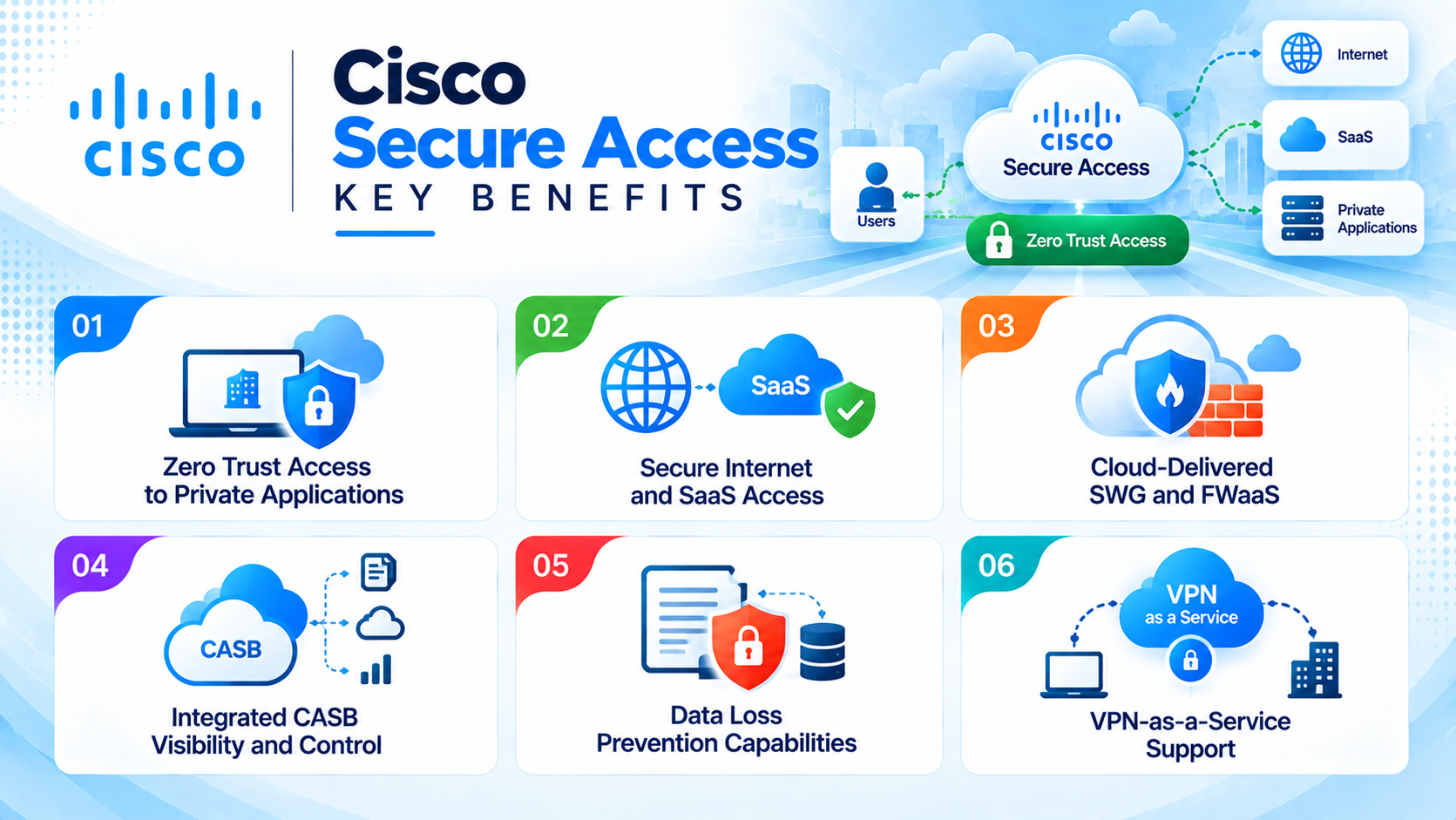
- Zero Trust access to private applications
- Secure Internet and SaaS access
- Cloud-delivered SWG and FWaaS
- Integrated CASB visibility and control
- Data Loss Prevention capabilities
- VPN-as-a-Service support
- DNS-layer security
- Digital Experience Monitoring
- Remote Browser Isolation
- Centralized security policies
- Cisco Secure Client integration
- Support for SASE architectures
At a Glance
- Product: Cisco Secure Access
- Parent Category: Cisco Security
- Architecture: Cloud-delivered SSE
- Security Model: Zero Trust
- Core Services: ZTNA, SWG, CASB and FWaaS
- Extended Services: DLP, VPNaaS, RBI, DEM and DNS security
- Access Scope: Internet, SaaS and private applications
- Primary Packages: Secure Internet Access and Secure Private Access
- Package Levels: Essentials and Advantage
- Client: Cisco Secure Client
- Management: Centralized cloud management
- SASE Integration: Cisco Catalyst SD-WAN and supported third-party SD-WAN environments
Cisco Secure Access License Overview
Cisco Secure Access licensing is structured according to the type and depth of security services required. Rather than using a single feature set for every organization, Cisco provides packages focused on secure internet access and private application access.
Secure Internet Access, or SIA, is designed for organizations that need to protect internet and SaaS traffic. Depending on the selected package, it can include DNS security, Secure Web Gateway, CASB, firewall controls, malware protection, cloud application visibility, and additional data-security capabilities.
Secure Private Access, or SPA, focuses on Zero Trust access to private applications. It allows organizations to provide application-level connectivity without exposing the broader internal network through a conventional VPN model.
Essentials and Advantage options provide different capability levels. Organizations should therefore identify whether the primary requirement is internet security, private application access, or a broader SSE deployment before selecting licensing.
Cisco Secure Access Product Overview
Cisco Secure Access moves security enforcement closer to users and cloud resources rather than requiring all traffic to return to a traditional enterprise data center.
Users can connect from an office, home network, branch location, or mobile environment while Secure Access applies security controls based on identity, device context, application, destination, and organizational policy.
For internet traffic, the platform can inspect web requests, evaluate domains, control cloud application usage, block malicious files, and apply firewall or DLP policies.
For private applications, Zero Trust Network Access can provide users with access to approved applications without automatically giving them broad network-level connectivity.
Secure Access can also integrate with Cisco technologies such as Secure Client, Duo, Identity Services Engine, SD-WAN, Splunk, and ThousandEyes, allowing security, identity, networking, and experience information to contribute to the access decision.
Core Technical Flow
The Secure Access process starts when a user or device attempts to reach an internet resource, SaaS application, or private enterprise application.
Traffic is directed to the Cisco Secure Access cloud using the appropriate connectivity method. Remote endpoints can use Cisco Secure Client, while branch and network environments can use supported tunnels, SD-WAN integrations, or other forwarding methods.
Secure Access then evaluates the request against applicable identity, application, device, destination, and security policies.
Internet and SaaS traffic can pass through controls such as DNS security, SWG, CASB, malware inspection, DLP, and cloud firewall services. Private application traffic can instead be evaluated through ZTNA policies that determine whether the user should receive access to the specific application.
Approved connections are forwarded to the destination while events and security activity remain available through centralized monitoring and reporting.
Options & Licensing Models
| Secure Access Option | Primary Scope | Typical Use |
|---|---|---|
| Secure Internet Access Essentials | Core internet and cloud security capabilities | Organizations securing web, SaaS and internet traffic |
| Secure Internet Access Advantage | Broader SIA security, inspection and data-protection capabilities | Enterprises requiring advanced cloud security |
| Secure Private Access Essentials | Zero Trust access to private applications | Replacing or reducing traditional VPN access |
| Secure Private Access Advantage | Expanded private-access and Zero Trust capabilities | Advanced enterprise private-access deployments |
| SIA Site-Based | Security for users at defined network locations | Branch, campus and onsite connectivity |
| DNS Defense | DNS-layer threat protection | Organizations beginning with DNS-focused cloud security |
Feature availability differs between Essentials and Advantage packages. Capabilities such as advanced DLP, Layer 7 firewall inspection, Remote Browser Isolation, advanced malware analysis, and other functions may require a specific package or additional entitlement.
Features & Benefits
Zero Trust Access for Internet, SaaS, and Private Applications
Cisco Secure Access applies Zero Trust principles across different access paths instead of automatically trusting a user because they are connected to the corporate network. ZTNA can provide application-specific access to private resources, while SWG, CASB, DNS security, and cloud firewall capabilities protect internet and SaaS traffic. This reduces unnecessary network exposure and allows policies to follow users regardless of their location.
Data Protection, Threat Prevention, and Cloud Security
Secure Access combines multiple inspection and security technologies within the same cloud-delivered architecture. Organizations can identify risky cloud applications, inspect web traffic, block malicious destinations, detect malware, apply firewall policies, and use DLP controls to reduce sensitive-data exposure. Advanced packages can extend these protections with capabilities such as Remote Browser Isolation, SaaS controls, AI application guardrails, and deeper cloud-security inspection.
Unified Operations and Secure Hybrid-Work Experience
By consolidating SSE functionality into a centralized platform, Cisco Secure Access can reduce the operational complexity created by separate VPN, proxy, firewall, CASB, and web-security products. Cisco Secure Client provides a common endpoint connection method, while integrations with SD-WAN, Duo, ISE, Splunk, and ThousandEyes can provide additional identity, networking, security, and experience context. Digital Experience Monitoring also helps IT teams distinguish security-policy problems from connectivity and application-performance issues.
Compatibility & Requirements
Before deploying Cisco Secure Access, organizations should assess:
- Total number of users requiring protection
- Internet and SaaS access requirements
- Private applications requiring Zero Trust access
- Current VPN and remote-access architecture
- Cisco Secure Client deployment
- Identity provider and authentication architecture
- Cisco Duo or other MFA requirements
- Branch and SD-WAN connectivity
- Managed and unmanaged endpoint requirements
- DLP and sensitive-data protection requirements
- CASB and cloud application requirements
- Firewall and web inspection policies
- Logging and SIEM integration
- Geographic user distribution
Secure Access supports integration with multiple identity providers, networking environments, browsers, endpoint platforms, and Cisco security technologies. Exact compatibility should be checked against the planned deployment architecture and selected package.
Activation and Deployment
Deployment typically begins by defining which traffic and applications must be protected. Organizations should separate internet and SaaS use cases from private application access because each may require different policies and connectivity methods.
Identity providers and user groups are then integrated so policies can be associated with individual users and roles. Cisco Secure Client can be deployed to roaming endpoints, while branch environments can connect through supported tunnels or SD-WAN integrations.
For private applications, connectors and application definitions are configured so users can access specific resources through Zero Trust policies.
Internet security policies can then be introduced for DNS, web, cloud applications, firewall controls, malware protection, and data security.
A phased deployment is preferable, beginning with representative users and applications before expanding enforcement across the organization.
Cisco Secure Access Pricing and Quote
Cisco Secure Access pricing depends on the selected package, number of protected users or sites, required security capabilities, subscription term, and overall deployment architecture.
An organization focused primarily on secure internet access may require an SIA package, while an environment replacing traditional VPN access may prioritize SPA. Organizations implementing complete SSE commonly require a broader combination of internet, SaaS, private-access, and data-protection capabilities.
Before requesting a quote, prepare the number of users, number of sites, required SIA or SPA package, private applications, endpoint types, identity infrastructure, SD-WAN environment, DLP requirements, and existing Cisco security products.
Cisco Secure Access pricing depends on your license type, deployment model and support requirements.